
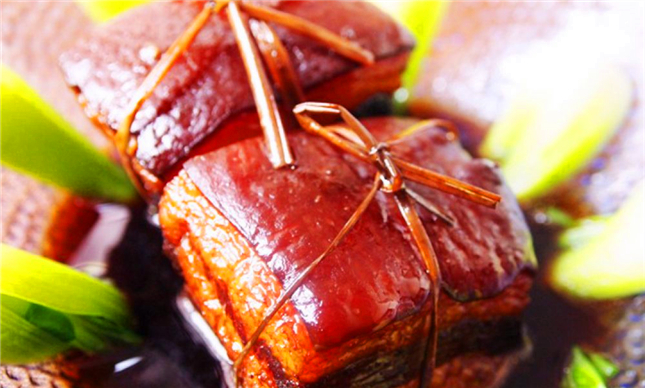
The pork used for this dish needs to be half fat and half lean, and it's usually cut up into cubes. The pork is stewed along with vinegar, scallion, ginger, and sugar, in a sealed casserole pot over a low heat. The pork cooked in this way glows red, and is as soft as tofu but not fragile, glutinous but not greasy.
This dish was named after Su Dongpo, who was a governor of Hangzhou, a great poet, prose writer and calligrapher in ancient China . During his term he started a thorough dredging of West Lake, a project involving thousands of workers. This project benefited Hangzhou local people a lot. It's no secret that Su Dongpo liked eating pork, and in order to express their gratitude the local people presented Su Dongpo with a lot of pork and Shangxing Wine (a cooking wine in Chinese cuisine) in the Spring Festival (Chinese New Year). Su Donpo knew all too well that it was the workers who truly deserved the gift, so he told his family to stew the pork and Shangxi Wine together and distributed the resulting dish to the workers. It turned out that the pork was extremely tasty, and because of Su Donpo's kindness Dongpo Pork was widely favored by all and rapidly gained popularity.












 京公网安备11010802044359
Contact Us:86-10-58882453 86-10-58882413