
Video by Li Minhua
Step into the SUSTech International Center for Mathematics at the Southern University of Science and Technology (SUSTech), and blackboards are the first things that catch the eye. They line corridors, meeting rooms, offices and lounge areas. On some, the chalk marks still look fresh.
“Mathematical ideas can strike at any moment. Inspiration waits for no one, so we need plenty of blackboards close at hand, ready to jot thoughts down the second they come,” said Efim Zelmanov, a Fields Medal winner, foreign member of the Chinese Academy of Sciences, chair professor in the College of Science at SUSTech and director of the Shenzhen International Center for Mathematics (SICM). He set down a piece of chalk and brushed dust from his palms as he stood before one of the boards.
To passersby, the dense calculations scrawled across the surfaces read like an indecipherable script. To Zelmanov, they are what a farmer sees when looking over his fields. Drawing on the rigor forged in Siberia, the energy he picked up in California and the pace of Shenzhen, he has been steadily planting mathematics into this young city’s soil.
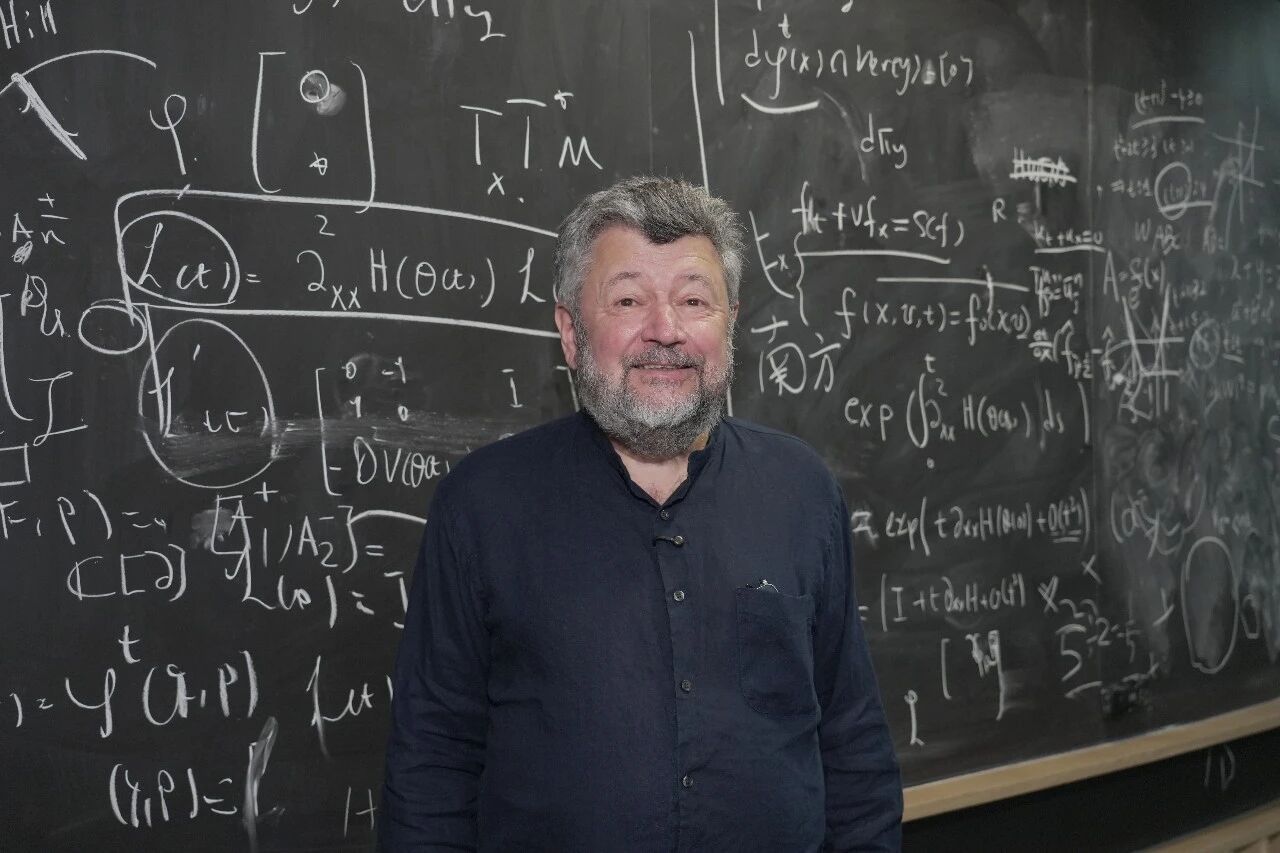
Efim Zelmanov, director of the Shenzhen International Center for Mathematics, stands in front of a blackboard filled with mathematical formulas at the center at SUSTech. Photo by Wei Dan
From a giant vessel to a swift ship
Zelmanov grew up in Siberia, where he first embarked on his mathematical research. In the early 1990s, he moved to the United States and spent three decades working across four top-tier universities. In 1994, before turning 40, he won the Fields Medal — mathematics’ highest honor — for resolving the restricted Burnside problem in finite group theory.
The mathematician could have settled into a comfortable retirement in California. Yet in 2019, when he joined SUSTech as a visiting professor to lay the groundwork for the SICM, something stirred within him.
“The University of California is absolutely huge. It’s like a big ocean ship moving in a certain direction,” Zelmanov explained, framing the thought with a mathematician’s instinct. “SUSTech is a smaller, faster ship. Our derivative is bigger. We move faster.”
“Silicon Valley did not emerge out of thin air,” he noted. Before and after World War II, America’s leading universities were mostly clustered on the East Coast. Consistent investment from California’s state government nurtured the University of California system, Stanford and Caltech. “Look at California now, home to swathes of high-tech industries. The roots trace back to those universities. Talented young people from all over the world went there to study, stayed to launch companies, and the whole region flourished.”
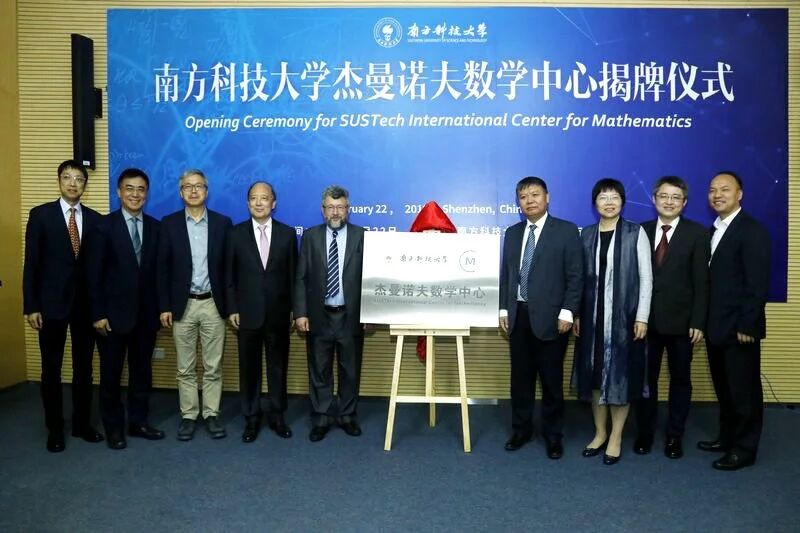
Efim Zelmanov (5th L) joins other guests at the unveiling ceremony of the SUSTech International Center for Mathematics at the Southern University of Science and Technology on Jan. 22, 2019. Courtesy of SUSTech
In his view, Shenzhen bears echoes of that California era. “I don’t fixate on skyscrapers. What moves me is the people. Shenzhen is full of drive. People come here to get things done.”
“A vibrant city like Shenzhen needs a great university, and SUSTech is striving toward that goal. We can learn from Silicon Valley’s example, yet forge a path uniquely Shenzhen’s. This mathematics center is like my child; I want to watch it grow.
”He highlighted one detail that struck him: SUSTech’s administrative staff include active researchers, making communication seamless. “We troubleshoot side by side, and work out how to hit our shared goals.
”That spirit mirrors the logic behind all those corridor blackboards. Anyone with an idea can step up and write it down. The boards carry handwriting from across the globe, and Zelmanov can name the authors. “This is from Brazil’s Vyacheslav Futorny, and those are from Stavros Garoufalidis,” he said. “I have to give Stavros a shout-out. He runs a wonderful Greek restaurant here in Shenzhen, and we often gather there.
”Scholars at the center hail from China, the United States, Brazil, Greece, France, Canada, Vietnam, Ukraine and beyond. “It is very international,” Zelmanov said. He likens the community to a miniature APEC. “Mathematics knows no borders. There is no such thing as Chinese mathematics, French mathematics, Russian mathematics or American mathematics. All mathematics worldwide belongs to one single body of knowledge.”
Not high in the clouds
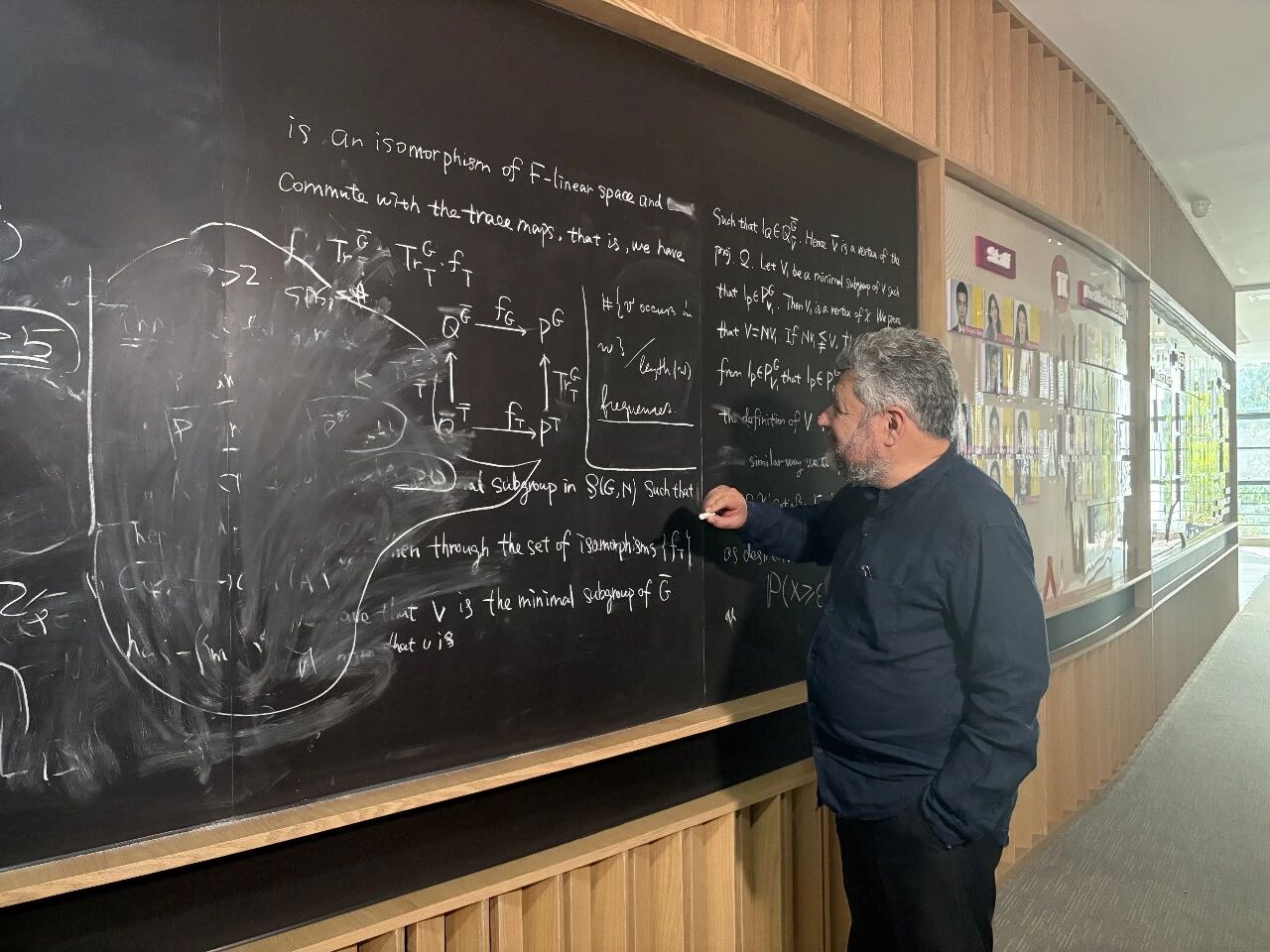
Efim Zelmanov discusses mathematical research beside a blackboard covered with equations at the SUSTech International Center for Mathematics. Zhang Yu
A young researcher once asked him: “Professor, could AI replace us one day?” He smiled and replied: “It is only a tool. It cannot spark insight.”
Zelmanov cited an open letter signed by chief executives of major US AI firms, which states that AI is rooted in mathematics, its language built on vectors and matrices. “No mathematics, no AI.” He pictured mathematics as a tree. “Pure mathematics forms the roots, applied mathematics the leaves. Neither can exist without the other.”
He pointed to Évariste Galois, the French prodigy who died young at just 20 nearly 200 years ago. The finite fields he devised were once seen as a “beautiful toy”. For 150 years, they appeared to have no practical application outside mathematics. Today, however, finite fields form part of the mathematical foundation for much of global financial cryptography, mobile encryption and data transmission across the internet.
“You can never tell which mathematical bloom will bear fruit, or in which year,” Zelmanov stressed. Breakthroughs in mathematics depend on nurturing a healthy ecosystem. “So what cities need to do is not keep asking ‘what is this good for?’ First, tend the soil.”
Genuine progress, he argued, comes from deep collaboration between universities, high schools, tech firms and research institutes. “What will eventually grow out of it? I cannot say for certain. It will almost certainly be something unexpected.”
That collaboration starts at secondary school. “Students should have access to rigorous mathematics courses, and mathematicians have a responsibility to support them. I fell in love with mathematics when I was 13, and I was lucky to have a great math teacher.”
Zelmanov has visited Shenzhen Middle School. On his desk sits an appointment letter naming him honorary vice-chair of the academic committee of the High School Affiliated to SUSTech, displayed alongside his appointment letter as distinguished chair professor at SUSTech. “They run dedicated mathematics specialty classes. I have rarely seen schools do that, even abroad.”
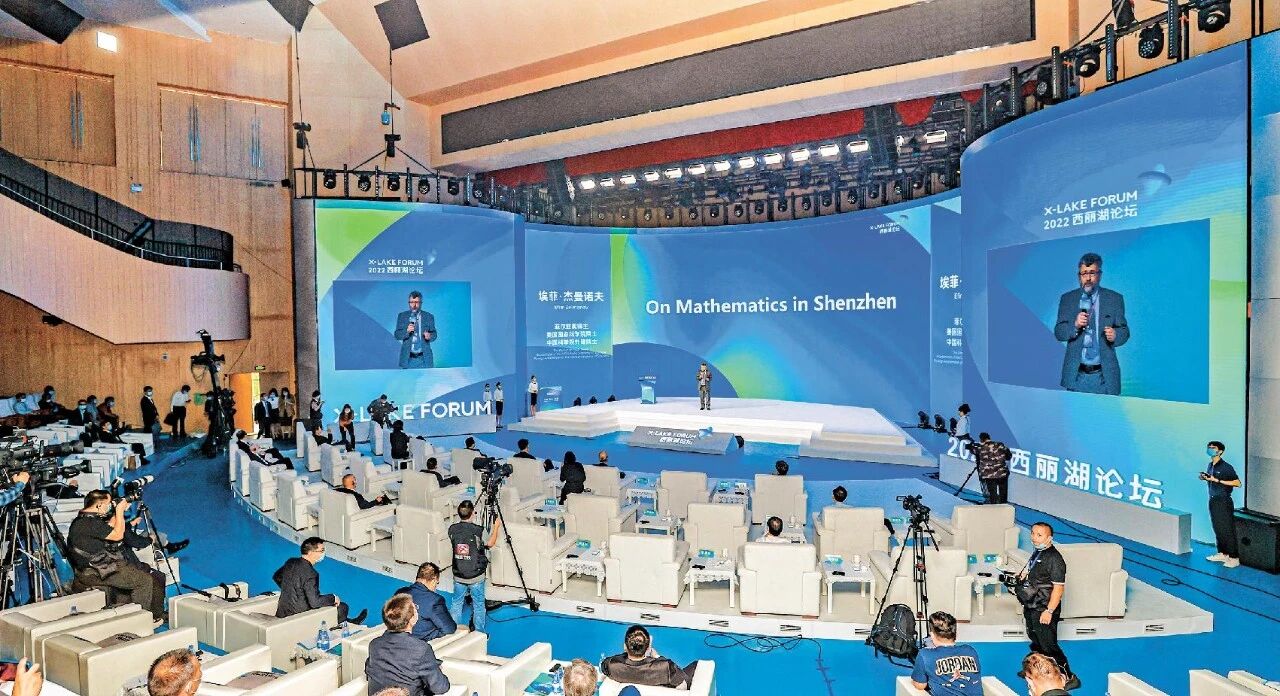
Fields Medal winner Efim Zelmanov delivers a keynote speech on mathematics in Shenzhen at the 2022 X-Lake Forum on Nov. 15, 2022. He Long
The end of the blackboards
Any conversation about secondary mathematics education in Shenzhen leads naturally to Deng Yu, the recent Fields Medal winner who grew up in the city. “We have talked,” Zelmanov said. “I hope he will come back someday; his family is still here. Shenzhen draws talent for one simple reason: people come here to build new things. You feel strong backing from the city and the nation. Authorities ask: What do you want to achieve? We will help you make it happen. If he returns, it will be to create something new.”
He extended an invitation to the world: “Shenzhen is a city for people who want to build. Plans here stand a better chance of taking shape.”
People often ask where he comes from, and the question unsettles him. “It sounds as if I might leave at any time. I live here. I pay utility bills. I nod and greet security guards on late-night walks. I am a Shenzhener,” Zelmanov said. “I did not come here to find ready-made answers. I came to ask more beautiful questions.”
Source: ShenzhenDaily
Events
More+-

Two sports expos to bring a wave of events, deals
-

Winter Holiday to Return in Splendor to Universal Beijing Resort from November 20
-

Daxing Airport Offers Free Trips to Beijing Wildlife Park
-
Harmony of Three Cities Choral Concert — Jiangyin
-
2026 Qingdao Grand Theatre Arts Festival — Special Concert Commemorating the 270th Anniversary of Mozart's Birth
Discover






 京公网安备11010802044359
Contact Us:86-10-58882453 86-10-58882413