A foreign experts symposium was held in Chengdu, China's southwestern Sichuan province, on Nov. 28. Experts from the United States, Germany, Russia and other countries gathered to share their insights and put forward suggestions.
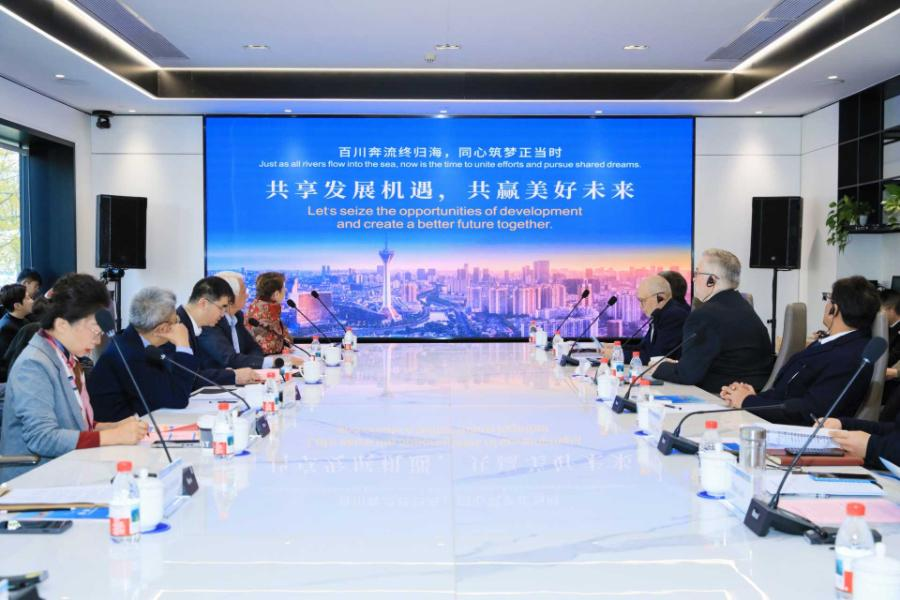
Participants attend the foreign experts symposium in Chengdu, Sichuan province, Nov. 28, 2025. [Photo provided to China.org.cn]
City of charm: Blend of history and modernity
"This is my first time in Chengdu, and from the moment I arrived, I was deeply captivated by the city's unique charm," said Hala Metwally, an Egyptian expert with 29 years of experience working at Xinhua News Agency. "Chengdu boasts profound historical heritage while exuding vigorous modern vitality. The harmonious coexistence of a relaxed lifestyle and dynamic urban energy makes this journey warm and unforgettable."
Olga Dubkova, a Russian expert who has worked in China for more than two decades, shares a profound emotional bond with Chengdu. "25 years ago, I taught at Sichuan University with my child, who still misses the food and campus life in Chengdu dearly," she recalled. Revisiting Chengdu, she marveled at its transformation into one of China's most important cities, attributing this success to what she called "Chengdu Spirit." She was touched by the local students' warmth: "They took snacks out of their pockets and insisted I try them — such enthusiasm is unique to Chengdu."
Lutz Pluemer, a 74-year-old German expert who has served as international dean at Southwest Jiaotong University since 2018, has long regarded Chengdu as his home. "It is one of China's most livable cities. You can witness the integration of tradition and modernity here — where Buddhist monks in traditional robes walk past livestreamers with smartphones," he said. He also praised Chengdu's infrastructure progress: "When I first came in 2018, the metro was only 200 kilometers long; now it has expanded to 600 kilometers, with stations designed like wonders. China's high-speed rail even surpasses that of Germany in speed, punctuality and reliability."
City of vitality: Improved innovation ecosystem and favorable talent environment
Hala Metwally noted that Chengdu values not only project implementation and infrastructure but also fosters a sound environment for scientific thinking and innovation. "My father, an engineer, told me that a strong innovation system requires close cooperation between universities, research institutions and enterprises — and Chengdu is putting this into practice, providing an excellent environment for international talents to innovate and start businesses," she said. She revealed that her two sons were drawn to China's technological strength and pursued undergraduate studies at Beijing Institute of Technology; her younger son even serves as a "China-Egypt Youth Ambassador," promoting Chinese culture in Egypt.
Nathan E. Stott, an American expert, testified to China's emphasis on international talent through his own experiences. "I obtained my Foreign Permanent Resident ID Card in just one-and-a-half years after working in China. The central government's recent policies — such as the 18-digit permanent resident ID card and extended visa-free stays — are rapid responses to international experts' suggestions," he said. Praising Chengdu's talent development environment, he added, "The international talent service center in Chengdu is a great idea to support and better retain international colleagues in China."
Matt Vegh, a Canadian expert with 25 years of experience in Chengdu, acknowledged the city's remarkable advancements in cutting-edge fields. He emphasized China's abundant talent pool and large scale, noting that the nation is exceptionally well-positioned to lead the global convergence of culture and technology.
Deepening international cooperation and telling Chengdu's story well
Centered on Chengdu's goal of becoming a major national technological innovation center by 2035, experts put forward targeted suggestions based on their experiences. Regarding talent introduction, Pluemer stressed the need to focus on young professionals under 30: "Major breakthroughs in history often come from young people. We should offer them competitive salaries, cutting-edge equipment and academic autonomy, while simplifying approval processes to complete talent recruitment within two months."
Stott proposed establishing dedicated service centers to improve supporting services such as funding and language training, addressing talents' needs through regular communication.
Metwally shared the story of Benban Solar Park, a China-Egypt cooperation project: "A local Egyptian employee said, 'Here, I found opportunity and a future.' Such authentic voices are touching." She suggested showcasing Chengdu's job opportunities, lifestyle and convenient services through multilingual platforms, enabling foreign experts to tell China's stories.
Dubkova added, "Beyond well-known symbols like pandas, we should highlight daily elements such as Sichuan-style pickles and twice-cooked pork to make Chengdu's story more relatable and compelling."
Vegh proposed a cultural-technological integration development strategy. He recommended including this in the 15th Five-Year Plan, integrating Chinese classic literature and philosophical ideas into AI model training, and creating virtual scenarios for cultural exchange between China and foreign countries. Through two-way academic exchanges and business cooperation, Chengdu can become a global hub for innovative talents, he explained.
The symposium is a core event of the "Walking into the Glamorous Chengdu" series guided by the Foreign Talent Research Center and sponsored by the Chengdu Municipal Science and Technology Bureau. Foreign experts interpreted Chengdu's international appeal and liveliness, showcasing both the pace of China's urban development and its open, inclusive spirit.
Source: China.org.cn








 京公网安备11010802044359