
The moment that made me "scream" might not be what people expect. It wasn't a snow-capped mountain or a desert — it was a sound.
I remember having lunch at a local Hotan baked bun restaurant. It's a very famous place. I've always been a fan of Hotan baked buns — I had heard of their fame even before arriving in Xinjiang. We had an incredible lunch, but while eating, I kept hearing a strange noise in the background. It sounded like someone was shouting — a rhythmic, distinctive sound.

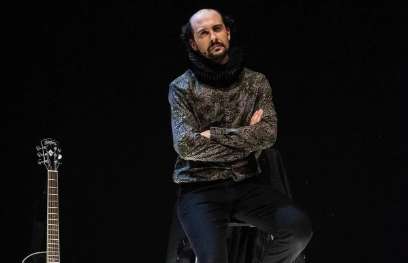
Photo shows Iain in the video.
I asked myself, "What on earth is that?" So I went outside to see.
That's when I learned that when the baked buns are fished out of the oven, the bakers put them into a big basket, and as they walk across the room making that unique vendor call, they dump all the baked buns onto the windowsill. Maybe it's to get people's attention, maybe to get them to come and buy. But for me, that moment was incredibly thought-provoking. The only thought in my mind was, "Wow, I'm really in Xinjiang." It was a truly unique experience — I had never seen anything like it anywhere else in the world.
I also remember visiting the Kunlun Mountains. The scenery took my breath away — but I quickly realized that was also because we were so high up. It was literally taking my breath away. A friend joked that she saw me holding an oxygen canister, and I laughed and said, "It's taking my breath away in two ways — metaphorically and literally."
But what truly moved me most was the discovery of Xinjiang's intangible cultural heritage. I once reflected on what these traditions bring to Xinjiang's modernizing cities—beyond just being tourist attractions. I said, "Let me tell you, Xinjiang is teaching us a lesson."
I have seen traditions disappear. On the island of Borneo, I witnessed an Iban tribe's village completely vanish, along with their traditional method of rice cultivation. Once those things are gone, they're gone forever. But in Xinjiang, I saw something different: young people continue to play the music and learn the dances—and that is really important.

Photo shows Iain talks about cultural heritage in Xinjiang.
I visited the Jade Museum. Jade is not a renewable resource: Once it is fully extracted, it's gone forever. Traditions, by contrast, are renewable—if we actively preserve and pass them on, they endure. Once they're gone, they're gone. Xinjiang is a great example of this — it's happening in everyday life.
I also visited a carpet factory, and it was a truly beautiful experience. The women working there were not only local villagers — thanks to the carpet factory, they had stable jobs and incomes, as well as the opportunity to practice the traditional weaving techniques passed down through generations. And of course, through these carpets, they can spread this culture far and wide — not only across Xinjiang and China, but actually internationally. They ship Xinjiang carpets around the world, thereby raising the profile of Xinjiang carpet-making.
I even tried weaving a carpet myself. It took me about ten minutes to tie just four knots. A friend said "Well done," but I knew that, compared to the skilled artisans, my effort was nothing. But it was precisely this hands-on experience that made me realize: this is not just a carpet; it is a living tradition that endures.
I would add this: it's great to see people living and breathing this intangible culture. At the same time, I deeply admire the well-organized support structure behind it. Because I suppose if everyone were left to their own devices, with the intrusion of modern technology — kids are always obsessed with iPads and iPhones and all that — it would be very easy for these things to gradually disappear. I've seen it in other parts of China as well. But I think the support structure there is also very well-organized.
As a friend once said, this is a really concerted effort that benefits everybody. Well done, and let's keep going. Good work!
Xinjiang is not just a single story. It has so many ethnic groups, so many intangible cultural heritage items, so many traditions that are still alive — its story is woven together by countless voices, countless hands, countless days and nights.
And I feel honored to have heard one small voice among them — the vendor’s call of the baked bun maker. It told me that Xinjiang's past has not disappeared, and Xinjiang's future is arriving.
Iain Inglis is a content creator from the UK.
Producer: Xiao Chunfei
Supervisors: Ding Tao and Jie Wenjin
Planners: Jie Wenjin and Cheng Li
Reviewers: Cheng Li and Hou Weili
Editor: Jia Shaoqi
Source : Tianshannet












 京公网安备11010802044359
Contact Us:86-10-58882453 86-10-58882413