
Video by Qiu Weibin, Lin Jianping, Li Ruohan, Ni Yongping and Li Bing'er
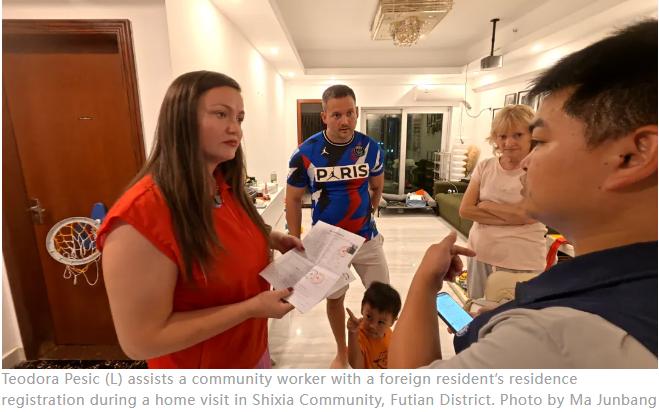
On the sunny afternoon of Oct. 9, Serbian-born Teodora Pesic knocked on the door of a foreign resident’s home in Shixia, a community in Shenzhen’s Futian District. The door opened, and the resident peered out cautiously.
“Hello, I’m Teodora Pesic, the international community worker for Shixia. I’m here with a neighborhood officer to help with your residence registration,” she said.
It was her first home visit since taking up the role. Previously, community workers visiting foreign residents to collect registration information had often struggled to communicate because of language and cultural barriers, relying on gestures and translation apps. Residents could be uneasy about unfamiliar visitors asking to see their passports, while staff struggled to explain local procedures, such as residence registration and access to health care and social insurance.
“When I first came to Shenzhen, I also thought it was strange. Why would someone come to my home to check my passport? In Serbia, that’s usually something the police do,” Pesic said with a laugh.
Having experienced that uncertainty herself, she understands the concerns residents may have when someone knocks on their door. She now helps foreign residents understand routine community procedures in China and conveys their questions and concerns to local officials.
Samy Slobodan, a foreign resident visited by Pesic, said her help made it easier and faster to handle local procedures.
“Having a foreign person involved in these situations is very helpful,” he said. “She speaks fluent Chinese and knows how to handle these things. She can act as a bridge between foreign residents, Chinese residents and the local community.”
Futian, Shenzhen’s central business district, has designated 2026 as its “Year of Internationalization” and introduced more than 300 measures to improve international services ahead of the 33rd APEC Economic Leaders’ Meeting, which Shenzhen will host in November. In Fubao Subdistrict, home to the Hetao Shenzhen-Hong Kong Science and Technology Innovation Cooperation Zone and a large foreign community, the international community worker program was created to improve communication and services for international residents.
Unlike temporary volunteers, these workers are formally integrated into the community governance system, with clearly defined responsibilities and support mechanisms. Pesic, who has lived in Shenzhen for 11 years and speaks Serbian, English and Chinese, was selected through a recruitment and screening process, followed by pre-service training. She is the city’s first international community worker.
From newcomer to neighbor
Pesic came to Shenzhen in 2015 to help her brother settle into life in the city, where he was running a business. She planned to stay only briefly, but has now lived here for 11 years.
She once ran a bar and restaurant focused on cultural exchanges, earning a local magazine’s “Best Bar of the Year” award for two consecutive years. She later opened a studio that hosted craft workshops and cultural events, and volunteered to teach English and introduce different cultures to local children. She has also encouraged friends from overseas to move to Shenzhen.
“Shenzhen has long been my home. I don’t want to leave,” she said. When she learned that Shixia Community was recruiting an international community worker, she applied almost immediately.
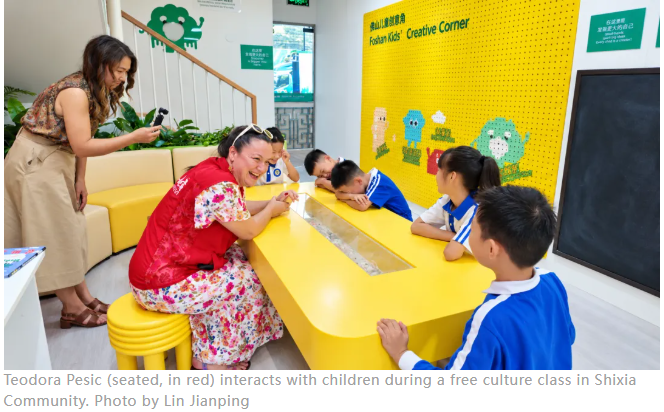
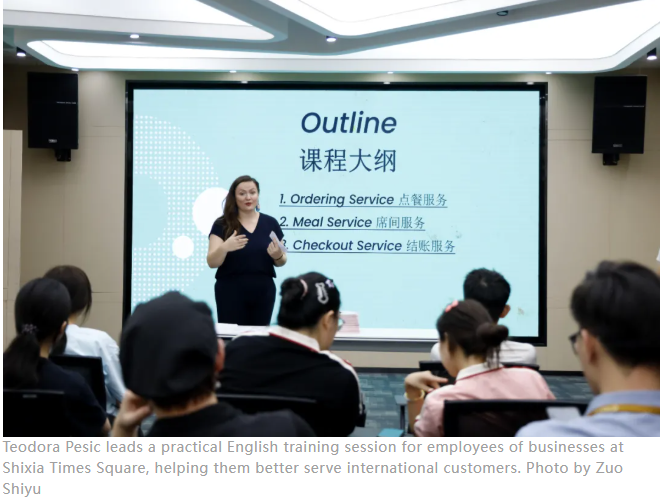
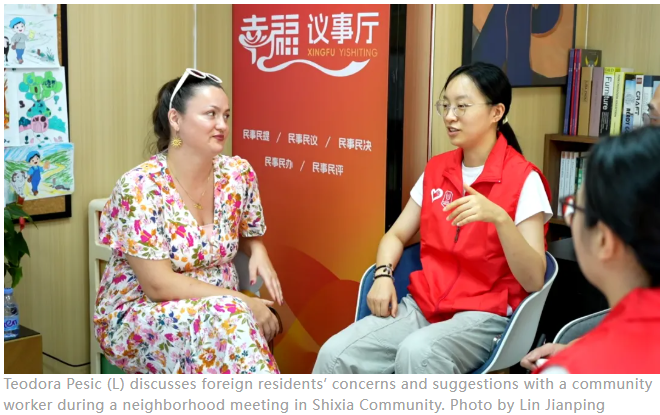
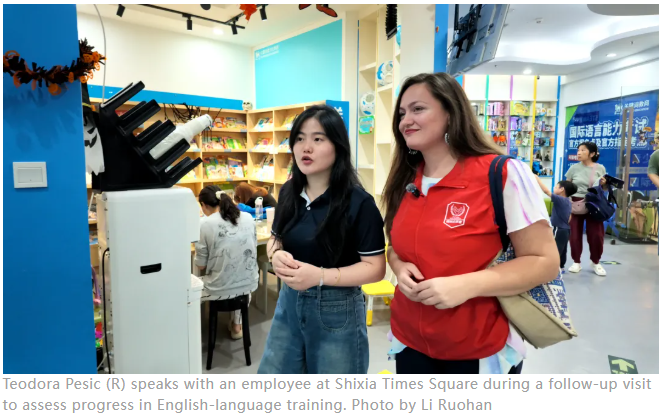
Her work spans four main areas. She helps community workers register foreign residents and explain local policies in ways they can easily understand, leads a weekly free English class for children, provides practical English training for more than 200 employees at over 30 restaurants at Shixia Times Square — Futian’s first officially certified international-friendly shopping area, and represents foreign residents at community meetings, raising their concerns about public spaces and neighborhood management before reporting back on the outcomes.
Through these roles, Pesic has become a two-way link between foreign and Chinese residents.
Intl. community worker program: From one-way services to shared governance
The international community worker program was designed to address long-standing challenges in serving and engaging foreign residents at the neighborhood level.
Shixia Community has one of the highest concentrations of foreign residents in Futian. In the past, outreach was largely one-way: official notices were sometimes misunderstood, channels for residents to raise concerns were limited, and foreign volunteers generally provided language support only at major events rather than participating in routine community affairs.
“Having staff learn foreign languages or rely on translation apps alone cannot solve the problem at its root,” said Liu Xiaomin, Party secretary of the Shixia Community Party Committee. The key, Liu said, is to involve foreign residents not only as recipients of services but also as active participants in managing community affairs.
Shixia Community has partnered with Shenzhen Daily, an English-language media with strong ties to the city’s international community, to recruit, train and manage the international community workers. The partnership aims to establish a sustainable program while drawing on the newspaper’s experience in international communication to bring stories from Shenzhen to a wider audience.
“At first, I thought the job would mainly involve translating and running errands,” Pesic said. “Then I realized the real goal is to help both sides understand each other.”
Many conflicts, she said, stem from cultural misunderstandings. Her role is to clear them up and help each side recognize the other’s goodwill.
“Friendliness at the community level in Shenzhen is something you experience right at your doorstep. Help is available in the building where you live and on the streets you walk,” she said. The program, she added, is not about managing foreign residents but about inviting them to help shape their communities.
A model for other communities
The international community worker program is part of Fubao Subdistrict’s broader effort to make its neighborhoods more welcoming to international residents. In recent years, the subdistrict has introduced initiatives including international-friendly shopping areas, a specialized mediation team for disputes involving foreign residents, and multilingual volunteer service posts.
Through the Starlight Program, Futian has recruited nearly 1,500 international volunteers from 28 countries and regions, who collectively speak 11 languages. The program has also helped establish a network of 153 specialists who serve international residents at the district, subdistrict and community levels. Pesic alone has encouraged more than 10 foreign friends to sign up as volunteers.
Liu said Fubao Subdistrict plans to expand its multilingual community worker team, develop standardized recruitment and training procedures, and broaden the program to include services such as mediation and cultural exchange. The goal is to turn the Shixia initiative into a model that other communities can adopt.
A city’s international character is reflected not only in its skyscrapers or global conferences, but also in a knock on a neighbor’s door, the voices heard at community meetings and the sight of children from different backgrounds holding hands.
What moves Pesic most about Shenzhen, she said, is not only its rapid development but also the warmth of being treated like family. The city reaches out to the world with grand ambitions, she said, yet remains attentive to the needs of individual residents, regardless of where they come from or what language they speak.
“Once you come to Shenzhen, you belong,” goes a popular saying in the city. The bridge Pesic helps build connects people who now call the same city home.
Source:ShenzhenDaily
Events
More+-

Hélène Rollès: “My Name Is Hélène” French Chanson Diva 2026 Concert — Hangzhou
-

2026 Qingdao · Grand Theatre Arts Festival: Twilight Hollywood Movie Soundtracks Candlelight Concert [ECM European Chamber Music]
-

French Original Musical La Dame aux Camélias
-
Maksim Mrvica “SEGMENTI II” Classical Crossover Piano Concert — Xiamen
-

Maksim Mrvica “SEGMENTI II” Classical Crossover Piano Concert — Suzhou
Discover






 京公网安备11010802044359
Contact Us:86-10-58882453 86-10-58882413