
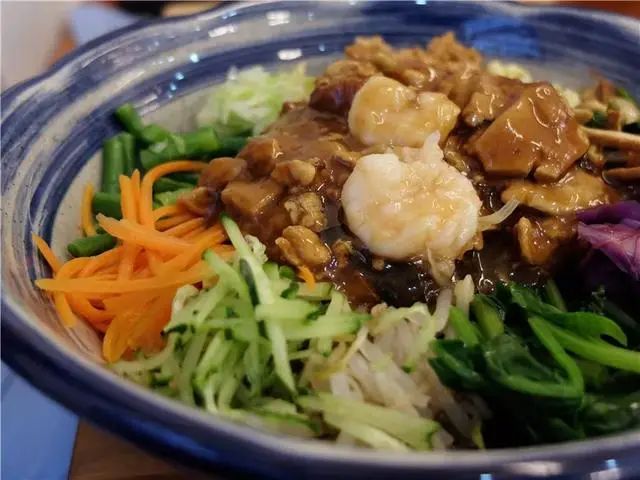
"Have some noodles!" In Tianjin, these two words often point to one thing—celebration.
Whenever there is a joyous occasion, Laomian is served. With each solar term, Laomian often appears. Sayings like "dumplings on the first day of the Lunar New Year, noodles on the second" and "dumplings during the first fu days, noodles during the second fu days" reveal the status of Laomian in Tianjin's folk traditions. Weddings and engagements, school admissions and job placements, job changes and housewarmings, partnerships and signings—as long as there's a reason, noodles are eaten.
Tianjin Laomian is quite particular. If you think it's just a bowl of noodles, you're underestimating the people of Tianjin.
Laomian was originally a humble home-cooked meal for the working class in Tianjin. In the late Qing Dynasty and early Republic period, "Xian Deyue," which was hailed as the number one restaurant among Tianjin's eight great eateries, took the lead in introducing the authentic "Laomian Feast," bringing this common folk dish into refined settings. The old Tianjin "Laomian Feast" was known for its four cold plates, four stir-fried dishes, four noodle toppings, four accompaniments, and both red and white gravies, forming a seasonal series that varied across spring, summer, autumn, and winter. For vegetarian options, there was also a专门的 vegetarian Laomian Feast.
Today's Tianjin Laomian, in addition to the gravy, features four side dishes and eight toppings. The four side dishes typically include: stir-fried shrimp, sweet and sour gluten, chives with dried tofu, and "scrambled yellow"—that is, scrambled eggs. The eight toppings generally consist of: shredded cucumber, shredded carrot, shredded cabbage, bean sprouts, spinach, soybeans, green soybeans, and red and white sliced mung bean jelly. Among these, the red mung bean jelly is essential for celebrations and birthdays.
The reason it's said that Tianjin Laomian "can form a feast in a single bowl" lies in the impressive presentation of the four side dishes and eight toppings, which make it suitable for accompanying drinks and entertaining guests without seeming meager. But the true soul of Laomian is the gravy.
In more home-style preparations of Tianjin Laomian gravy, ingredients such as pork belly, eggs, shiitake mushrooms, day lily buds, gluten, and dried tofu are all indispensable. Over high heat with ample oil, Sichuan peppercorns and star anise are fried until fragrant, followed by minced scallion, ginger, and garlic. The pork belly is added and stir-fried until it changes color. Seasonings such as dark soy sauce, aged vinegar, sugar, and MSG are added, along with rehydrated shiitake mushrooms and day lily buds, as well as shredded dried tofu, all stir-fried. An appropriate amount of boiling water is added and brought to a boil. The mixture is gradually thickened with a starch slurry to the right consistency. Shredded gluten is added, a drizzle of sesame oil is stirred in, and finally, scrambled eggs, chopped scallions, and green soybeans are sprinkled on top. Done.
In a comedy sketch, the line "The gravy is free—give me a bowl" was a punchline. In reality, Tianjin does have a type of gravy that can be used as a noodle topping or eaten as a dish on its own, called "cockle gravy." The main ingredient is the flesh of hairy cockles, a specialty of Tianjin's coastal waters, taken from their shells.
As for the noodles themselves, there are hand-rolled noodles and machine-cut noodles. Nowadays, many restaurants emphasize open kitchens and clear display areas. Restaurants that take their noodles seriously often have a preparation room with large glass windows. Standing tall within, the skilled noodle maker wields a rolling pin over a meter long with effortless grace. Through rolling, pressing, folding, cutting, and shaking, pieces of dough that have been mixed and rested come to life under their hands, transforming into smooth, slender, flowing strands of noodles. Diners find it a pleasure to watch and feel at ease eating.
Cooking the noodles follows the "three waters" method—meaning that after the water comes to a boil, cold water is added three times until the noodles are fully cooked.
Once cooked, noodles can be served "water-passed" or "straight-from-the-pot." "Water-passed" means the noodles are briefly rinsed in cold water after being lifted out before being placed in a bowl, resulting in a firmer, springier texture. "Straight-from-the-pot" means the noodles are lifted directly from the pot into the bowl, keeping them hot. In summer, noodles are typically water-passed. When the weather cools, many customers will inform the server in advance that they want their noodles straight-from-the-pot. Hearing this, the server knows they are dealing with a seasoned diner.
When eating Laomian, a large bowl is essential. The rule of thumb is one-third noodles, one-third side dishes, one-third toppings, all covered with the gravy and mixed thoroughly—almost to the point of overshadowing the noodles themselves. With a small bowl, it's impossible to mix everything properly.
Chinese Source: fw.whly.tj.gov.cn












 京公网安备11010802044359
Contact Us:86-10-58882453 86-10-58882413