
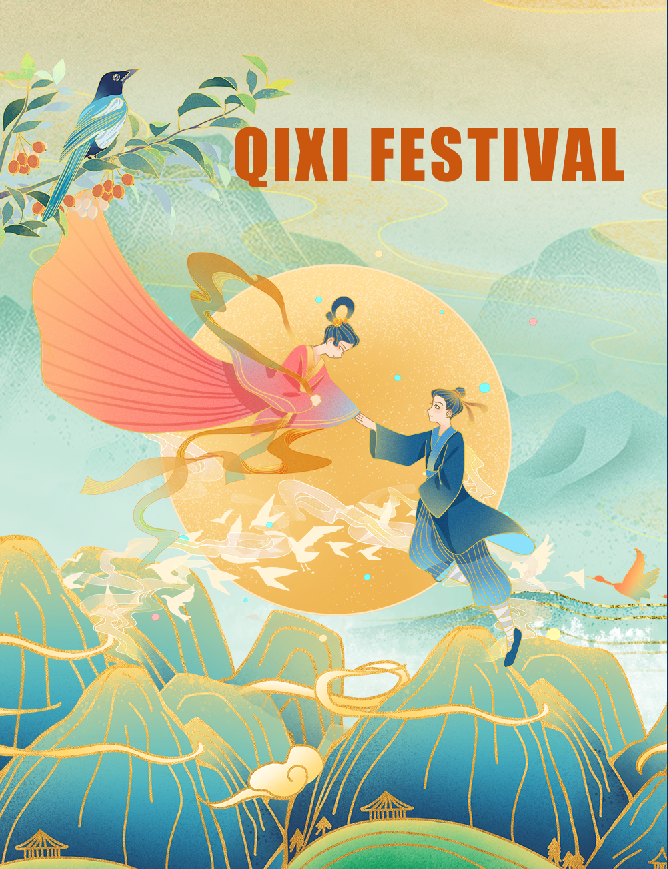
The legend of Niulang and Zhinyu
The festival originates from the legend of Niulang (the Cowherd) and Zhinyu (the Weaver Girl). According to the tale, Zhinyu, the seventh daughter of the Jade Emperor and the Mother Queen of Heaven, was a skilled weaver fairy who fell in love with a mortal cowherd named Niulang. Their love enraged the gods, who separated them with the Silver River (symbolizing the Milky Way). Once a year, on the seventh day of the seventh lunar month, a flock of magpies would form a bridge to reunite the celestial couple for one day. If it rains on Qixi Festival, legend has it that it is because heaven is moved by their love.
'Begging for Skills' (Qiqiao)
In bygone days, Qixi was not only a special day for lovers, but also for girls. It is also known as the "Begging for Skills Festival" or "Daughters' Festival." Young women would go to temples to pray to Zhinyu for wisdom, dexterity in needlework, and a happy marriage. Historical accounts reveal that girls would race to thread seven-hole needles under the moon. Another custom involved putting a spider into a box; the one whose spider wove the roundest web with the most mesh would be the winner. During the Ming and Qing dynasties (1368-1911), girls would throw a sewing needle into a bowl filled with water. The water was a blend collected from a river and a well during both the day and night. If the needle floated on the surface and its reflection took on various shapes, it proved the girl was a skilled embroiderer.
Regional rituals in Gansu
In northwest China's Gansu Province, grand rituals for Qixi start on the first day of the seventh month of the lunar calendar. The seven-day ritual consists of seven procedures and 12 ceremonies. Celebrated for hundreds of years, the events attract at least 500,000 local participants every year. In 2008, the Xihe Qixi ritual in Gansu was inscribed on the national intangible cultural heritage list.
Modern celebrations and cultural influence
Today, more and more young Chinese people celebrate Qixi by exchanging gifts like flowers, chocolates, and jewelry, enjoying romantic outings or dinners, and many couples choose to register their marriage on this day. Modern celebrations also include floating river lanterns and wearing traditional Han Chinese clothing to pay respect to traditional culture. Though it originated in China, the Qixi Festival inspired the Tanabata festival in Japan, the Chilseok festival in Korea, and the Thất Tịch festival in Vietnam.
Intangible cultural heritage
The festival was added to the National Intangible Cultural Heritage List by the State Council of China in 2006.
Source: Chinajob











 京公网安备11010802044359
Contact Us:86-10-58882453 86-10-58882413