
Qingdao, “Qing” for short, is a city in eastern Shandong Province on the east coast of China. It is a city specifically designated in the state plan, a megacity, a sub-provincial city, the economic center of Shandong Province, a coastal important central city of China, a coastal city for resort and tourism, an international port city, an important pilot zone for development of modern marine industry of China, an international shipping hub of Northeast Asia, a marine sports base, a main hub in the economic corridor of New Eurasian Land Bridge of “the Belt and Road” and a pivot of marine cooperation strategy.
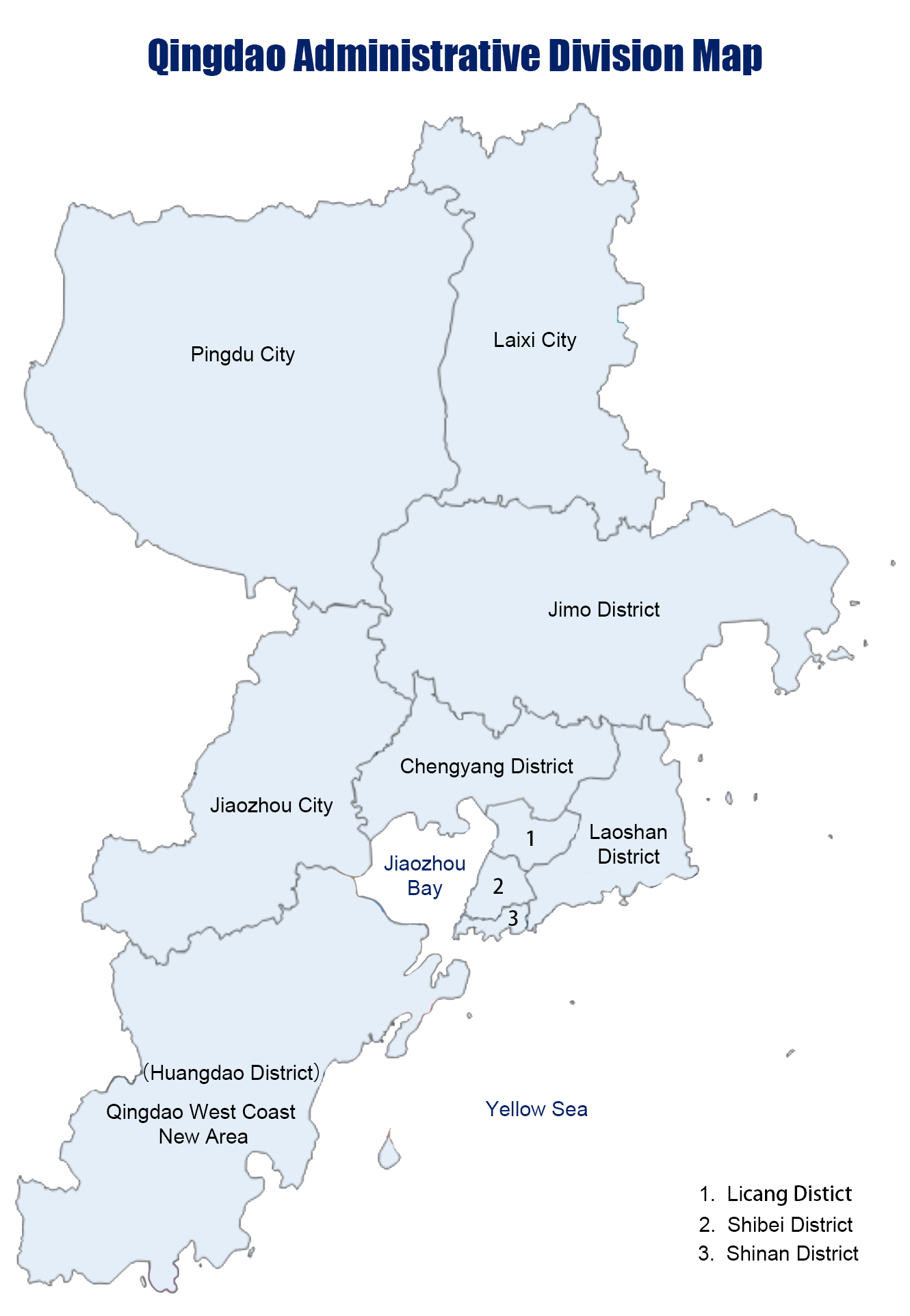
Qingdao is located on the southeast coast of Shandong Peninsula, in the east of Jiaodong Peninsula and in the frontal zone of China-Japan-South Korea free trade area. It borders on Yellow Sea, facing Korean Peninsula across the sea, adjacent to Yantai in the northeast, connected to Weifang in the west and neighboring Rizhao in the southwest. It has a total area of 11,282 km2, administering 7 districts and managing 3 county-level cities. In 2017, its total number of permanent residents was 9,290,500 and its total regional GDP was RMB 1,103,728,000,000 Yuan.
Qingdao is the host city of sailing races of 2008 Beijing Olympic Games and of the 13th Paralympic Games, known as the Sailing City of China, the Best Sailing City of Asia, the World Beer City, the “Cinema City” of the United Nations, one of the first coastal open-up cities of China, the National Civilized City, one of the Happiest Cities of China. It also won the reputations of the European-style city as “the Oriental Swiss” and “the City of Brands of China”.
Qingdao is an international marine scientific research and education center where reside 26 universities such as Shandong University (Qingdao Campus), Ocean University of China, China University of Petroleum. Another 29 universities such as Tsinghua University and Peking University have been introduced into Qingdao. There are diversified exotic-style architectures in Qingdao, so it is called “the Universal Exposition of Architectures”. The architectural complex in Eight Great Passes was awarded the title of “the Most Beautiful Urban Area of China”.
History
Qingdao was called Jiao'ao in the past. In 1891, the Qing Government decided to establish a garrison in Jiao'ao, which marked the beginning of Qingdao as an administrative division in China. The next year, Zhang Gaoyuan, General-Commander of Dengzhou Town, stationed his troops in Jiao'ao. In November 1897, German troops occupied Jiao’ao under the pretext of the "Juye Religious Incident" and made Jiao’ao its colony. German included Shandong into its sphere of influence after forcing the Qing Dynasty to sign the Jiao’ao Concession Treaty on March 6, 1898. Soon after the outbreak of World War I in November 1914, Japanese replaced German to become the occupant of Jiao’ao and implemented the military colonial rule to the area.
After World War I, Chinese people fought bravely for the sovereignty over Qingdao. In 1919, the failure in restoring Chinese rule to Qingdao triggered the famous May 4th Movement, which forced Japanese to sign the Treaty to Resolve Unsettled Issues on Shandong with Chinese government on February 4, 1922. On December 10 of the same year, Jiao’ao was returned to China under the direct control of Beiyang Government. The latter established Jiao’ao Trade Port Administration and its administrative region was the same as German’s Jiao’ao Concession. In July 1929, Kuomintang Government took over Jiao’ao and designated it as a special city and renamed it as Qingdao City in 1930.
In January 1938, Japanese reoccupied Qingdao. In September 1945, Kuomintang Government took over Qingdao with the help of the United States and designated it as a special city again.
After its liberation on June 2, 1949, Qingdao was under the direct jurisdiction of Shandong Province. In 1981, Qingdao was designated one of the 15 economic central cities of China. In April 1984, Qingdao was selected as one of the 14 coastal open cities of China. On October 15, 1986, Qingdao was approved as a city specifically designated in the state plan and granted with provincial-level authority over economic administration by the State Council. In February 1994, Qingdao became one of the 15 deputy provincial cities of China.
Location&Climate
Geological Landforms
Qingdao is a costal and hilly city, its terrain descends from east to west, uplifts along south and north and sinks in the middle.The mountain area accounts for approximately 15.5% of the city’s total area and the hilly area 2.1%, flatland 37.7% and depression area 21.7%. The city’s coast is formed by three basic types: the hilly rocky coast dotted with headlands and bays, mountainous harbor argillaceous silt coast and bedrock gravel coast. And there are underwater shoal, modern underwater delta and marine-erosion plain at the bottom of the shallow sea.
The geotectonic location of Qingdao belongs to the secondary tectonic unit of the New Huaxia Uplift Belt- the northeast edge of Jiaonan uplift area and the south middle part of Jiaolai depression area. The whole Paleozoic strata and part of mid Mesozoic strata are absent in this area, but volcanic rock of the Cretaceous are well developed and exposed widely in the city. Magmatic rocks mainly include Jiaonan-period Yuejishan Mountain type gneissose granite in the Proterozoic era, late Yanshanian Aishan Mountain type granodiorite in the Mesozoic era and granite in Laoshan Mountain area. The entire downtown area lies on such granite enabling a stable natural foundation for construction on it. The geological structure of this region is mainly governed by the fault structure. The fault block uplift is relatively stable in its entirety and the rise in general is not big in this region since the tertiary period.
The Mountains
The city has three major mountain ridges. Laoshan Mountain is located at the southeast part of the city; it is steep and extends westward and northward to the downtown area with the peak reaching 1,132.7 m above sea level. Daze Mountain stands in the north with its peak at 736.7 m above sea level and all the mountains of Pingdu and part of the mountains in Laixi belong to Daze Mountain. The Jiaonan mountain group composed of Dazhu Mountain (peak at 486.4 m above sea level), Xiaozhu Mountain (peak at 724.9 m above sea level), Tiejue Mountain (peak at 595.1m above sea level) and other mountains are located in the southern part of the city. The hill ridge in downtown consists of Fushan Mountain (peak at 384 m above sea level), Taiping hill (peak at 150 m above sea level), Qingdao Hill (peak at 128.5m above sea level), Xinhao Hill (peak at 99 m above sea level), Fulong Hill (peak at 86m above sea level) and Zhushui Hill (peak at 80.6 m above sea level), etc.
The Rivers
Overview: Qingdao has 224 rivers of different sizes that are all of monsoon region rain source type and most of them are small rivers that originate from mountains and run into the sea with their own estuaries. There are 33 relatively large rivers with over 100 square kilometers basin area. And the city has three main water systems, i.e. Dagu River, North Jiaolai River and the coastal rivers.
The Dagu River water system includes the main stream of Dagu River and its tributaries like Xiaogu River, Wugu River, Liuhao River and South Jiaolai River. Originating from Fu Mountain of Zhaoyuan City, Dagu River is the largest river of Qingdao; it flows southward into Qingdao crossing Laixi, Pingdu, Jimo, Jiaozhou and Chengyang before emptying into the sea at Nanmatou Village of Jiaozhou. The river is 179.9 km long with its basin area of 6,131.3 km2 (including 1,500 km2 basin of South Jiaolai River) and it is the largest water system at Jiaodong Peninsula. The annual average runoff volume of Dagu River is 661 million m3. Before 1970’s, the river had a clear seasonal feature: water level rising quickly in summer due to flood and having water all year round; but afterwards, except the flood season, the middle and lower reaches of the river dry up.
North Jiaolai River water system includes the North Jiaolai River and its tributaries and the main tributaries within the boundary of Qingdao are Ze River, Dragon King River, Xian River and White Sand River with a total basin area of 1,914 km2. Originating from the northern slope of the watershed of Yaojia Village of Pingdu City, North Jiaolai River flows northward along the border of Pingdu City and Changyi City and leaves Qingdao at Damiaojia Village, Xinhe Town of Pingdu City before emptying into Laizhou Bay. The main stream of the river is 100 km long with a basin area of 3,978.6 km2. And the annual average runoff volume of the river is 253 million m3 and the mean annual sediment content is 0.24 kg/ m3.
The Coastal Rivers System refers to the rivers that flow into the sea with their own estuaries. The major rivers include White Sand River, Moshui River, Wanggezhuang River, White Horse River, Jili River, Zhoutuan River and Yang River.
The Sea area and tides
Coastline and bays: The total sea area of Qingdao is about 12,200 km2, in which the sea area within the territorial sea baseline is 8,405 km2. The total length of the coastline (including the coastline of its islands) is 816.98 km, including 710.9 km mainland coastline which represents more than 1/4 of the coastline of Shandong Province. The coastline is winding with capes and bays alternatively distributed. The bays with an area of more than 0.5 km2 are scattered from north to south including Dingzi Bay, Kaolao Bay, Yanshui Bay (also called Hengmen Bay), Laoshan Bay (also called North Bay), Xiaodao Bay, Wanggezhuang Bay, Qingshan Bay, Yaodao Bay, Taiqing Palace Mouth, Liuqinghe Bay, Laoshan Mouth, Shazikou Bay, Maidao Bay, Fushan Bay, Taiping Bay, Huiquan Bay, Qianhai Bay (also called Zhanqiao Bay), Jiaozhou Bay, Tangdao Bay, Lingshan Bay, Ligen Bay, Guzhen Mouth, Zhaitang Bay, Dongjiakou Bay, Muguandao Bay, etc. And there’re 49 bays within Jiaozhou Bay, including Haixi Bay (including Xiaocha Bay, Xuejiadao Bay), Huangdaoqian Bay, Hongdao Bay, Nugu Mouth, Cangkou Bay, etc.
Islands: There were originally 70 islands in Qingdao. In 1987, Zhaitang Front Island and Zhaitang Back Island were connected by an artificial embankment into one Zhaitang Island and Qianliyan Isle was included into the jurisdiction of Haiyang. In 2006, three islands not officially reported (Shidao Reef, Daqiao Island and Xiaoqiao Island) were confirmed through satellite remote sense imaging and field investigation, while Huangdao and Tuandao were not in the list of islands any longer as they had lost their attribution of island. At present, there’re 69 islands in Qingdao, in which Water Island, Donkey Island, Little Qingdao Island, Xiaomaidao Island, Tuandao Nose Island, Ox Island and Ji Island are connected to the continent by artificial embankments and only 62 islands are surrounded by sea. The total area of the 69 islands is 13.82 km2 with a coastline of 106.08 km in total. Most of the islands are small. Only Tianheng Island and Lingshan Island have an area of more than 1 km2, while the area of the other islands is all less than 0.6 km2 each. Among the 69 islands, only 10 islands are inhabited by permanent residents.
Tides: Qingdao is a regular semi-diurnal tidal harbor with two high tides and two low tides on each lunar day (24 hours and 48 minutes). The average tidal range is approximately 2.8 m. The spring tidal range occurs 2 or 3 days after the 1st or the 15th date of the lunar month (the first quarter or the last quarter). The tide level in August is normally 0.5 m higher than that in January. In China, the average tide level observed at Qingdao Tide Station is taken for the average sea level of the Yellow Sea. The height of Qingdao Tide Station is 72.289 m lower than China national base leveling origin on Qingdao Observatory Hill. Since 1957, this height has been taken as the zero point for calculating the terrain elevation of the Mainland China.
The Climate
Qingdao is located in the monsoon region of the North Temperate Zone and belongs to the monsoon climate of medium latitudes. The downtown has obvious characteristic of marine climate due to the direct regulation of marine environment and influence of southeast monsoon, ocean current and water mass coming from the ocean. It has moist air, abundant rainfall, moderate temperature and distinct four seasons. Spring comes one month later than inland and the temperature rises slowly; in summer, it’s humid, hot and rainy but there are seldom very hot days; in autumn, the sky is clear and the air is crisp with less rainfall which is evaporated quickly; in winter, the windy and cold weather lasts long. According to the meteorological documents of over 100 years since 1898, the annual average temperature of the downtown is12.7℃, the extremely high temperature was 38.9℃(July 15th, 2002) and the extremely low temperature was -16.9℃(January 10th, 1931). August is the hottest month of the year with an average temperature of 25.3℃; January is the coldest month with an average temperature of -0.5℃. On the average, there’re 11.4 days per year with the maximum temperature higher than 30℃ while 22 days per year with the minimum temperature lower than -5℃. The annual average rainfall is 662.1 mm and the rainfalls of spring, summer, autumn and winter represent 17%, 57%, 21% and 5% of the total annual rainfall respectively. The maximum annual rainfall is 1,272.7 mm (1911) and the minimum is 308.2 mm (1981), and the annual variability of rainfall is 62%. On the average, there’re only 10 days per year with snowfall. The annual average air pressure is 1,008.6 Mbar. The annual average wind speed is 5.2 m/sec dominated by south wind and east wind. The annual average relative humidity is 73% with the maximum humidity of 89% in July and the minimum humidity of 68% in December. Qingdao is foggy and the sea fog occurs frequently. On the average, there’re 51.3 days with smog and 108.2 days with mist every year.
The Soil
Overview: According to the land classification system of the second national soil survey, the soil of Qingdao is divided into 5 categories: brown soil, mortar black soil, alluvial soil, cinnamon soil and saline soil.
Brown soil occupies an area of 493,700 hectares representing 59.8% of total soil area of Qingdao. It’s the soil kind that has the widest distribution and occupies the largest area in Qingdao. It’s mainly distributed in mountains, hills and piedmont plains. The degree of development of the soil is influenced by topographic location. It is divided into 3 families: young brown earth, brown earth and meadow brown earth. The young brown earth is mostly used for forestry and animal husbandry due to its higher topographic location, bigger gradient, thin soil layer, serious erosion and lower fertility while the brown earth and the meadow brown earth serve as the planting soil for main food and economic crops of Qingdao.
Mortar black soil occupies an area of 176,900 hectares representing 21.42% of the total soil area of Qingdao. It’s mainly distributed in the depression in the southwest of Laixi, in the southwest of Pingdu, in the northwest of Jimo and in the north of Jiaozhou. This category of soil is deep, thick and sticky. The topsoil is from light loam to heavy loam with poor physical characteristics, inconsistent water conductivity, air permeability, heat conductivity and low content of available nutrient.
Alluvial soil occupies an area of 14.49 hectares representing 17.55% of the total soil area of Qingdao. It’s mainly distributed in the downstream flatland of Dagu River, Wugu River and Jiaolai River. Due to different distance from the river way, the soil quality and the soil structure are very different. The salinized alluvial soil is formed in the offshore area which are frequently influenced by sea salt, so the fertility and the usage of the soil are very different.
Cinnamon soil occupies an area of 6,333.33 hectares representing 0.77% of the total soil area of Qingdao. It’s sporadically distributed in the middle and upper part of monadnock of limestone in Pingdu, Laixi and Jiaonan.
Saline soil occupies an area of 3,666.67 hectares representing 0.44% of the total soil area of Qingdao. It’s distributed in coastal lowland and bottomland.
Population
Qingdao is located in the southern part of Shandong Peninsula, at 119°30′~121°00′ east longitude and 35°35′~37°09′ north latitude, bordering the Yellow Sea in the east and in the south, adjacent to Yantai in the northeast, to Weifang in the west and to Rizhao in the southwest. The city's total area is 11,293 km2 of which the urban area (including seven districts: Shenan, Shibei, Licang, Laoshan, Qingdao West Coast New District, Chengyang and Jimo) is 5,226 km2 and the total area of the three county-level cities of Jiaozhou, Pingdu and Laixi is 6,067 km2.
As of November 1, 2020, the resident population of Qingdao was 10,071,700, of which the urban population was 7,172,500. There were 55 ethnic minorities in Qingdao, with a total population of 117,769. Among them, the 10 ethnic minorities with the largest population include 38,985 Koreans, 23,962 Manchus, 10,711 Hui people, 10,447 Mongolians, 6,331 Miao people, 3,925 Yi people, 3,518 Tujia people, 2,623 Zhuang people, 2,237 Buyi people and 2,210 Uyghur people. And there were 12,820 people from the other 45 ethnic minorities.
Source:english.qingdao.gov.cn
Countries
Shinan District
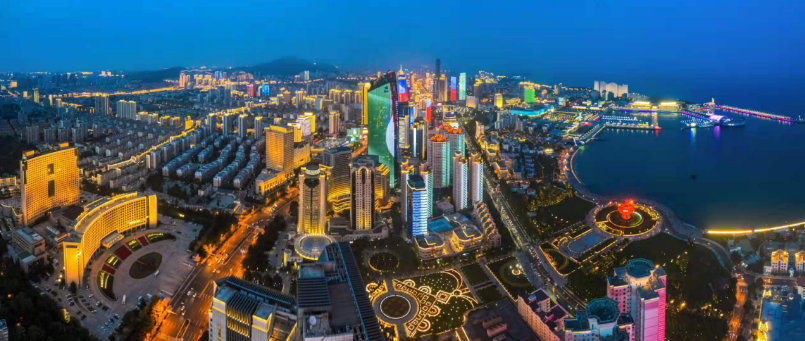
Shinan district is Qingdao's administrative center and home to government agencies including the municipal government and liaison offices of the central and provincial governments. [Photo provided to chinadaily.com.cn]
Geographical location and acreage
Shinan district, situated in the south of Qingdao city, is located at 120°19' east longitude and 36°04' north latitude. Its western end is Tuandao Cape, with the other side across Kiaochow Bay in Huangdao district. It adjoins Maidao village of Laoshan district in the east, Shibei district in the north, and the Yellow Sea in the south. Covering an area of 30.01 square kilometers, the district is 12.7 kilometers long from the east to the west reaches, and 4.8 kilometers wide from south to north.
Climate
Shinan district, located in the monsoon region of the North Temperate Zone, has a monsoon climate of medium latitudes. Thanks to the effects of the southeast monsoon, ocean current and water mass from the sea, it also has a typical oceanic climate. The air is gentle and humid, the rainfall is abundant, the temperature is moderate, and the four seasons are distinctive. Its spring temperature goes up slowly, about a month later than inland areas. The summer weather is tepid and rainy, but there is no intense heat. The autumn weather is fine with the small amount of rainfall evaporating fast. It is windy and the temperature is low in winter, but it is not chilly. According to statistics from 2002, the average temperature of the hottest July is 25.3 degrees Celsius, and that of the coldest December is 1.9 degrees Celsius below zero. Its average annual rainfall is 424.6 millimeters.
Administrative division
The current Shinan district belonged to Qingdao district and Huiqian district of the Jiao'ao Concession in 1900, and belonged to Qingdao district and Taixi town of the concession in 1910. In 1922, the Chinese government regained sovereignty of Qingdao, and Shinan belonged to Qingdao district, Bieshu district and Xizhen town. In 1929, the Nanjing Kuomintang government ruled Qingdao, and it then belonged to the first district and the second district. In 1935, it belonged to Haibin district, Xizhen town, and Fushan district. In 1938, after the Japanese army's second occupation of Qingdao, it became Shinan Bao-Jia administrative district. In 1946, the Nanjing Kuomintang government regained its ruling over Qingdao, and Shinan district was established and became one of Qingdao's four districts; the name has remained unchanged. At the end of 1949, Shinan district was one of the seven districts of Qingdao. In 1954, the Fushan district was cancelled, and its Maidao, Fukang, Fuxi, and Tianjia villages were incorporated into Shinan district and the Fushan administrative office was set up. In 1956, Fuxi and Maidao, under the jurisdiction of the Fushan administrative office (later becoming a sub-district office, and a people's commune), were incorporated into Laoshan suburb. In 1963, the Taixi district was cancelled, and its five streets including Yunnan Road and Nancun Road were incorporated into Shinan district. And the Fushan People's Commune was incorporated into Laoshan county in the same year. In 1978, the Fushan People's Commune became part of the Shinan district again.
By the end of 2019, Shinan district had 11 streets: Badaxia, Yunnan Road, Zhongshan Road, Badaguan, Zhanshan, Hong Kong Middle Road, Badahu, Jinmen Road, Zhuhai Road, and Jiangsu Road, as well as 50 communities.
Regional Characteristics
Administration center area
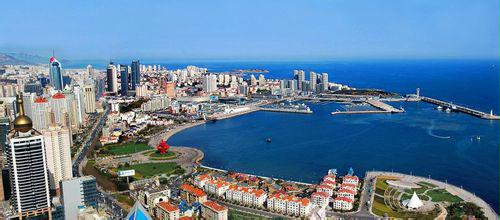
Administrative departments including Qingdao Municipal Committee of the CPC, the Qingdao municipal government and its subordinate units, and the Qingdao administrative approval service and public resources trading centers are located near Hong Kong Middle Road of Shinan district.
Tourist center area
The Seaside Scenic Spot of Qingdao was among the first national tourist attractions released by the State Council in 1982. The entire coastal area of Shinan district is included in the scenic spot, and is the main body of the scenic area. It has nearly 50 attractions.
The policies of reform and opening-up and eastern development promoted the exploitation of Shinan's abundant natural tourism resources and cultural landscapes. The sea, mountains and coastal scenery make Shinan a famous summer resort.
The middle and western part of Shinan features a combination of ancient architecture and modern skyscrapers. And the eastern part features a prosperous modern and international city thanks to the eastern development and opening-up of Qingdao.
The Shinan district government has focused on developing tourism economy since 2003. Taking advantage of its geographical location, its status as a sub-venue of the 2008 Olympic Games, and its abundant resources, it highlights urban scenery and coastal tourism. It has built an eastern tourist and shopping scenic area featuring urban scenery, Olympic Games facilities, commercial culture and commercial tourism, a middle and western entertainment scenic area featuring red tiles and green trees, and European-style architecture, as well as a coastal sightseeing scenic area featuring seaside walkways to promote the development of the local tourism industry.
About 80 percent of Qingdao's tourist attractions, well-known architecture, and former residences of celebrities are located in Shinan district.
Landmarks: Zhanqiao Bridge, Small Qingdao Island, and a large-sized sculpture named May Breeze.
Seaside attractions: Qingdao Bay, Temple of the Queen of Heaven, Qingdao Navy Museum, Huiquan Bay, Lu Xun Park, Qingdao Museum of Marine Products, the First Bathing Beach, Xiaoyushan Park, Huiquan (former site of Fort Barbette), the 2nd Bathing Beach, Taipingjiao Park, Zhanshan Temple, Fushan Bay, a coastal sightseeing walkway.
Gardens: Zhongshan Park, Celebrity Sculpture Park at Baihua Garden, May Fourth Square, Music Square, Qingdao Zoo, Qingdao Botanical Garden, Guanxiangshan Park, Xinhaoshan Park, and Qingdaoshan Park.
Famous architecture: Jiao'ao Governor's Palace, St. Michael's Cathedral, the Christian Church, Donghai Hotel, Princess Building, Huashi Building, and Qingdao Observatory.
Former residences of the following celebrities: Kang Youwei, Shen Congwen, Hong Shen, Wen Yiduo, Lao She, Liang Shiqiu, Wang Tongzhao, and Xiao Jun, Xiao Hong, and Shu Qun.
Other attractions: Qingdao Museum, stone sculpture of Northern Dynasty, Memorial of Revolutionary Martyrs.
Cultural center area
Qingdao's commerce and trade, urban construction, tourism, education, and foreign exchanges began to thrive in the early twentieth century, and culture and entertainment industries such as theaters, cinemas, theatrical stages, libraries, newspaper offices, literature clubs, drama clubs, art clubs, and music clubs sprang up, most of them located in the current Shinan district. Many cultural celebrities came here too, and their legacy and former residences enrich Shinan's cultural landscape. Thanks to these cultural characteristics, Qingdao became one of the three cultural center cities in North China in the 1930s.
Major cultural facilities: May 4th Square, Music Square, Badaxia Square, Zhanshan Square, Lao She Park, Huiquan Square, and Railway Station Square.
Cinemas: Red Star Cinema, China Cinema, and Huiquan Cinema.
Auditoriums: Qingdao Hall of the People, Qingdao International Convention Center, Qingdao Gymnasium, and Qingdao Municipal Authorities Convention Center.
Financial Center Area
Qingdao is an important financial center of Shandong. Shinan's Hong Kong Middle Road, Hong Kong West Road, Shandong Road, Fuzhou Road, and surrounding areas serve as the city's financial hub. All the headquarters of State-owned banks, foreign-invested banks, and non-banking financial institutions such as insurance, securities and trust fund firms, and credit cooperatives are located in Shinan. The district now has a sound financial organization system, complete financial market functions, strong financing capacity, and wide-ranging financial businesses. The district inked deals with the Qingdao Branch of People's Bank of China, the China Banking Regulatory Commission Qingdao Bureau, the China Securities Regulatory Commission Qingdao Bureau, the China Insurance Regulatory Commission Qingdao Bureau, and the Qingdao Municipal Commission of Economic and Trade to accelerate the construction of the regional financial center. Hong Kong Middle Road was named the Financial Street of Qingdao by the municipal government.
Scientific and technological center area
Western science and technology involving meteorology, oceanography, mariculture, medicine, urban construction, and architecture has been applied in Shinan district since 1897, which has laid a foundation for the development of multidisciplinary science and technology in Qingdao and led to a number of scientific achievements.
More than 20 research institutes successively settled down in Shinan after October 1949, including the Yellow Sea Fisheries Research Institute of the Chinese Academy of Fishery Sciences, the Institute of Oceanology of the Chinese Academy of Sciences, the Ocean University of China, Shandong Provincial Aquafarm, the First Institute of Oceanography of National Bureau of Oceanography, the Institute of Marine Geology of Ministry of Geology and Mineral Resources, the Institute of Marine Coatings of Ministry of Chemical Industry, the Institute of Chemical Industry Labor Protection of Ministry of Chemical Industry, and the Qingdao Institute of Marine Meteorological Science. A total of 227 companies have been recognized as hi-tech enterprises, by 2019. And 3,740 patents have been applied for, more than any other regions in the city.
In 2001, the Qingdao municipal government rolled out some preferential policies for the development of the software industry, and set up the Qingdao Software Park centering on Shinan District Park and hi-tech park.
Shinan Software Park, located in the south of Qingdao, covers an area of about 10,000 sq m with Taipingjiao Six Road to the east, Yangji Road to the south, and Qingdao University to the west. The region has a beautiful natural environment and full-fledged service facilities.
The software park is composed of multiple buildings and one core area. A 13,000-sq-m software building, located at 172 Minjiang Road, has been fully-occupied in less than half a year since its opening on April 29, 2001. Companies moving into the building are leading ones including the digital and smart service provider Yonyou, Kingdee, and Beijing Talent Technology. A 10,000-sq-m science and technology building, located at 116 Hong Kong Middle Road, started operation in April 2002. The core area, located on the west of Qingdao University, covers 140,000 sq m, and plans to build a multifunctional national software R&D base integrating production, R&D, talent cultivation, company incubation, technology transactions, investment, and financing within two years. In 2004, the first-phase 200,000-sq-m construction of the software industrial base was completed and an area of 102,000 sq m was put into service. The second phase project proceeded well, and the displacement and resettlement work has been finished. Top software companies such as Microsoft, IBM, Haier-Qingdao University Software Co, and Hisense Hiview Technology moved in the park, making the number of software companies grow to 220. All the buildings that have been put into use for R&D have been fully occupied at the software base. And the software base has become one of the ten advanced industrial parks in China. Buildings such as the Sunshine Building, Word Trade Center, Time Square, and Shenye Building also house many software enterprises.
The Shinan Software Park is developing into a national software industrial base that has software R&D and software export as major businesses and information technology service as minor business. It depends on universities and research institutes, targets private tech companies, takes advantages of preferential policies, and gives guarantees to the companies by providing high-quality services.
Shibei District
Located in the geographical center of urban Qingdao, it covers an area of 65. 4 square kilometers. Shibei District, inheriting history and culture of the century-old city, is home to a number of national industrial heritage including centuryold port and train station, along with historic and cultural blocks like Guantao Road and Haiyun'an Nunnery, 22 museums like the beer museum, and Radish, Rice Glue Ball, and Sugar Ball Gathering which has a history of over 700 years and attributes to the district's place as the birthplace for Qingdao folk custom. It is the cradle of Qingdao's industries in modern times with a cluster of modern national industries like beer textile, and home appliances. Taidong Town, Dabao Island, Xiaobao Island, etc. are regions where the citys commerce originated, where Guantao Road used to be Qingdao's economic and financial center. Textile industry represented by the first state-owned textile mill attributed to Qingdao's reputation for its advanced textile development comparable to Shanghai and Tianjin back in early and mid-20th century. Qingdao's modern national industries like Haier, Tsingtao Beer, Etsong Tabacco and CRRC Qingdao Sifang were born here.
Licang District
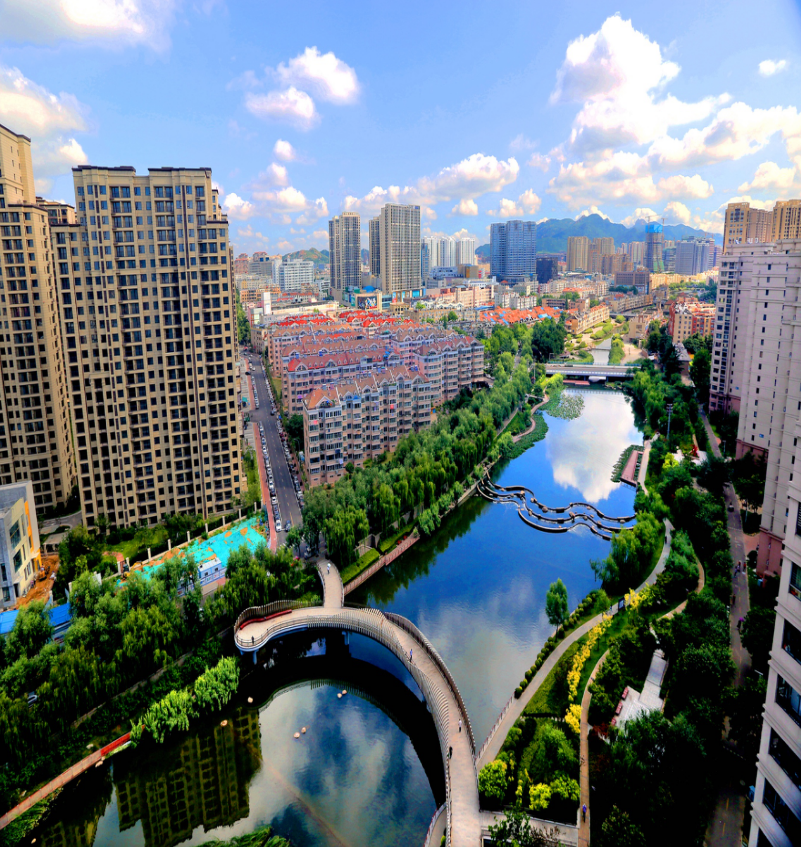
It is located in the north of Qing Dao, with an area of 99.9 square kilometers. It has laid down a 4+N industrial system dominated by the Internet and information, new finance, design and R&D, and film tv industries and supported by biomedicine, new energy, new materials and high-end equipment manufacturing industries. It has successfully developed an international port of academician. recruiting academicians from around the globe to conduct scienitic research and commercialize research findings, and build a highland for top specialists and high-end industries. It is home to the first Joint Innovation Center of Amazon Web Services (AWS), Qingdao Postal Service Cross-border E-commerce Industrial Park, the worlds biggest cloud service provider, the first workstation for overseas academicians under the Western Returned Scholars Association in China, Qingdao North Station-a national Class I hub station, and Qingdao Horticultural Expo Park.
Chengyang District
Facing Mount Lao in the east, embracing Jiaozhou Bay in the west, Chengyang District covers some 378 square kilometers. Chengyang District is a national ecological district, enjoying good ambient air in over 90% of the days throughout a year. It is a national model district in mass sports, with more than 40 public sports venues, close to the European level. It is speeding up construction of the national high speed trail technology innovation center and Qingdao rail transit industry demonstration zone, with the rail transit listed as the city's 100-billion industrial chain development strategy. Nearly 70%of the high-speed trains are made here. The first modern tram demonstration line in Shandong has been put into use here. It has launched China's first permanent magnet straddle-type monorail train and fully automatic unmanned train, and is also the birthplace of Fuxing trains. It is also the countrys agricultural product safe type monorail train and fully automatic unmanned train,and is also the birthplace of Fuxing trains.It is also the country's agricultural product safety district, national demonstration district for chronic disease prevention and control.
West Coast New Area
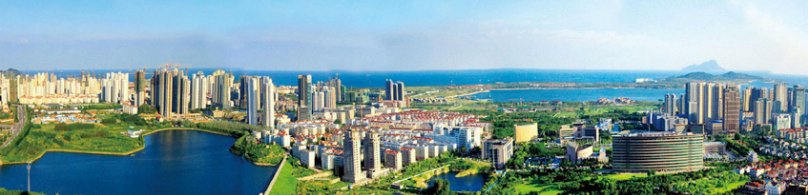
Profile of Qingdao West Coast New Area
Qingdao West Coast New Area is the ninth state-level new are approved by the State Council. It is located on the west coast of Qingdao Jiaozhou Bay and is one of the three main urban areas of Qingdao. Focusing on marine economy and enjoying provincial-level jurisdiction, the New Area is leading Qingdao’s socio-economic development.
Land area: 2,128 square kilometers
Sea area: 5000 square kilometers
Shoreline: 330.5 kilometers
Population: million
Economic strength
In 2018, the New Area registered a GDP of 351.71 billion yuan, ranking third among the 19 state-level new areas, up 9.8%; its public fiscal budgetary revenue reached 26.27 billion yuan, up 7.8%; investment in fixed assets increased by 13.1%.
Four Name Cards
Since the approval of Qingdao West Coast New Area, it has been striving to set up its external image and improve its internal vitality. By creating four business cards as "City of Beer, Island of Music, Metropolis of Film and Center of Exhibition", West Coast New Area has been continuing to enhance its soft power and comprehensive competitiveness as new state-level area.
Metropolis of Film
Qingdao is a city with movie in its blood. It nurtures a large number of famous film artists; more than 200 films and television programs are shot here every year; Qingdao is China’s first and UNESCO’s ninth City of Film, Lingshan bay film and Television Cultural Industry Zone was planned and established to build a world-class shooting and production base. The Qingdao Movie Metropolis with a total investment of RMB 50 billion Yuan has been put into operation, and there are a 40 international standard studios in the film and television.
Island of Music
Qingdao is also called “Qindao”, as the romantic charm of the mountains and the sea shows the beauty of music. The "Sound of Phoenix"Performance Center looks like a dancing phoenix stretching its neck and singing. The Concert Hall, the Grand Theater and open-air music squares built along the coast host world-class musical events, including the EUYouth Music Festival and Mendelssohn Piano International Competition, making the New Area immersed in enchanting melodies.
City of Beer
Qingdao International Beer Festival is a grand event which gives full play to Qingdao passion, manifests Qingdao specialty and charm, and has international influence. Qingdao International Bear Festival was celebrated in the New Area since 2015, which display “Same” Beer Festival, Different Bear Culture” and raises the popularity, reputation and influence of Qingdao and the West Coast New Area. The scientific planning of the Beer City’s subsequent operation mode continues to write the legend of the everlasting "Four-season Beer Festival".
Coast of Exhibition
Qingdao was one of China's first coastal open cities and is an important window for China's opening-up as well as a major destination for international conferences and exhibitions. The West Coast New Area is the permanent venue for East Asia Marine Cooperation Platform. It has successively held about 100 high-end exhibitions and forums with high standards such as East Asia Marine Cooperation Platform, World OceanConference, BRICS Sherpa Meeting and FIAP Photo Meeting, which significantly raise the popularity, reputation and influence of Qingdao and the New Area. The World ExpoCity is the largest coastal expo center in Northeast Asia with the most complete facilities and the highest level of technology which is energy-efficient and environmentally friendly.
Laoshan District
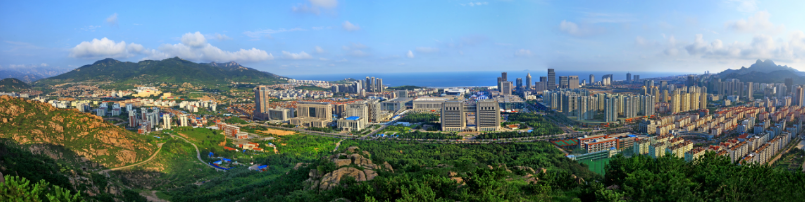
Located in the southeast of Qingdao, with an area of 395.79 square kilometers, it has one national 5A and three 4A scenic spots. The district focuses its efforts on a leading area for Qingdao's high-end industries, "four main leading pillars"and"6+1 emerging industry system. It is vigorously advancing the development of Qingdao Central Innovation Zone, Jinjialing Financial District, Laoshan Tourist Resort and Laoshan Bay International Ecological Health-Preserving City, carrying out six major campaigns, namely, to optimize political ecology, build a demonstration zone for replacing old growth drivers with new ones, enhance urban cultural strength, improve social governance, environmental governance of illegal activities and urban construction administration.
Jimo District
Jimo District is located in the northern urban area of Qingdao. It covers a land area of 1, 780 square kilometers and a sea area of 2, 517 square kilometers. The district ranks 15th among top 100 districts nationwide in terms of comprehensive strength, 18th among top 100 districts nationwide in terms of green development, 24 th among top 100 districts nationwide in terms of scientific and technological innovations. A traditional commercial capital, it is nicknamed a town of automobiles worth 100 billion yuan, where three major vehicle projects produce over 300,000 cars annually, and another 110 key projects are put in operation. It introduced the first H135 final assembly line from deutsche airbus outside europe and ushered in a new era in Qingdao's navigation industry. It succeeded in research and release of Jimo Chip, a digital chip, and in establishment of the country's first demonstration zone for "Internet+SMEs. It is a comprehensive tourist resort, known for its unique seawater hot spring. Its hot spring town was listed among Chinas most beautiful rural tourist destinations, Chinas best leisure towns suitable for living and touring, China's top ten districts for conventions and exhibitions. the most influential cities for conventions and exhibitions.
Jiaozhou City
Located in western Qingdao, it covers some 1, 324 square kilometers. During Tang and Song dynasties, it was the only foreign trade port to the north of the yangtze river, one of the five commercial ports in China, and an important city along the Maritime Silk road, and has been known as golden jiaozhou since thenk It is home to the under-construction Qingdao Jiaodong International Airport. It is coordinating the development of China-SCO Local Econom. nd Trade Cooperation Demo Zone, Jiaozhou Economic and Technoiogical Development Zone, Airport Economic Demonstration Zone, Qingdao Jiaozhou Bay International Logistics Park, as well as the provincial-level Dagu River ecological tourist resort, striving to build the innovation system for economic development, the social credit system, the modern social governance system, and an efficient, cordial, clean pro-business environment, and rising to become a modern livable airport zone.
Pingdu City
Located in the northwest of Qingdao, with an area of 3.176 square kilometers, it is the largest county-level city in Shandong Province. In March 2015, it was approved to be a pilot city for comprehensive reform of small-and medium-sized cities. It is richly endowed with graphite, gold, talc and other mineral resources. It is the only city among the top 100 producers of grains, oil, meat and fruits, has won the Model County for Grain Production for 14 consecutive years, home to 19 products under state protection of geographical indications including Majiagou celery and Daze Mountain grapes, and is named one of the first-batch national
demonstration zones for agricultural modernization. It has four industrial clusters: machinery parts, electronics home appliances, food processing and special chemicals, each with an output exceeding 100 billion yuan. Aspiring to be a modern central city in north Qingdao, it has been speeding up to develop the advanced manufacturing base. the land port logistics base on Shandong Peninsula, the tourist resort, and the national demonstration zone for agricultural modernization.
Laixi City
It is home to Chanzhi Reservoir (Laixi Lake), the biggest reservoir in Jiaodong with a total capacity of 402 million cubic meters and Jiangshan Wetland, the biggest inland wetland of Jiaodong with an area of 25 square kilometers. It is among the top 100 counties in terms of comprehensive strength and among the top 100 county economies in terms of basic competitiveness, a national model city in scientific and technological advancement, a national competitive city in food industry, one of the first-batch national demonstration zones for agricultural modernization, and a provincial-level civilized city. It hosted the 2nd and 3rd World Leisure Games. It is a recipient of the Asian Golden Tourism Award and rated one of the first-batch top 10 leisure (vacationing) destinations. It is also a pilot city for comprehensive standardization of leisure cities. It strives to build a modern subregional center, an advanced manufacturing base of Qingdao, a transportation and logistics hub on the peninsula, a national demonstration zone of agricultural modernization, and an international leisure and tourism destination, and rises to be an example of green development in the greater North Qingdao area.
Source:Qingdao International Community Center (for Culture and Tourism)








 京公网安备11010802044359
Contact Us:86-10-58882453 86-10-58882413