
From November 1, will employers who underpay social insurance contributions face penalties of up to three times the unpaid amount? First, let’s look at the range.
The penalty range of one to three times unpaid amount is already set out in Article 86 of the Social Insurance Law. In the past, penalty discretion varied across regions, and comparable arrears cases might be treated differently from province to province.
The core of the forthcoming rules is not about heavier penalties, but about a unified standard: Item 30 of the National Tax Administrative Penalty Discretion Benchmark (2026 Edition) will formally incorporate employers' non-payment or underpayment of social insurance contributions into the national unified tax discretion system, setting three tiers based on the amount in arrears and its proportion of the total amount payable, with penalty multiples rising accordingly.
Two categories of violations
Non-payment: Failing to report and pay contributions when participation and payment are required; or having reported but failed to actually pay the amount into the social insurance fund.
Underpayment: Being duly enrolled in social insurance but, over an extended period, reporting a contribution base lower than the employee's actual wage, resulting in a shortfall in social insurance contributions.
Many employers still attempt to avoid their statutory obligations by entering into "voluntary waiver of social insurance" agreements with employees, or providing cash allowances in lieu of social insurance contributions. Such agreements are void as they contravene mandatory legal provisions and cannot discharge the employer’s statutory payment obligations. Where an investigation is conducted, the employer remains obligated to make up the shortfall and bear associated liabilities.
Three-tier discretionary standard
Penalty discretion is based on two dimensions: the unpaid amount (ie the amount of social insurance contributions arising from non‑payment or underpayment) and the proportion of such amount to the total amount payable for the period. Accordingly, penalties are calculated as multiples of the unpaid amount (see table below) .
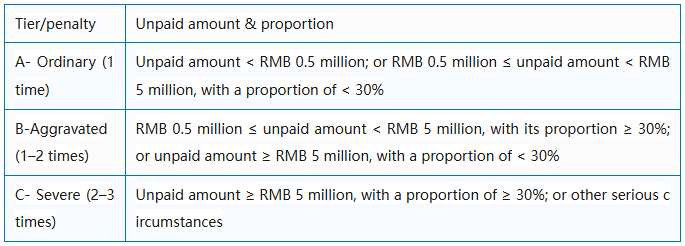
A penalty will not be imposed immediately once the unpaid amount is identified. The statutory process: issue an order for supplementary payment within a time limit → failure to pay upon expiry → initiation of penalty discretion.
Separately, late payment surcharges accrue independently: calculated at 0.05% per day from the due date of payment. Surcharges still apply even if no penalty is imposed.
Compliance recommendations
Conduct regular self‑checks: Verify that the list of enrolled employees, declared contribution bases and actual wages match. Identify risks early rather than waiting for a retrospective audit of prior periods.
Communicate proactively when facing payment difficulties: Deferred payment applies only where force majeure causes significant operational hardship, and is subject to approval by the provincial social security administrative authority. Where the bank account balance is insufficient to settle the outstanding amount, the employer may consult the collecting authority regarding a deferred payment agreement, which may be concluded upon provision of security. Approval and security requirements are determined by the collecting authority in accordance with the law.
Act immediately upon receiving an official notice: Once served with a notice ordering payment within a specified period, make up the amount before the deadline to avoid triggering administrative penalties.
The actual penalty discretion is subject to the enforcement guidance of the competent tax authority.
Source:Liser Accounting Services
Events
More+-

Hélène Rollès: “My Name Is Hélène” French Chanson Diva 2026 Concert — Hangzhou
-

2026 Qingdao · Grand Theatre Arts Festival: Twilight Hollywood Movie Soundtracks Candlelight Concert [ECM European Chamber Music]
-

French Original Musical La Dame aux Camélias
-
Maksim Mrvica “SEGMENTI II” Classical Crossover Piano Concert — Xiamen
-

Maksim Mrvica “SEGMENTI II” Classical Crossover Piano Concert — Suzhou
Discover










 京公网安备11010802044359
Contact Us:86-10-58882453 86-10-58882413