
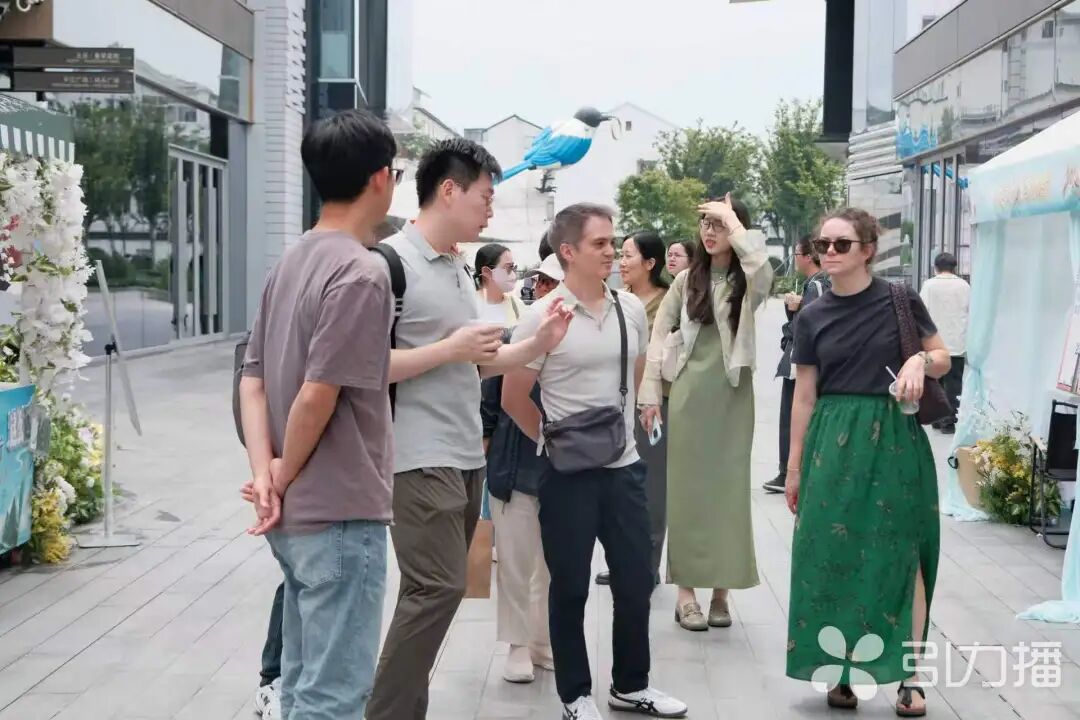
The "A Glimpse of Jiangnan — Foreign Experts Discover Suzhou" event was recently held in Gusu District. Four foreign experts from Xi'an Jiaotong-Liverpool University (XJTLU), including department heads, professors, and assistant professors, embarked on a citywalk through Suzhou's ancient city area, experiencing firsthand the unique atmosphere and consumer vitality generated by the integrated development of "intangible cultural heritage + cultural tourism."
Photo/Yinlibo
During a subsequent discussion session, they offered their international perspectives on how Suzhou's intangible cultural heritage can expand onto the global stage.
From Preservation to Participation: Engaging Young People in the Future of Intangible Cultural Heritage
Ange Fitzgerald (Australia), Professor, Department of Educational Studies, Academy of Future Education, XJTLU
Few cities embody the dialogue between past and future as beautifully as Suzhou. On one hand, Xiangmen City Wall Square presents a vibrant vision of contemporary urban life. On the other, the China Kunqu Opera Museum preserves a cultural tradition that has captivated audiences for centuries. Moving between these spaces as part of the XIPU Institute's Suzhou in the Eyes of International Experts programme, I was reminded that heritage is not simply about preserving the past. It is about ensuring that future generations understand its value and choose to carry it forward.
This reflection led me to a simple but important question: how do we ensure that intangible cultural heritage remains alive for future generations? The answer, I believe, lies not only in preservation, but in participation.
As an educator, I have spent much of my career exploring how learning connects people to place, identity, and community. During my time working as a youth engagement advisor in Jordan, I helped develop programmes that connected young people with their cultural heritage through lived experience. Students visited significant sites, engaged with local stories, and participated in hands-on activities that brought history and culture to life. What we learned was simple: young people develop a sense of ownership when they are active participants rather than passive observers.
This learning resonated strongly with me during our visit to Suzhou. Walking through the China Kunqu Opera Museum, I was struck not only by the richness of the tradition itself, but also by the dedication required to sustain it across generations. Kunqu Opera represents centuries of artistic knowledge, storytelling, music, and performance. Yet its future, like that of many forms of intangible cultural heritage, depends on whether younger generations see it as relevant to their lives. This is where education has a critical role to play.
Too often, cultural heritage education is treated as an additional activity rather than an integral part of learning. The most successful programmes are not occasional excursions or one-off events. Instead, heritage becomes a lens through which students learn about history, language, art, identity, creativity, and community. When learning is connected to authentic cultural experiences, young people begin to understand not only what heritage is, but why it matters.
Importantly, today's young people are not simply future custodians of cultural heritage; they are also innovators. Across the world, young creators are reimagining traditional practices through digital storytelling, social media, design, fashion, and other contemporary forms of expression. These innovations create new pathways for engagement while also opening opportunities in cultural tourism, creative industries, and cultural entrepreneurship.
For intangible cultural heritage to thrive, it must be allowed to evolve. Authenticity and innovation should not be viewed as competing priorities. Rather, thoughtful innovation can help cultural traditions reach new audiences while maintaining their cultural significance. This is particularly important in a city like Suzhou, where history and modernity coexist so visibly. The challenge is not whether young people value cultural heritage. The challenge is whether we create meaningful opportunities for them to experience it, contribute to it, and shape its future.
From my experience, the preservation of intangible cultural heritage is ultimately about people, not objects. It is about sustaining the stories, skills, performances, and cultural knowledge that help communities understand who they are and where they come from. If we want these traditions to endure, we must move beyond preservation alone and focus on participation. By embedding cultural heritage within education and empowering young people as both learners and creators, we can ensure that the traditions represented within places such as the China Kunqu Opera Museum remain as much a part of Suzhou's future as the modern skyline visible from Xiangmen City Wall Square.
One City, Fifteen Strings, Six Hundred Years
Daniel Anthony Yonto (USA), Assistant Professor, Department of Urban Planning and Design, Design School, XJTLU
On a warm June afternoon, I walked into the historic Gusu District of Suzhou as an international researcher from Xi'an Jiaotong-Liverpool University, invited to examine how the city is keeping its intangible cultural heritage alive. The streets were busy with the city's Non-Heritage Summer Festival, stalls lining the old alleyways with silk embroidery, eggshell carving, and craft traditions from across China. It was a fitting introduction. But it was what waited inside the China Kunqu Opera Museum that made me want to come back for more.
I have watched my share of detective stories — American crime dramas, British murder mysteries, even Japan's manga series Case Closed: Detective Conan — but I did not expect to find one inside a classical Chinese opera museum. The Fifteen Strings of Cash is a Kunqu opera built around wrongful accusation, a miscarried investigation, and the question of who will speak up for the innocent. The kind of story, in other words, that you might settle in for on your favorite streaming service on a Friday night. Except this one has been in Suzhou for six hundred years.
The plot is simple. A man is accused of murder on the basis of fifteen strings of cash found in his possession, while the real criminal, Lou Ashu, walks free. His name in Chinese hints at his nature: "rat." Yet Lou Ashu is no ordinary villain. He is also the comic heartbeat of the story. You can tell from the facial expressions and theatrical delivery that the laughter is deliberate, drawing the audience deeper into the plot even as the "rat" manipulates the court and shifts blame onto the innocent.
What is easy to forget, standing in the museum, is how close this opera came to silence. By the 1950s, Kunqu — once called the mother of all Chinese operas — had been eclipsed by newer regional forms. Only a handful of masters kept the tradition alive. No Kunqu performances could be found in Beijing or Shanghai. Then, in 1956, a single production changed everything. A troupe brought a newly adapted Fifteen Strings of Cash to Beijing, where it ran for 46 consecutive performances and drew more than 70,000 spectators. People's Daily called it "a single play that revived an entire operatic genre." Kunqu, which had been spoken of as a relic, was suddenly alive again.
That survival is audible in every performance. When the singers open their mouths, they sing not in Mandarin but in the Suzhou dialect — the particular music of this city's own tongue. In an era when younger generations are drifting toward standardized language, hearing that dialect carried through performance is a quiet act of defiance. The dialect is not incidental to the opera; it is part of what the opera protects.
The costumes carry their own history too. The embroidered robes on stage connect directly to Suzhou's centuries-long identity as a center of silk production — the textile economy of the past made visible, stitched into the story being told. And that story traveled: Fifteen Strings of Cash moved north along the Grand Canal, carried by the same commercial networks that made Suzhou wealthy, shaping the development of Chinese opera far beyond this city's borders.
This is what intangible cultural heritage actually means, seen from the inside. Not a label applied to something old and fragile, but dialect, craft, narrative, and memory held together in a single performance — alive because people kept choosing, even in the leanest years, to perform it and to fight for it.
For an international visitor, The Fifteen Strings of Cash offers the rarest kind of encounter: something genuinely unfamiliar that nonetheless feels immediately human. A man is accused of something he did not do. The clock is running. Someone has to act.
Suzhou has been telling that story for six hundred years. It is worth coming to listen.
Tradition in Motion: Reflections on Memory, Identity, and Innovation in Suzhou
Wai Kit Leong (Malaysia), Assistant Professor, Academy of Film and Creative Technology, XJTLU
When the familiar lines, "So many colors glow in spring, yet all are given to broken walls and crumbling wells…", flowed gently from the lips of a high school student, I found myself unexpectedly transported across time and space. Sitting in the audience in Suzhou, I was no longer merely a visitor. Instead, I was a child again, seated beside my grandmother at an open-air opera performance in our Malaysian hometown. In that fleeting moment, memories of the Nanyang Chinese diaspora and the cultural landscape of Jiangnan became intertwined, reminding me that culture often travels not through textbooks but through sounds, emotions, and shared experiences.
For many Chinese families in Malaysia and Singapore, the traditional "Da Xi" performances of our childhood are far more than entertainment. They represent collective memory, emotional attachment, and cultural continuity. Perhaps because of these deeply rooted experiences, I arrived in Gusu Field Trip carrying an unexamined assumption: that Kunqu Opera would simply be a more refined version of the Cantonese operas I had grown up with. Looking back, I realize that this expectation reflected a tendency to interpret unfamiliar traditions through the lens of my own experiences. Rather than approaching Kunqu with curiosity, I had unconsciously framed it as something already familiar. This visit challenged that assumption and became an important lesson in cultural humility.
My visit to the Kunqu Museum along Pingjiang Road opened a world I had previously overlooked. I was struck not only by the beauty of the art itself but also by a sense of regret. How had I, someone interested in storytelling and cultural heritage, known so little about one of China's oldest theatrical traditions? Why had this remarkable cultural treasure not occupied a more prominent place in public consciousness? These questions became a source of reflection rather than criticism, prompting me to recognize how many forms of intangible heritage remain invisible unless we actively seek them out.
Learning that Kunqu is regarded as the "ancestor of Chinese opera," with a history spanning over six centuries, transformed my understanding of its significance. Discovering that only around one hundred of its original three hundred musical scores have survived underscored the fragility of cultural memory. Preservation, I realized, is not merely about protecting artifacts from disappearance; it is about ensuring that traditions remain meaningful and capable of speaking to contemporary audiences. I particularly appreciated the guides' ability to explain sophisticated concepts through simple demonstrations. Their use of a folding fan to illustrate the structure of zhezi xi transformed abstract theory into something tangible and memorable. It reminded me that effective cultural communication often depends not on complexity, but on accessibility.
The architecture of the traditional stage left an equally profound impression. Initially, I recognized similarities with the temple stages associated with Chinese opera performances in Malaysia, where performances are often dedicated to deities during festivals. Yet what fascinated me most was discovering the deeper philosophy embedded within the design. The principles of "round heaven and square earth" were not merely symbolic but represented a remarkable integration of aesthetics, spirituality, and acoustics. Even more astonishing was the realization that the entire stage structure could be assembled without nails, demonstrating a level of craftsmanship and engineering sophistication that I had never previously considered. I began to understand that cultural heritage is not confined to performance alone; it also encompasses architecture, craftsmanship, and systems of knowledge accumulated over generations.
Perhaps the most important personal revelation was recognizing how I had conflated Kunqu with Cantonese opera. My previous understanding had reduced two distinct artistic traditions into a single category simply because both belonged to Chinese opera. Through the visit, I came to appreciate their unique aesthetic systems. Kunqu, based on the qupai ti melodic structure, emphasizes refinement, elegance, and subtle emotional expression, while Cantonese opera, built upon the banqiang ti system, allows greater improvisation and responds closely to the tonal qualities and emotional rhythms of the Cantonese language. This realization taught me that cultural similarities should not obscure diversity. Respecting heritage requires acknowledging differences rather than assuming equivalence.
As a delegate from a academy specializing in film and technology, I could not help but consider the implications for cultural preservation in the digital era. More importantly, I began to question whether preservation alone is sufficient. Museums safeguard the past, but younger generations increasingly engage with culture through digital media. If heritage is to remain alive, it must also evolve.
This led me to envision several possibilities. AI-assisted storytelling could generate short, multilingual videos that make the history and aesthetics of Kunqu more accessible to international audiences. Interactive mobile applications could gamify learning by allowing users to explore costume symbolism and role categories through play rather than passive observation. Immersive technologies such as augmented reality and virtual reality could recreate stage experiences, allowing audiences around the world to appreciate the unique acoustics and visual aesthetics of traditional performances.
However, this experience also prompted me to reflect critically on the role of technology. While AI and immersive media offer exciting possibilities, they should not replace the human artistry and emotional authenticity that define Kunqu. Digital tools should serve as bridges rather than substitutes. Their purpose is not to simplify heritage into entertainment but to create pathways through which contemporary audiences can encounter and appreciate its complexity. The challenge lies not merely in preserving cultural forms, but in balancing innovation with authenticity.
Ultimately, my experience in Gusu Field Trip transformed more than my understanding of Kunqu Opera. It reshaped the way I think about culture itself. I arrived expecting familiarity and left with humility. I arrived seeking performances and departed with a deeper appreciation for the interconnectedness of memory, identity, craftsmanship, and technology. Most importantly, I came to understand that tradition is not a static relic preserved behind museum walls. It is a living conversation between generations, continuously reinterpreted through new contexts and new voices.
Perhaps that is the greatest lesson Gusu Field Trip offered me. Heritage survives not because it remains unchanged, but because each generation finds its own way of listening, understanding, and retelling the stories it inherits. If future generations encounter the opening lines, "So many colors glow in spring…", and embark upon their own journeys of discovery, then the legacy of Kunqu will continue—not as a memory frozen in time, but as a living art carried forward with renewed passion and meaning.
Balancing Commercialisation and Authentic Transmission in Intangible Cultural Heritage
Emily Williams (UK), Head, Department of China Studies, School of Humanities and Social Sciences, XJTLU
In the past 20 years, China has proactively supported the protection of intangible cultural heritage, including through the 2011 Intangible Cultural Heritage Law of the People's Republic of China, which established a legal and administrative framework for the protection and perpetuation of traditional practices and believes. In a country experiencing as rapid change as China has over the past decades, it is important for the government and local communities to protect not just the physical heritage of the past, but also the intangible cultural heritage, generally understood as the practices, expressions, knowledge and skills that communities recognise as part of their cultural heritage. Our visit to the Suzhou Kunqu Museum was an opportunity to learn about the history of this important cultural form, to see the stage on which it would have been performed, to see the costumes that would have been worn, and to hear about its historical development and impact. But intangible cultural heritage cannot simply exist in a museum, and so for me, the most rewarding part of the trip was to hear the performance by a local teenager, who had studied Kunqu for many years. This highlights the key importance of intangible cultural heritage: while it also is now integrated into legal and economic systems of value, it must remain rooted in local community practice if it is going to have a future.
In a Chinese context, the priority has often been on integrating intangible cultural heritage into cultural industries, tourism and local economic development. This can work as a strategy to spread awareness of cultural practices to new, and often younger, or perhaps more international audiences, as we saw when we visited the Intangible Cultural Heritage market in Cangjie commercial plaza. It can also be a strategy to provide exposure to these lesser known, but no less artistically-impressive handicrafts. However, this desire to safeguard these cultural forms via economic activation also brings with it the risk of commercialisation, and can lead to tensions between 'authentic' transmission vs market performance. The intangible cultural heritage industry needs to find a balance between the economic imperatives of production and the requisite continuity of embedded community practice. Getting young people involved in cultural transmission will be crucial to the success of this, as the young woman performing at the Kunqu museum demonstrated. Cultural practices have always been subject to change over time; there is no need to ossify them. Young people working together with established community practitioners to carry forward these traditions into the future is likely the best way to balance the competing challenges facing China's intangible cultural heritage industry.
Sources: iSuzhou







 京公网安备11010802044359
Contact Us:86-10-58882453 86-10-58882413