
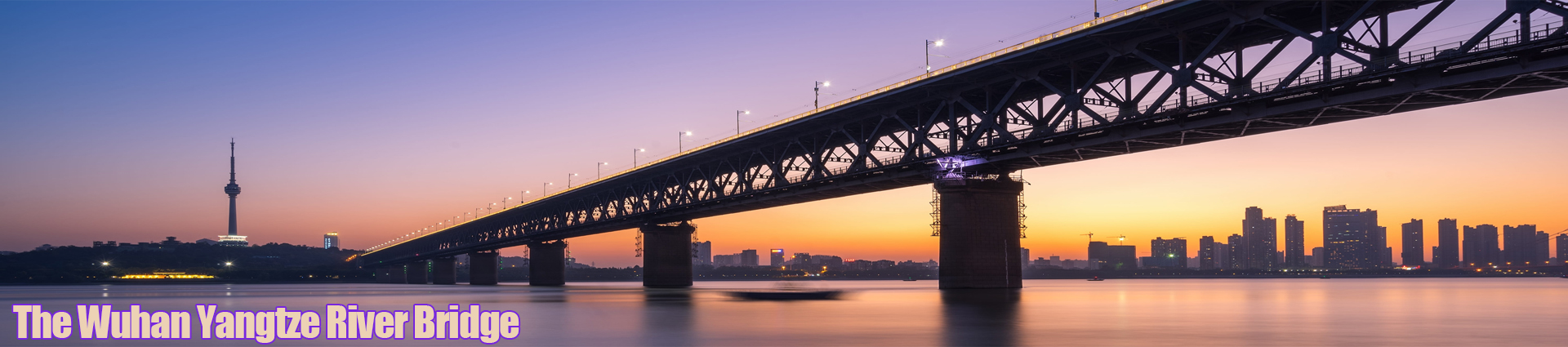

Hubei
Location: Hubei Province lies in the middle reach of the Yangtze River with an area of 186,000 square kilometers. Situated 108'21"-116'07" east longitude and 29'05"-33'20" north latitude, it got its name from being in the north of the Dongting Lake. The terrain of Hubei Province is high in the west and low in the east and wide open to the south, the Jianghan Plain.
The province is surrounded on three sides (east, west and north) by mountains. Its low and flat middle part is a piece of incomplete basin slightly open towards south. Of the gross area, there are 56% mountains, 24% hills and 20% lowland lake area.
As to mountains, they are divided into four parts in the province. Northwestern mountains are area extending to the east by Qinling and east section of Daba Mountain. Area extending to the east by Qinling is called Wudang mountain chain, going from northwest to southeast, with lots of mountains. Altitude of ridge of mountains is generally above 1000m, and the highest is Tianzhu Peak of Wudang Mountain with altitude of 1621m. East section of Daba Mountain consists of Shennongjia, Jingshan Mountain and Wushan Mountain, with thick forests and deep river valleys. Peak of Shennongjia is Shennongding with altitude of 3105m, always known as “The First Peak in Central China”.
Climate: Situated in South-central China, Hubei Province features a subtropical monsoon climate. The average temperature for a year is about 15° C (59° F). The Province has distinct four seasons with burning hot summer (June, July and ugust) and chilly winter (December, January and February). The hottest month, July, averaging 27-30°C and the coldest month, January, 1-5°C.
Wuhan, the capital city in Hubei Province, is known as one of the ‘four stoves’ in China because the torrid climate in summer (there are more than 20 days with the temperature above 35° C or 95° F. The mountainous districts of western Hubei, in particular Shennongjia, with their cooler summers, attract numerous visitors from Wuhan and other lowland cities.
The annual rainfall in Hubei Province is between 800-1600mm on average. Summer is the wettest month in Hubei with 300-700mm in average. Hubei’s driest season is Winter, with average rainfall at 30-190mm. The period from mid-June to mid-July is called the plum rain season in Hubei as the rainfall in this time reaches the peek in the year.
Hydropower: Hubei is the hydropower base of China. There are over 1190 rivers with a total length of 35,000km. Installed capacity of hydroenergy developable is 33, 570, 000 kilowatt, ranking the fourth throughout the country. Currently, the Three Gorges Hydropower Plant in Yichang city of Hubei is the largest hydropower plant in the world with the total installed capacity of 22,500 MW and annual power generation of around 100 TWH. It plays an important role in flood control, electricity generation, shipping and tourism. A number of large hydropower plants are also located in Hubei, namely Gezhouba, Geheyan and Danjiangkou.
With the transmission of Three Gorges’ electric power and the completion of China’s first UHV project, Hubei grid has become a modern grid covering the urban and rural areas of the whole province with no more than 110 KV grid.
It has linked up with a 1000KV high voltage grid with a backbone of 500KV grid and a mainstay of 220KV grid. In 2010, the accumulative amount of electricity generation in Hubei province amounted to 202.9 TWH, among which hydropower reached 125 TWH.
The Three Gorges Project
Gezhouba Hydropower Plant History: One of the Birthplaces of the Chinese Nation The Shennong Altar With a long history, Hubei is one of the birthplaces of Chinese nation and the ancient Chinese culture. The ancient human fossils discovered at Yunxi, Yunxian, Changyang etc. have proven that human being began to live here several hundred thousand years ago. Moreover, 5,000 years ago, the Emperor Yan (Shengnong), the first ancestor of the Chinese nation, was born in Suizhou, Hubei. The Qujialing Culture and the Shijiahe Culture are the relics of the Neolithic Age with a history of more than 4,000 years.
The Relics of Panlong City excavated at the Huangpi District of Wuhan has a history of more than 3,500 years. It is one of the oldest cities discovered in China. The city is enclosed with the rammed wall. Inside it, there are many palace relics. Outside it are the workshop relics and cemeteries. A lot of delicate bronze wares have been unearthed.
The Cradle of the Chu Culture
The Chu Culture is one of the most important parts of the Chinese Culture. In the Spring and Autumn Period (770-475 BC) and the Warring States period (476-221 BC), Chu was the largest country in area within the territory of Hubei with its capital at Jiangling for 400 years. Chu once tried to conquer the Central Plains (comprising the middle and lower reaches of the Yellow River), and became one of the five super powers in the Spring and Autumn Period as well as one of the 7 powerful states in the Warring States Period.
Chu had once reached a very high level in the fields of bronze smelting, colorful weaving on silk, embroidery, lacquer ware manufacturing, etc. Great achievements had also been made in the artistic field, which was mainly demonstrated in music, dancing, paintings, sculptures, etc. The chime bells unearthed from the tomb of Yi, a high official of the ancient State Zeng at Suizhou are gems among the ancient musical instruments in the world. They are praised as “the eighth miracle in the ancient world”. The Tonglushan Relic of the ancient mineral smelting at Daye is the largest and oldest mineral-smelting relic discovered in China. It has a history of 3,000 years and is called “the hometown of bronze.”
The Chime bells unearthed from the Tombof Marquis Yi of the Zeng State The Place Contested by All Strategists
In the Three Kingdoms Period, Hubei was the place contested by all strategists where many famous historical events took place. The Romance of Three kingdoms, one of the four classics in ancient China, consists of 120 chapers, among which 72 chapters are concerned with Hubei.
Among the famous battle fields in ancient China, the Red Crag is the only battle relic keeping the original state. The Red Crag Battle (A.D.208) was the most famous few-win-many battle in the Chinese history. The ancient Longzhong at Xiangyang was the place where Zhuge Liang, the most well-known strategist and statesman in the Three Kingdoms Period, once lived in seclusion. Liu Bei, the emperor of Shu, had made at Zhuge Liang’s thatched cottage to invite him to be official. This story has been told from mouth to mouth with general approval for thousands of years. Countless historical and cultural stories such as “Liu Bei borrowed the Jingzhou City”, “Guan Yu was defeated at Maicheng”, etc. took place in Hubei.
The Ancient Longzhong scenic spot The Birthplace of Chinese Modern Industry
As early as the end of nineteenth century, Zhang Zhidong, the Governor of Hubei and Hunan, set up the first Hanyang Steel Works that was the earliest industrial enterprise in China. In the meantime, the textile industries such as weaving, spinning, etc. were also established. After that, the enterprises such as hides-processing, papermaking, etc. were opened up as well. All of these had made Hubei the birthplace of Chinese modern industry.
The Sacred Place of Chinese Revolution
On October 10,1911,the Xinhai Revolution (the Revolution of 1911),the Chinese bourgeois democratic revolution led by Dr.sun Yat-sen was started firstly at Wuchang. It overthrew the feudal monarchy lasting more than 2,000 years in China and established the Bourgeois Republic. During the new democratic revolution period, countless revolutionists of Hubei shed their blood for the founding of the People’s Republic of China. Hong’an “a country of generals”, is known as the hometown of more than 200generals. In Yangxin, “a county of martyrs”, 200thousands revolutionists sacrificed their liver for the Chinese revolution. The city of Honghu was the revolution base area of Hunan and west Hubei. “The song of Honghu lake” encouraged countless people with lofty ideals.
The Cultural Allusions of Hubei
Hubei has a long historical and cultural history. There are many famous allusions in ancient China, such as “drive a cart in ragged clothes to blaze a new trail”, “lofty mountains and flowing water”, “Zhaojun leaving the frontier fortress”, “Mulan joining the army”, “offer service as Mao Sui did”, “The sincerity can make metal and stone crack”, “The Spring Snow,---a highbrow song”, “The Song of Rustic Poor”, and the love story of Dong Yong and the Seventh Fairy Maiden. All these allusions originated form Hubei.
Hubei Custom
The main habitants in Hubei are Han people. Compared with other regions in China, Han people are very similar in customs as paying New Year calls, appreciating lanterns on the 15th day of the 1st lunar month, visiting graves on Qingming, eating zongzi(glutinous rice dumplings) and dong dragon boat racing on the Dragon Boat Day, as well as appreciating the moon on Mid-autumn Day.
Though a tradition in many places in China, eating zongzi an doing dragon boat racing is especially popular in Hubei, Qu Yuan’s hometown, as the custom comes form the commemorating of Qu Yuan, the patriotic poet, every year on the Dragon Boat Day, the practice of zongzi eating and dragon boat racing will prevail all across the province, in all the places where there is a river of lake, dragon boats will have been prepared will ahead of time, ready to compare form the 5th lunar month’s 1st day to 5th day, dragon boar racing creates splendid views with the boats rushing forward like arrows, and the huge crowd on both banks shouting over the beating gongs an drums, also during this period, Hubei people have the tradition of having preserved eggs and salted duck eggs, a cold dish of preserved eggs tofu or fried beans with salted duck eggs becomes a must in the dining table, And these eggs make perfect presents for those who plan to visit friends or relatives.
Major minorities in Hubei include tujia and Miao people, living primarily in Enshi Tujia and Miao Autonomous Prefecture in the west of Hubei. From the 3rd day to the 15th day of the 1st lunar month, Tujia people hold large-scaled activities of sacrifice, pray and celebration, in which the hand-waving dance is an indispensable part. The dance is primarily and a demonstration of ritual, labor or battles. Though simple and rough, it looks beautiful and has a tremendous primitive style. Tujia people have unique wedding and funeral customs, the wedding is accompanied by a lot of crying and the bride has to sing a weeping song of marriage. The funeral custom, on the other hand, is characterized by the funeral dance: people nearby, men and women, old and young, gather in front of coffin, laughing and dancing until the next morning.
For Miao people, songs are always a part of the life. Young people even use songs to send their hearts to their loved ones. Miao folk songs are sonorous, sweet and crystal. On Miao holidays, people from different mountain villages will gather in a square to celebrate. At the time, people in their colorful costumes sing their songs and beat gongs and drums, making a sonorous and exciting symphony.
Source: en.hubei.gov.cn
Video source: Foreign Affairs Office of Hubei Provincial People's Government
The province is surrounded on three sides (east, west and north) by mountains. Its low and flat middle part is a piece of incomplete basin slightly open towards south. Of the gross area, there are 56% mountains, 24% hills and 20% lowland lake area.
As to mountains, they are divided into four parts in the province. Northwestern mountains are area extending to the east by Qinling and east section of Daba Mountain. Area extending to the east by Qinling is called Wudang mountain chain, going from northwest to southeast, with lots of mountains. Altitude of ridge of mountains is generally above 1000m, and the highest is Tianzhu Peak of Wudang Mountain with altitude of 1621m. East section of Daba Mountain consists of Shennongjia, Jingshan Mountain and Wushan Mountain, with thick forests and deep river valleys. Peak of Shennongjia is Shennongding with altitude of 3105m, always known as “The First Peak in Central China”.
Climate: Situated in South-central China, Hubei Province features a subtropical monsoon climate. The average temperature for a year is about 15° C (59° F). The Province has distinct four seasons with burning hot summer (June, July and ugust) and chilly winter (December, January and February). The hottest month, July, averaging 27-30°C and the coldest month, January, 1-5°C.
Wuhan, the capital city in Hubei Province, is known as one of the ‘four stoves’ in China because the torrid climate in summer (there are more than 20 days with the temperature above 35° C or 95° F. The mountainous districts of western Hubei, in particular Shennongjia, with their cooler summers, attract numerous visitors from Wuhan and other lowland cities.
The annual rainfall in Hubei Province is between 800-1600mm on average. Summer is the wettest month in Hubei with 300-700mm in average. Hubei’s driest season is Winter, with average rainfall at 30-190mm. The period from mid-June to mid-July is called the plum rain season in Hubei as the rainfall in this time reaches the peek in the year.
Hydropower: Hubei is the hydropower base of China. There are over 1190 rivers with a total length of 35,000km. Installed capacity of hydroenergy developable is 33, 570, 000 kilowatt, ranking the fourth throughout the country. Currently, the Three Gorges Hydropower Plant in Yichang city of Hubei is the largest hydropower plant in the world with the total installed capacity of 22,500 MW and annual power generation of around 100 TWH. It plays an important role in flood control, electricity generation, shipping and tourism. A number of large hydropower plants are also located in Hubei, namely Gezhouba, Geheyan and Danjiangkou.
With the transmission of Three Gorges’ electric power and the completion of China’s first UHV project, Hubei grid has become a modern grid covering the urban and rural areas of the whole province with no more than 110 KV grid.
It has linked up with a 1000KV high voltage grid with a backbone of 500KV grid and a mainstay of 220KV grid. In 2010, the accumulative amount of electricity generation in Hubei province amounted to 202.9 TWH, among which hydropower reached 125 TWH.
The Three Gorges Project
Gezhouba Hydropower Plant History: One of the Birthplaces of the Chinese Nation The Shennong Altar With a long history, Hubei is one of the birthplaces of Chinese nation and the ancient Chinese culture. The ancient human fossils discovered at Yunxi, Yunxian, Changyang etc. have proven that human being began to live here several hundred thousand years ago. Moreover, 5,000 years ago, the Emperor Yan (Shengnong), the first ancestor of the Chinese nation, was born in Suizhou, Hubei. The Qujialing Culture and the Shijiahe Culture are the relics of the Neolithic Age with a history of more than 4,000 years.
The Relics of Panlong City excavated at the Huangpi District of Wuhan has a history of more than 3,500 years. It is one of the oldest cities discovered in China. The city is enclosed with the rammed wall. Inside it, there are many palace relics. Outside it are the workshop relics and cemeteries. A lot of delicate bronze wares have been unearthed.
The Cradle of the Chu Culture
The Chu Culture is one of the most important parts of the Chinese Culture. In the Spring and Autumn Period (770-475 BC) and the Warring States period (476-221 BC), Chu was the largest country in area within the territory of Hubei with its capital at Jiangling for 400 years. Chu once tried to conquer the Central Plains (comprising the middle and lower reaches of the Yellow River), and became one of the five super powers in the Spring and Autumn Period as well as one of the 7 powerful states in the Warring States Period.
Chu had once reached a very high level in the fields of bronze smelting, colorful weaving on silk, embroidery, lacquer ware manufacturing, etc. Great achievements had also been made in the artistic field, which was mainly demonstrated in music, dancing, paintings, sculptures, etc. The chime bells unearthed from the tomb of Yi, a high official of the ancient State Zeng at Suizhou are gems among the ancient musical instruments in the world. They are praised as “the eighth miracle in the ancient world”. The Tonglushan Relic of the ancient mineral smelting at Daye is the largest and oldest mineral-smelting relic discovered in China. It has a history of 3,000 years and is called “the hometown of bronze.”
The Chime bells unearthed from the Tombof Marquis Yi of the Zeng State The Place Contested by All Strategists
In the Three Kingdoms Period, Hubei was the place contested by all strategists where many famous historical events took place. The Romance of Three kingdoms, one of the four classics in ancient China, consists of 120 chapers, among which 72 chapters are concerned with Hubei.
Among the famous battle fields in ancient China, the Red Crag is the only battle relic keeping the original state. The Red Crag Battle (A.D.208) was the most famous few-win-many battle in the Chinese history. The ancient Longzhong at Xiangyang was the place where Zhuge Liang, the most well-known strategist and statesman in the Three Kingdoms Period, once lived in seclusion. Liu Bei, the emperor of Shu, had made at Zhuge Liang’s thatched cottage to invite him to be official. This story has been told from mouth to mouth with general approval for thousands of years. Countless historical and cultural stories such as “Liu Bei borrowed the Jingzhou City”, “Guan Yu was defeated at Maicheng”, etc. took place in Hubei.
The Ancient Longzhong scenic spot The Birthplace of Chinese Modern Industry
As early as the end of nineteenth century, Zhang Zhidong, the Governor of Hubei and Hunan, set up the first Hanyang Steel Works that was the earliest industrial enterprise in China. In the meantime, the textile industries such as weaving, spinning, etc. were also established. After that, the enterprises such as hides-processing, papermaking, etc. were opened up as well. All of these had made Hubei the birthplace of Chinese modern industry.
The Sacred Place of Chinese Revolution
On October 10,1911,the Xinhai Revolution (the Revolution of 1911),the Chinese bourgeois democratic revolution led by Dr.sun Yat-sen was started firstly at Wuchang. It overthrew the feudal monarchy lasting more than 2,000 years in China and established the Bourgeois Republic. During the new democratic revolution period, countless revolutionists of Hubei shed their blood for the founding of the People’s Republic of China. Hong’an “a country of generals”, is known as the hometown of more than 200generals. In Yangxin, “a county of martyrs”, 200thousands revolutionists sacrificed their liver for the Chinese revolution. The city of Honghu was the revolution base area of Hunan and west Hubei. “The song of Honghu lake” encouraged countless people with lofty ideals.
The Cultural Allusions of Hubei
Hubei has a long historical and cultural history. There are many famous allusions in ancient China, such as “drive a cart in ragged clothes to blaze a new trail”, “lofty mountains and flowing water”, “Zhaojun leaving the frontier fortress”, “Mulan joining the army”, “offer service as Mao Sui did”, “The sincerity can make metal and stone crack”, “The Spring Snow,---a highbrow song”, “The Song of Rustic Poor”, and the love story of Dong Yong and the Seventh Fairy Maiden. All these allusions originated form Hubei.
Hubei Custom
The main habitants in Hubei are Han people. Compared with other regions in China, Han people are very similar in customs as paying New Year calls, appreciating lanterns on the 15th day of the 1st lunar month, visiting graves on Qingming, eating zongzi(glutinous rice dumplings) and dong dragon boat racing on the Dragon Boat Day, as well as appreciating the moon on Mid-autumn Day.
Though a tradition in many places in China, eating zongzi an doing dragon boat racing is especially popular in Hubei, Qu Yuan’s hometown, as the custom comes form the commemorating of Qu Yuan, the patriotic poet, every year on the Dragon Boat Day, the practice of zongzi eating and dragon boat racing will prevail all across the province, in all the places where there is a river of lake, dragon boats will have been prepared will ahead of time, ready to compare form the 5th lunar month’s 1st day to 5th day, dragon boar racing creates splendid views with the boats rushing forward like arrows, and the huge crowd on both banks shouting over the beating gongs an drums, also during this period, Hubei people have the tradition of having preserved eggs and salted duck eggs, a cold dish of preserved eggs tofu or fried beans with salted duck eggs becomes a must in the dining table, And these eggs make perfect presents for those who plan to visit friends or relatives.
Major minorities in Hubei include tujia and Miao people, living primarily in Enshi Tujia and Miao Autonomous Prefecture in the west of Hubei. From the 3rd day to the 15th day of the 1st lunar month, Tujia people hold large-scaled activities of sacrifice, pray and celebration, in which the hand-waving dance is an indispensable part. The dance is primarily and a demonstration of ritual, labor or battles. Though simple and rough, it looks beautiful and has a tremendous primitive style. Tujia people have unique wedding and funeral customs, the wedding is accompanied by a lot of crying and the bride has to sing a weeping song of marriage. The funeral custom, on the other hand, is characterized by the funeral dance: people nearby, men and women, old and young, gather in front of coffin, laughing and dancing until the next morning.
For Miao people, songs are always a part of the life. Young people even use songs to send their hearts to their loved ones. Miao folk songs are sonorous, sweet and crystal. On Miao holidays, people from different mountain villages will gather in a square to celebrate. At the time, people in their colorful costumes sing their songs and beat gongs and drums, making a sonorous and exciting symphony.
Source: en.hubei.gov.cn
Video source: Foreign Affairs Office of Hubei Provincial People's Government
MORE+




Jobs
Hot Jobs
MORE+Discover

Upon Arrival
Attractions

Entertainment

Travel

Health

Service

Education
MORE+




Stories
MORE+




© Copyright : Foreign Talent Research Center, MOHRSS (人力资源和社会保障部国外人才研究中心) 1998-2026 网站备案号码 京ICP备08003099号-7  京公网安备11010802044359
京公网安备11010802044359