What makes a Chinese city attractive to global talent? In Hangzhou, part of the answer is quality of life. The rest is an ecosystem in which technological innovation, industrial development and talent cultivation support one another.
The 2025-2026 Amazing China – The Most Attractive Chinese Cities in the Eyes of Foreign Talents survey, released Sept. 28, helps explain that appeal. Conducted by the Foreign Talent Research Center of the Ministry of Human Resources and Social Security, the survey covered 81 Chinese cities and collected 6,258 responses from foreign professionals. It assessed cities on work satisfaction, ease of daily life and social inclusion.
Hangzhou ranked among the top 20 cities in the overall Foreign Talent Attraction Index and among the top five in the "City of Opportunities," "City of Livability," and "City of Inclusion" categories.
Behind the rankings is an increasingly sophisticated innovation ecosystem.
At the China (Hangzhou) Artificial Intelligence Town, a 3.43-square-kilometer innovation hub in Hangzhou Future Sci-Tech City, companies are integrating AI with big data, cloud computing and the Internet of Things. The area is also fostering the development of emerging fields including robotics, intelligent wearable devices, drones, virtual and augmented reality, and next-generation chip design, while bringing together high-end professionals and research resources.
BrainCo, a company specializing in noninvasive brain-computer interface technology, is one example. Founded in 2015, the company has built a research team drawing on talent from leading universities including Harvard University, MIT, Tsinghua University, and Peking University. It has applied for more than 660 patents in the field, with more than 420 granted.
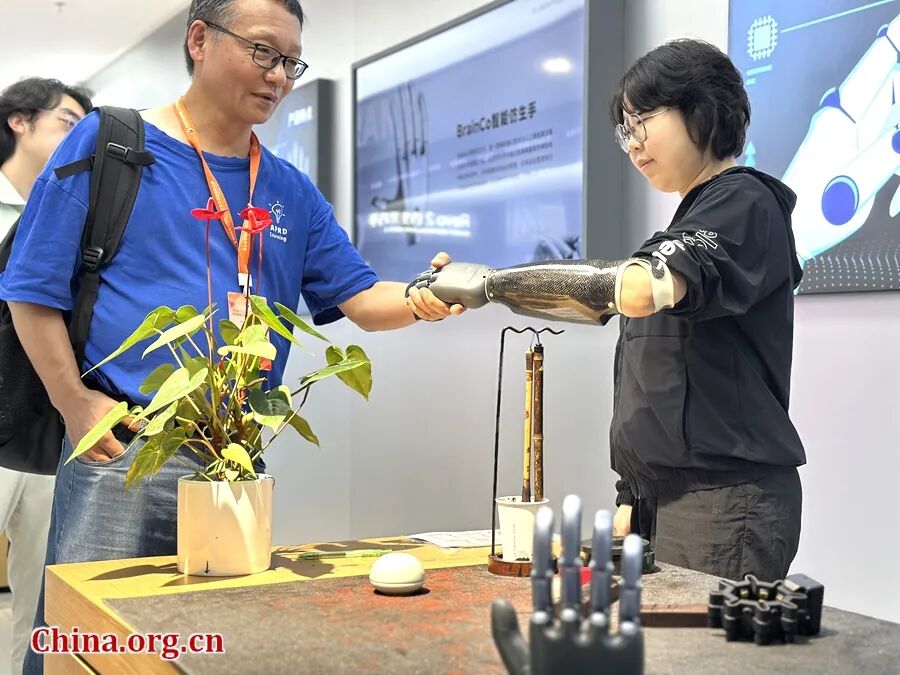
A foreign professional shakes hands with a staff member wearing a bionic arm at the Brain-Computer Interface Science Innovation Demonstration Center in Hangzhou, Zhejiang province, Sept. 28, 2026. [Photo by Wang Ziteng/China.org.cn]
The Brain-Computer Interface Science Innovation Demonstration Center shows how frontier technologies are moving from laboratories toward practical applications. Visitors can try brain-controlled robotic arms, intelligent prosthetic limbs and other technologies. The center also serves as a platform for industrial exhibitions and public science education.
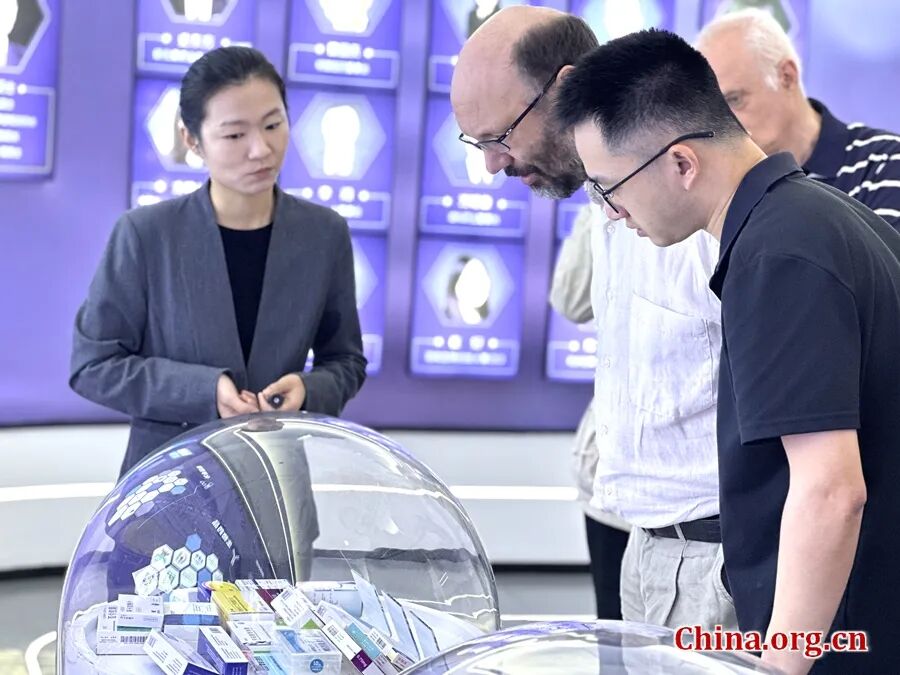
Foreign professionals view pharmaceutical products at China Biopharma Town in Hangzhou, Zhejiang province, Sept. 29, 2026. [Photo by Wang Ziteng/China.org.cn]
In biomedicine, China Biopharma Town is home to more than 1,800 biopharmaceutical companies, with an industry valued at more than 50 billion yuan ($7.46 billion). The town has attracted seven of the top 10 global pharmaceutical companies and hosts 27 high-level innovation platforms. It is building an ecosystem that links its innovation, industrial, talent, policy, financial and service chains.
The Hangzhou Institute of Medicine under the Chinese Academy of Sciences, meanwhile, focuses on major questions at the frontier of medical science and aims to become an internationally leading source of original innovation in the life and health sciences.
Together, these developments help explain why emerging industrial clusters have become a major draw for international professionals in China. The Amazing China survey found that more than 60% of surveyed senior foreign professionals hoped to build long-term careers in China. It also noted improvements in the safety, inclusiveness and convenience of Chinese cities, as well as growing efforts to provide integrated services for foreign talent.
As China advances high-quality development and strengthens its capacity for scientific and technological innovation, cities are playing an increasingly important role in connecting talent, technology, industry and openness.
Hangzhou's experience shows how a city can turn these connections into a source of sustained vitality, becoming both a destination for global talent and a place where that talent can contribute to and share in China's innovation-driven future.
Source: INTERNATIONAL TALENT









 京公网安备11010802044359
Contact Us:86-10-58882453 86-10-58882413