
Rooted in China, Reaching Out to the World —A Profile of Professor Marie Harder, Recipient of the Chinese Government Friendship Award
Jul 22, 2026
ShanghaiIn January 2025, Professor Marie Harder of the Department of Environmental Science and Engineering at Fudan University was awarded the 2024 Chinese Government Friendship Award. This is the highest honor conferred by the Chinese government on foreign experts who have made outstanding contributions to China’s modernization drive and its cause of reform and openingup. As one of the foreign expert awardees, she was invited to attend a symposium hosted by Premier Li Qiang at the Great Hall of the People. For Marie, the honor was not only a recognition, but also a renewed source of encouragement.
Those who know her well understand that Marie is not someone who likes to place the spotlight on herself. She is more at home in the everyday rhythms of life on the Fudan campus-immersed among students and colleagues, gathered around a conference table discussing work, revising plans, and advancing concrete initiatives. She often says her Chinese is limited, laughing as she sighs, “Chinese is so hard to learn.” Yet when faced with Chinese-language materials and complex procedures, she always listens carefully and asks questions proactively. This humi l it y and diligence has become the most distinctive undertone of her fifteen years of work in China.
From Britain to Shanghai, from university laboratories to grassroots communities, from research on urban waste sorting to the exploration of pathways for sustainable development, and in recent years to her role in the toplevel design and preparatory work for Fudan University’s Sustainable Development Institute, Marie's China story is a vivid portrait of a foreign expert earning trust , working with quiet dedication, and making enduring contributions to China.
Taking Root in Shanghai: Understanding Chinese Urban Governance from the Community Frontlines
Marie came to truly understand Shanghai not among skyscrapers, nor in conference rooms, but in its many ordinary neighborhoods.
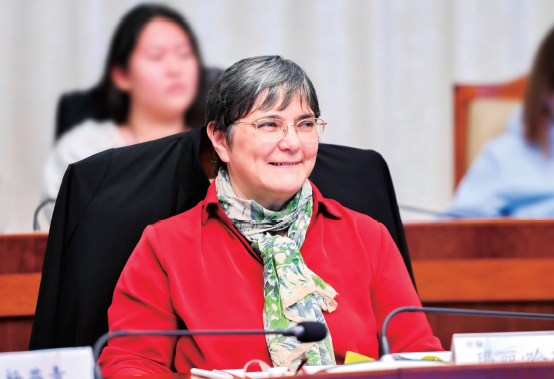
In 2011, Marie first came to Shanghai and began her academic journey in China. In 2016, she was appointed as a full-time Distinguished Professor at Fudan University, continuing to put down roots at Fudan and in Shanghai and devot ing herself to sustainability research. Her concern has never been an abstract notion of the city, but specific people, concrete ways of life, and how sustainable development takes shape in real society.
Since 2012, she has led her team in long-term fieldwork in Shanghai’s grassroots communities, initially conducting research on household waste sor t ing, solid waste management, and community governance. To collect authentic first-hand data, she and her students entered many residential compounds, studied waste sorting sites, and communicated with community workers, residents, and organizations, seeking to understand how people move from “knowing they should sort waste,” to “being willing to sort waste,” and then to “gradually forming a habit.”
This was not an exercise in looking down from above, but a sustained and practical journey of learning. Marie has never positioned herself as an “outside expert.” She prefers to be a listener, a fellow traveler, and a collaborator. In her view, research that is genuinely valuable must begin from reality and ultimately be tested by reality. In the past, professional researchers often worked in laboratories and then applied their innovations to serve society. Today, we need more people-centered solutions. Therefore, researchers must engage deeply with people and understand their diverse wishes and motivations, which may not always be logical—and which cannot be found in any textbook.
Advancing Action Through Research: Making Research Truly Serve Chinese Practice
Shanghai’s waste-sorting work is the starting point for which Marie is best known in China, but it is not the endpoint.
Using Shanghai's waste sorting initiatives as an entry point, she led her team in in-depth interdisciplinary research and gradually developed a theoretical model of sustainable behavioural change, the “Fudan 16 Sustainable Behavioural Change Model”, providing practical, policyoriented advice to help shape waste-sort ing policies and support their implementation on the ground. Mariehas always believed that academic research cannot stop at the level of published academic papers. Sustainable development is neither an empty slogan nor a set of quantitative indicators on paper; it must be genuinely integrated into communities, campuses, and enterprises, and permeate every aspect of urban governance and public services. Her research team has built partnerships with environmental organizations, philanthropic foundations, and others to promote community waste sorting and to facilitate the translation of research findings into practice.
Through this process, Marie developed a clearer academic concern: if the Sustainable Development Goals are to be truly realized, implementation cannot rely only on macro-level initiatives and technological instruments. It must also understand the real needs of local communities, thereby enabling deep integration of scientific theory, local experience, and policy practice. This experiential knowledge, rooted in reality, often does not exist in written form. The basic research methodology she has developed to bridge the gaps that hinder such integration is not limited to a particular country or issue; rather, it aims to help people in different places express their tacit shared concerns more clearly and advance sustainable development design and action at the local level. The insight s she gained from Shanghai’s communities profoundly shaped her thinking. China’s evolving practice, in turn, continued to deepen and broaden her understanding of sustainable development.
Quietly Nurturing Growth: Growing Together at Fudan
At Fudan, Marie is not only a researcher but also a dedicated mentor. Over more than a decade, she has supervised many Chinese and international doctoral students and careful ly nurtured a group of young researchers. She often leads students into communities and field sites, and into the frontlines of international projects, with their work taking them to rural areas in developing countries including Indonesia, India, Nepal, and Senegal. Her bond with students goes beyond academic instruction. She cares about their success as young scholars, and even more about their growth as people. She encourages Chinese students to go out into the world, while also welcoming students from different countries to come to Fudan and learn about China. Her students come from Pakistan, Nigeria, Botswana, Cameroon, India, Mexico, and other countries. They bring development experiences from their own countries to China while also studying China’s practices in urban governance and community governance in Shanghai.
In Mar ie’s view, these students are not simply “international students”, but young partners in a future global cooperation network for sustainable development. They connect Asia, Latin America, and the wider Global South, transforming Fudan's classrooms and research sites into important windows for the world to understand China and connect China to the world.
“China encourages international students and their diversity allows me to train the team about a deep-rooted vision of a ‘community with a shared future for mankind.’ After all these years, we have alumni all over the world who have a shared vision with me, Fudan and China, working in parallel.”
Walking Forward in Openness: Deepening Academic Roots in China
Marie often says that she has learned far more in China than she initially imagined.
“I think Chinese people do not realize how lucky they are to live in a country that has the ‘people’ at its center. In China, I don’t have to spend energy on creating my space to work; I just have to join in the collective framework and spend 100% effort on contributing to humankind. I am very thankful.” Marie says. What Fudan has given her is not merely a workplace or a professorship but more importantly, it has given her a space where she can cultivate long-term work, continue to explore, and grow together with the Chinese academic community.
Marie works closely with her Chinese colleagues, engaging in in-depth collaboration, joint discussion, and shared progress. When academic questions arise, they examine them repeatedly; when policy language is involved, they deliberate together; when administrative matters appear, they break them down and implement
them item by item. Marie often jokes that her Chinese is not good enough, but she listens carefully to her Chinese colleagues as they explain the nuance of a term, the boundary of an expression, and the institutional logic behind a procedure. She respects the Chinese context, and through day-to-day collaboration, has gradually become integrated into China's working system. This humble and eager-to-learn attitude has made her truly part of Fudan University.
China and Fudan, in turn, have responded to her years of deep engagement and dedication with openness, inclusiveness, and trust. From the Shanghai Magnolia
Silver Award and the Shanghai Magnolia Gold Award to the Chinese Government Friendship Award, each honor Marie has received is not only a recognition of her
personal achievements, but also a reflection of China’s respect and warmth toward foreign experts who put down roots locally and contribute with sincerity.
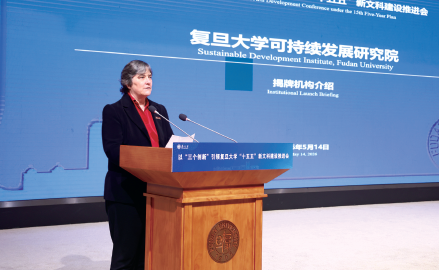
A New Starting Point: Building a Better Future on the Fudan Platform
In recent years, Marie’s work at Fudan University has entered a new stage. Jin Li, President of Fudan University and an academician of the Chinese Academy of Sciences, has called for “Lego thinking” to reshape the disciplines construction. This initiative aims to promote a shift in the university from a purely discipline-based logic toward a logic of serving the needs of science and technology, industry, and society, and to move the university’s focus from “which priority disciplines to build” to “which strategic f ields to serve.” He has proposed that an innovative university should focus on building platformtype organizations, strengthening functions and forms such as foundations, interfaces, hubs, and special zones. The core of university development, in this view, lies not only in producing knowledge, but also in exploring how knowledge can be produced and used more effectively.
This development philosophy is highly aligned with Marie’s long-standing research pursuits. Sustainable development cannot be addressed by a single discipline, a single department, or a single research method. It concerns multiple dimensions, including the environment, society, the economy, and governance. It also tests how different groups understand problems, jointly design solutions, and promote real-world change. It was within this broader context that the Sustainable Development Institute, Fudan University (SDI), was formally established. The Institute is positioned as a university-level platform focusing on major issues of national development and global governance. It integrates research and teaching resources and builds a four-dimensional functional system centered on RE-CoP—Research, Education, Contributions, and Partnerships—thereby reconstructing a complete closed loop of “research–education–practice–governance.”
Entrusted by President Jin Li, Marie participated in leading the top-level strategic design of SDI and supported the preparatory work at every stage, helping to move the institute from concept to establishment. For her, this is not a title, but a weighty responsibility. She deeply cherishes this trust and strongly identifies with Fudan's understanding of the value of a university: not only to produce knowledge, but also to use knowledge to serve society, serve the nation, and serve the common future of humanity.
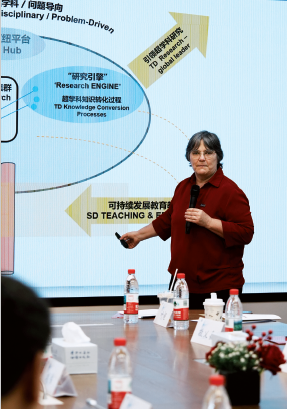
During the preparation of SDI, Marie worked closely with her Chinese colleagues. From clarifying research directions and designing platform functions to improving various application materials, she was involved personally in every step. She never regarded herself as “the designer,” but as an ordinary member of the team. This, too, is a true reflection of her more than ten years of work in China: humble, diligent, reliable, never seeking credit or exaggerating her role, but keeping her feet on the ground and doing every concrete task carefully.
Continuing the Journey Together: Based in China, Reaching Out to the World
Looking back over the past decade in China, Marie’s journey has evolved f rom engaging with Shanghai communities to conducting research on urban governance;
from the practice of waste sorting, she turned to the explorat ion of sustainable development pathways; from Fudan's classrooms, she extended her work into international talent development; and today, she has moved from individual research and team collaboration into the construct ion of a university-level strategic platform at Fudan.
SDI does not aim to become an ordinary research institute. Rather, through transdisciplinary collaboration, talent cultivation, policy translation, and international
cooperation, it seeks to make a portfolio of achievements with Fudan characteristics and global influence. SDI will focus closely on major issues of national development and global governance, help build China’s independent knowledge system for sustainable development, support implementation on the ground, and better tell China’s stories to the world. Looking toward the post-2030 global sustainable development agenda, it wi ll help Fudan University move further from being a responder to international agendas toward becoming an agenda initiator, knowledge contributor, methodological designer, and co-developer of rules.
This is consistent with Mar ie’s many years of internat ional research experience, but she has never interpreted “internationalization” simply as going global. For her, international cooperation that is truly meaningful is about mutual understanding, mutual respect, and joint problem-solving among di fferent countries, regions, and knowledge systems. China's rich practices in urban governance, community building, green transformation, and international cooperation will provide important reference for global development; in turn, practical experiences from around the world will further enrich the understanding of sustainable development among Chinese universities.
In Marie’s view, SDI is more like a bridge. One end connects China’s local practical experience, Fudan University's disciplinary resources, and its talent teams; the other reaches toward the shared chal lenges of global sustainable development, the relevant United Nations agendas, and the common future of mankind. She hopes to continue contributing the practical experience, research methods, and international resources she has accumulated over many years through this platform, working together with more Chinese colleagues to contribute “Fudan wisdom” to the world.
For her, these experiences are not merely a series of “achievement milestones,” but rather an ongoing journey of steady progress. She is not in a hurry to draw conclusions about her own story. She hopes to cont inue working alongside Chinese colleagues to refine plans, discuss research questions deeply with students, enter frontline field sites, and explore how the Sustainable Development Goals can be translated into concrete measures on the ground.
In China, the starting point of work is “for the people”; at Fudan, the pursuit is a deeply rooted form of excellence. What SDI aims to do is to help the Fudan community to use their strengths in new ways, respond to the real challenges facing the world, and enable China’s ideas and practices to be more fully understood and presented on the United Nations stage and the wider international stage.
The spotlight will eventually fade, and medals of honor will one day be carefully put away. But for Marie, the cause that truly matters is still on the road ahead—
at Fudan, in Shanghai, in China, and within the broader shared future of mankind.
Source: INTERNATIONAL TALENT








 京公网安备11010802044359
Contact Us:86-10-58882453 86-10-58882413