
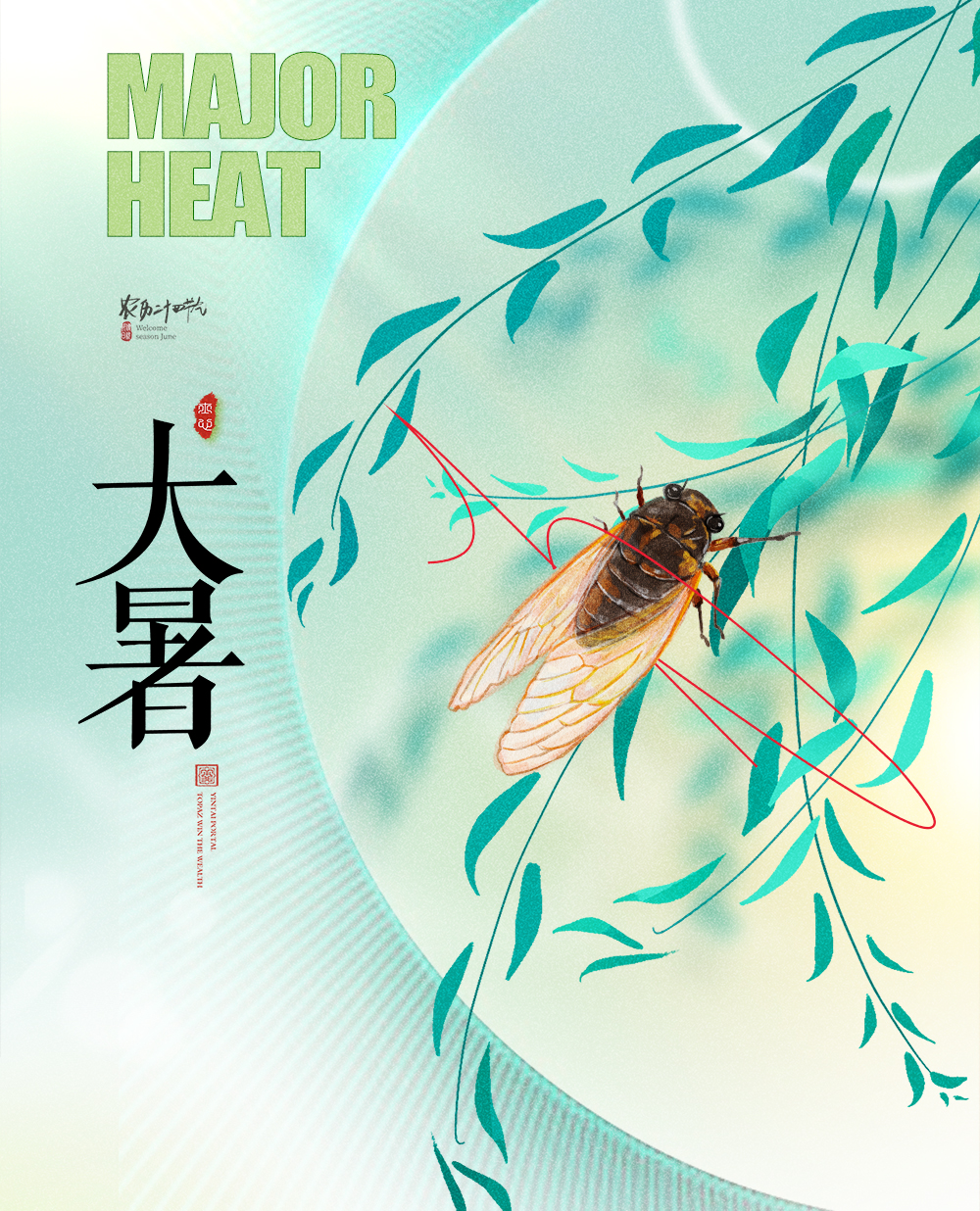
The traditional Chinese solar calendar divides the year into 24 solar terms. Major Heat, or Dashu in Chinese (大暑), is the 12th solar term of the year and the last solar term of summer. It usually falls between July 22 and 24 each year and signals that most parts of China have entered the hottest season of the year. In classical Chinese, the character “Shu” (暑) was compared to “boiling,” delivering an image that the earth is like a pot of boiling water during this time period.
In China, the 24 solar terms were created thousands of years ago to guide agricultural production. But solar term culture is still useful today to guide people‘s lives through special foods, cultural ceremonies and even healthy living tips that correspond with each term.
In the oppressive dog days, time seems to stop as it is broiling both in the morning and the afternoon with the stridulation of cicadas buzzing in the background. Cicadas may stridulate on, but the woods sound even quieter, as a Chinese poem goes. In muggy summer afternoons, dragonflies hover low, preying over a pond in the middle of outspreading green lotus leaves. Fragrant lotus flowers, in bud or blooming, stand gorgeously upright in pink or white.
Three Phenomena (Sanhou)
Ancient Chinese divided Major Heat into three five-day periods, known as sanhou (三候):
- First hou – Fireflies illuminate summer nights. Ancient Chinese found that fireflies usually appeared when Major Heat began. They believed that fireflies were born out of decayed grass. Scientists have since found that fireflies lay eggs in dead grass, and young fireflies mature and fly out during this time, illuminating summer nights like shining stars.
- Second hou – Sweltering summer weather and moist earth. With moist soil, humid air and frequent rainfalls, crops grow vigorously and forecast a bumper harvest.
- Third hou – Heavy rains. The coming of Major Heat often brings thunderstorms, which ease the hot summer weather and lead to the transition to autumn.
Traditional Customs
- Sending the “Major Heat Ship“ – Sending the Major Heat ship is a folk tradition spanning hundreds of years in Taizhou, Zhejiang province. The ship is filled with various animals for sacrifice such as pigs, sheep, chicken, fish, and shrimp. More than 50 fishermen take turns carrying the ship as they march through the streets. Drums are played and fireworks are lit. After a series of ceremonies, the ship is finally carried to the wharf, pulled out of the fishing port, and burned at sea. People carry out this ritual to pray for good harvests and health. In 2021, this ceremony was listed as a national intangible cultural heritage.
- Cricket fighting – Major Heat is a season with the largest number of crickets that can be found in the fields along the countryside. Cricket fighting is a popular pastime for some people in China during this period. The custom dates back more than 1,000 years to the Tang Dynasty (AD 618-907).
Dietary Customs
- Eating litchi – On the day of Major Heat, there is a custom of eating litchi in Putian, Fujian province, as a celebration of Major Heat. Litchi is a nutritious fruit containing glucose and vitamins. It is said that eating litchi during Major Heat is as nourishing as eating ginseng.
- Eating grass jelly (xiancaodong) – In Guangdong, people usually eat grass jelly during Major Heat. It is made with a special grass whose stems and leaves can be made into herb jelly after being dried in the sun. With the ability to quell summer heat, grass jelly is described in a popular saying: ”eating herb jelly in Major Heat will make you stay young like the immortals.“
- Eating mutton soup – There is a custom in southern Shandong province where people drink mutton soup on the day of Major Heat, which is called ”summer mutton soup.“ Many people go to local restaurants to have it.
Agricultural Significance
Major Heat is also a crucial time for farming. During Major Heat, the sunshine, high temperatures, and heavy rainfall are good for agricultural crops. However, like Minor Heat, many natural calamities such as floods, droughts, and typhoons also happen during this period. Therefore, it is important to harvest and plant in time to avoid setbacks caused by natural disasters.
Source:Chinajob









 京公网安备11010802044359
Contact Us:86-10-58882453 86-10-58882413