
An international delegation of foreign experts and national media representatives visited Chengdu, Sichuan province, from Nov. 25 to 28. They explored the city, learning of its strengths in talent attraction, scientific and technological collaboration and the supporting cultural environment.
The delegation visited the Tianfu Changdao Digital Cultural and Creative Industry Service Platform. It was jointly developed by Tencent and key Chengdu High-Tech Zone enterprises with the aim of fostering creativity through a digital and cultural innovation ecosystem. It connects leaders across the gaming, e-sports, digital music, animation and media industries.
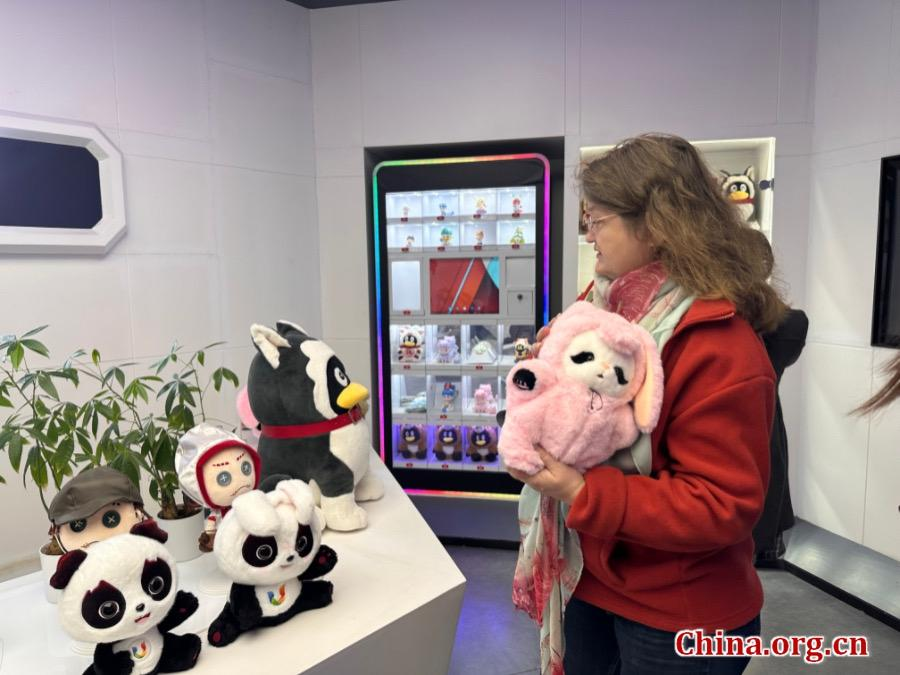
A foreign expert visits the Tianfu Changdao Digital Cultural and Creative Industry Service Platform in Chengdu, Sichuan province, Nov. 26, 2025. [Photo by Yang Chuanli/China.org.cn]
Nathan E. Stott, an expert with experience in South Korea and the U.S., commended the platform's creativity-friendly environment. "In creative fields, you need freedom," he said, noting Chengdu's "laid-back vibe" fosters innovation.
Matt Vegh, a Canadian who has lived in Chengdu for 25 years, highlighted the city's methodical development of the animation industry. "Successes like Ne Zha aren't a coincidence. Over the years, universities have been feeding tens of thousands of highly skilled animators and developers into the industrial base in Chengdu," he stated.
Vegh, whose cultural projects have been optioned by China Film Group, emphasized the crucial role of people-to-people exchanges. He pointed to the overseas-returned Chinese talents and outbound students as key bridges for global cultural and technological cooperation, stating that "genuine collaboration always starts at the grassroots level."
A cornerstone of Chengdu's advanced manufacturing sector is the Chengdu Robot Innovation Center. This is in many ways a case study that showcases China's progress in implementing the 14th Five-Year Plan for the Development of the Robot Industry. Equipped with more than 300 sets of smart manufacturing equipment, the center focuses on the application of robotics in manufacturing, agriculture, energy and logistics. These are all key industries in southwest China.
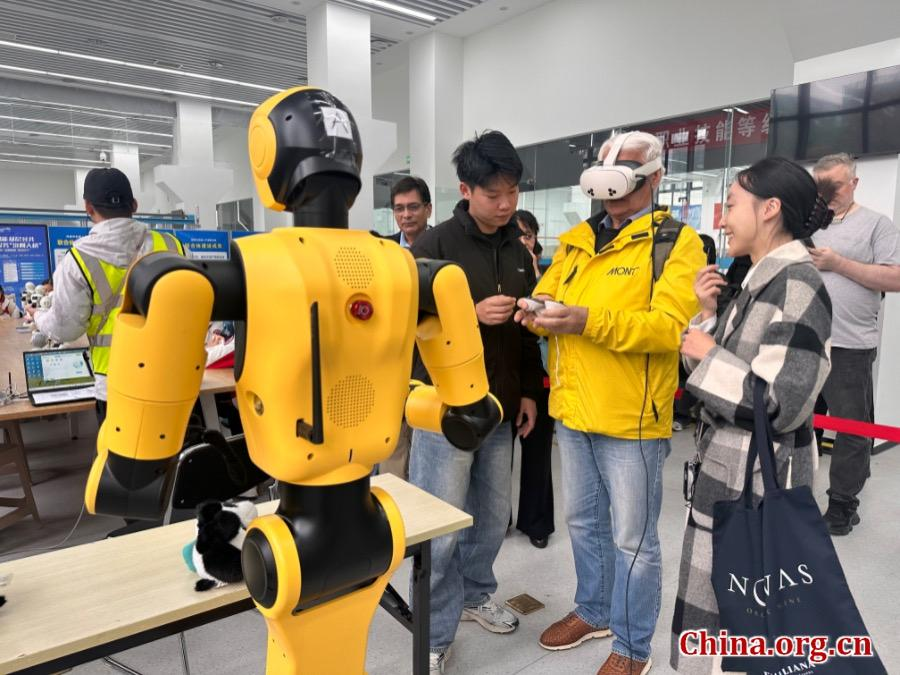
A foreign expert operating a robot at the Chengdu Robot Innovation Center in Chengdu, Sichuan province, Nov. 26, 2025. [Photo by Yang Chuanli/China.org.cn]
Vegh noted that China's sci-tech industrialization during the 14th Five-Year Plan period (2021-2025) has been remarkable. "From chips and robotics to quantum AI, China is either a global leader or among the top-tier players worldwide. What impresses me most is how technology enhances daily life, Chengdu's healthcare services and smart city amenities outperform those of many Western countries."
Stott echoed this sentiment, citing AI breakthroughs by DeepSeek: "China's innovation advantage lies in efficiency, achieving more with fewer resources. DeepSeek's streamlined algorithms have outperformed Western giants at a fraction of the cost, a model we see across multiple sectors."
In the biomedical sector, the delegation visited the City of Future Medicine, a 14.79-square-kilometer park focused on high-performance medical devices, high-end medical services and cutting-edge biotechnology. As a core project within the City of Future Medicine, the Tianfu Jincheng Frontier Medical Equipment Research Institute demonstrated its "medical-engineering integration" model. It addresses core technologies in medical imaging and offers end-to-end services spanning from R&D to market entry.
Wu Zhe, director of the institute, shared their accomplishments, "Over the past decade, we have advanced miniaturized, intelligent, and remote medical devices. Our ultrasound system has been deployed in village clinics, town hospitals, and hospitals in Chengdu's Eastern New Area, and has also been exported to Peru, where it is used to screen for breast cancer, thyroid nodules, and carotid artery diseases in Amazonian communities."
Chengdu has been consistently ranked among the top 10 "Most Attractive Cities for Foreign Expats" list, for seven times. The Chengdu Talent Service Center, with a total area of 2,225 square meters, offers policy consultation, career support and cultural exchanges for foreign talents. This further amplifies the trajectory and building of a global innovation hub. By offering such a foundation, both talents and industry have a home in Chengdu.
"Government support was crucial in our early stages, subsidies helped us survive before product launches, which solved our financial difficulties greatly," noted Ran Peng, CEO of Seamaty Diagnostic Technology (Chengdu) Co., Ltd. He added that the company's products are now sold to 150 countries and regions, with overseas sales accounting for 60% of the total.
The tour is a part of the "Walking into the Glamorous Chengdu" series guided by the Foreign Talent Research Center and sponsored by the Chengdu Municipal Science and Technology Bureau.
As the event came to an end, the delegation recognized Chengdu's emergence as an innovation center, driven by its robust industrial ecosystem, talent-friendly policies, and commitment to opening up. Perhaps for the outsider looking at Chengdu, the words from Vegh offer a perfect summary, "Chengdu's safety, convenience, and cultural richness are unmatched. The world can learn from its model of integrating technology into daily life without sacrificing quality of life."
Source: China.org.cn







 京公网安备11010802044359
Contact Us:86-10-58882453 86-10-58882413