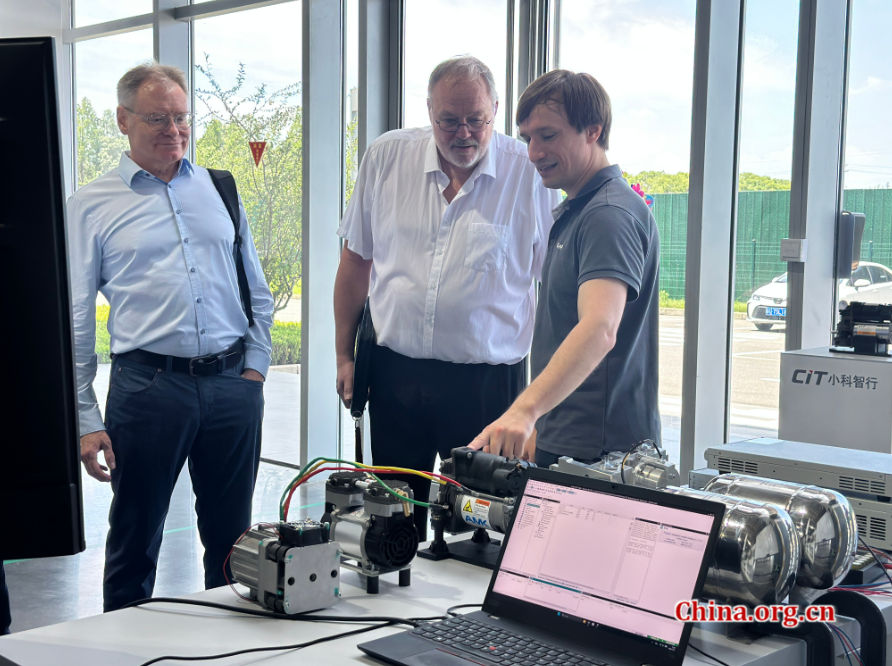
Christopher Praetzas, CEO and CTO of CIT (Taicang) Automotive Technology Co. Ltd., demonstrates the company's products at its production facility in Taicang, Jiangsu province, July 10, 2026. [Photo by Wang Ziteng/China.org.cn]
When Christopher Praetzas arrived in Taicang, in eastern China's Jiangsu province, in early 2023 with plans to launch an automotive technology startup, he expected only a short visit. Within days, he decided to stay. "When we visited Taicang, we could see that the economy was already sprawling," said the German engineer.
His experience mirrors a broader story. What began with a single German investment in 1993 has grown into China's densest hub of German manufacturing — a model built on industrial agglomeration, applied research and vocational training.
Building a German industrial hub on the Yangtze
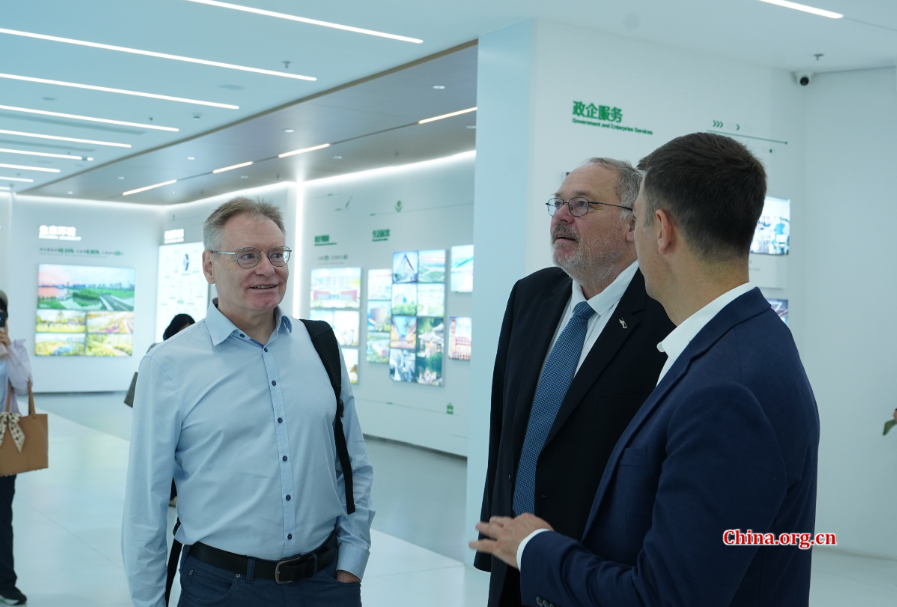
German technical experts view exhibits at the Taicang Sino-German Achievements Exhibition Center in Taicang, Jiangsu province, July 10, 2026. [Photo by Wang Ziteng/China.org.cn]
Kern-Liebers, a family-owned German precision-parts maker, became the first German enterprise to settle in Taicang in 1993. Today, the city hosts China's largest concentration of German-funded companies, which generate 8% of the local GDP. Total investment has exceeded $6 billion while over 90% of early entrants have expanded at least once, many of them three times or more. More than 60 global "hidden champions" — small and medium-sized firms that dominate niche markets — are among them.
The city's industrial base centers on precision manufacturing: automotive components, aerospace, integrated equipment and machine tools. More than 600 local private enterprises now collaborate with German firms in the supply chain, and a growing number of German companies have established regional headquarters and R&D centers in Taicang.
In 2008, the German Federal Ministry for Economic Cooperation and Development and China's Ministry of Commerce jointly designated Taicang as China's first Sino‑German Enterprise Cooperation Base.
Praetzas, whose company CIT (Taicang) Automotive Technology Co. Ltd. develops integrated air-supply systems for electric vehicles, said the decision to settle in Taicang was shaped by more than just government support. "When we arrived here, we were struck by the strong economic momentum and the well-established industrial ecosystem," he said. He noted that his firm relies on a dense network of local suppliers and potential partners, and Taicang offered that from day one.
That emphasis on supply-chain integration is perhaps most evident in Taicang's automotive sector, where the city has built a comprehensive cluster spanning powertrain, chassis, electronics and body systems. With more than 700 suppliers and the ability to source nearly 70% of a vehicle's components locally, Taicang has become a key node in China's electric-vehicle supply chain.
Where R&D follows the factory
For decades, foreign manufacturers in China followed a familiar pattern: design abroad, assemble locally. In Taicang, that formula is changing.
More than 95% of German-funded enterprises above designated size — a Chinese classification for larger industrial firms — have established local R&D operations and applied innovations directly in the Chinese market. Nearly 80% maintain dedicated R&D centers in the city.
"The shift reflects both market scale and technical capability," said Mo Zhenzhou, director of the Taicang High-Tech Zone's Science and Technology Bureau. "China has a sizable market and strong research capabilities. A growing number of German companies are choosing to open R&D centers in China — not simply to adapt products, but to develop new ones here."
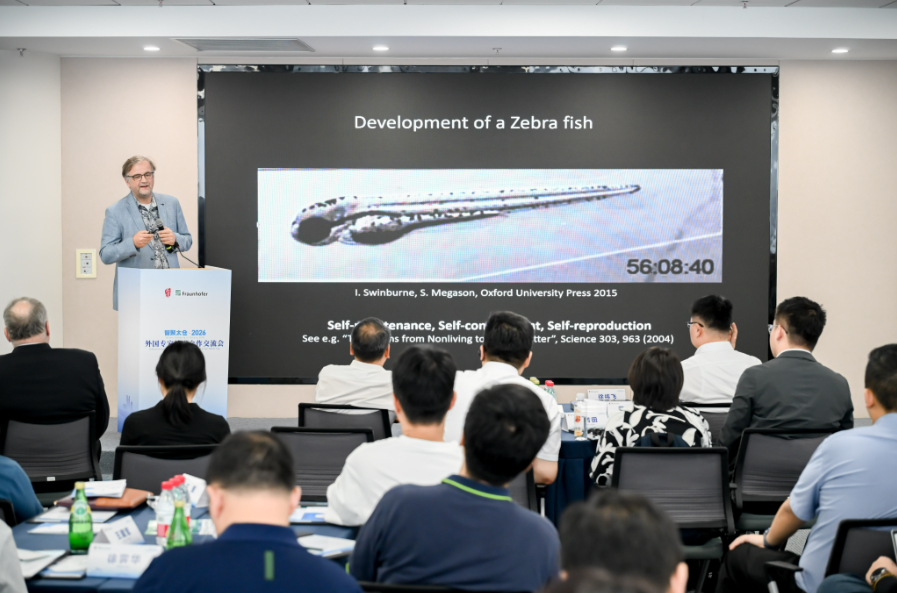
Oliver G. Schmidt, a German technical expert, speaks at a Fraunhofer-Gesellschaft technology exchange forum in Taicang, Jiangsu province, July 10, 2026. [Photo provided to China.org.cn]
In September 2023, Taicang formalized a partnership with Germany's Fraunhofer-Gesellschaft, Europe's leading applied-research organization, connecting local enterprises with more than 70 Fraunhofer institutes for targeted projects in intelligent manufacturing, new materials and new energy.
Xu Yifei, member of the Party Leadership Group of Taicang Municipal Government and head of the Science and Technology Town Mayor Team, described the engagement as a structured departure from convention. "Fraunhofer expert teams have conducted multiple on-site assessments in Taicang," Xu said. "We are moving toward a new paradigm of international science and technology cooperation combining government coordination, business participation and institutional support."
Praetzas's company, which developed a central air‑supply system entirely in Taicang, embodies that trajectory. "Innovation needs talents, and in Taicang many talented employees can be found," he said.
A workforce built to German standards
Industrial agglomeration and R&D depend on a skilled workforce. In 2001, Taicang became the first Chinese city to introduce Germany's dual‑system vocational education — combining classroom theory with in-company apprenticeships. It established China's first training center synchronized with German standards and the country's sole German Chambers of Commerce Abroad (AHK) Sino-German dual-system demonstration base.
Since then, Taicang has launched China's first dual-system undergraduate program and drafted the nation's first local standard for such education. Today, it operates the largest German-qualification examination and training center in China, having produced more than 10,000 certified technicians and management professionals. Fifteen dual-system platforms offer pathways from secondary vocational schools through undergraduate degrees, and a newly opened dual-system industrial park provides training across all levels of the vocational spectrum.
For employers, the system delivers measurable results. "We work directly with local vocational schools to co-develop curricula based on our actual technical needs," said Shen Yanzi, HR manager at CIT (Taicang) Automotive Technology Co. Ltd. "Each year, the partnership supplies us with 12 trained technicians — fully prepared for our production floor."
Praetzas, who employs a mixed Chinese-German team, views the vocational infrastructure as a strategic asset. "Taicang built a lot of different educational systems, which provides us with a big pool of potential employees," he said.
More than three decades after the first German company arrived, Taicang has developed into a manufacturing ecosystem where industrial clustering, applied research and workforce development reinforce one another — a combination that continues to attract companies and entrepreneurs like Praetzas.
By Wang Ziteng
Source:www.china.org.cn








 京公网安备11010802044359
Contact Us:86-10-58882453 86-10-58882413