
The Tea Road was a long-distance trade route between China, Mongolia and Russia, with tea the main commodity. It emerged in the late 17th century as a significant international trade route across the Eurasian continent after the decline of the Silk Road.
The route began in Chong'an (now Wuyishan city) in Fujian province, passing through Jiangxi, Hunan, Hubei, Henan, Shanxi and Hebei provinces, and Inner Mongolia autonomous region, entering Mongolia through Ereenhot, winding along the Altay military post road, crossing the Gobi Desert, and eventually reaching the trading port of Kyakhta on the China-Russia border via Küriye (now Ulaanbaatar). The total length of the route was about 4,760 kilometers, with 3,280 km of this on land and the other 1,480 km on water.
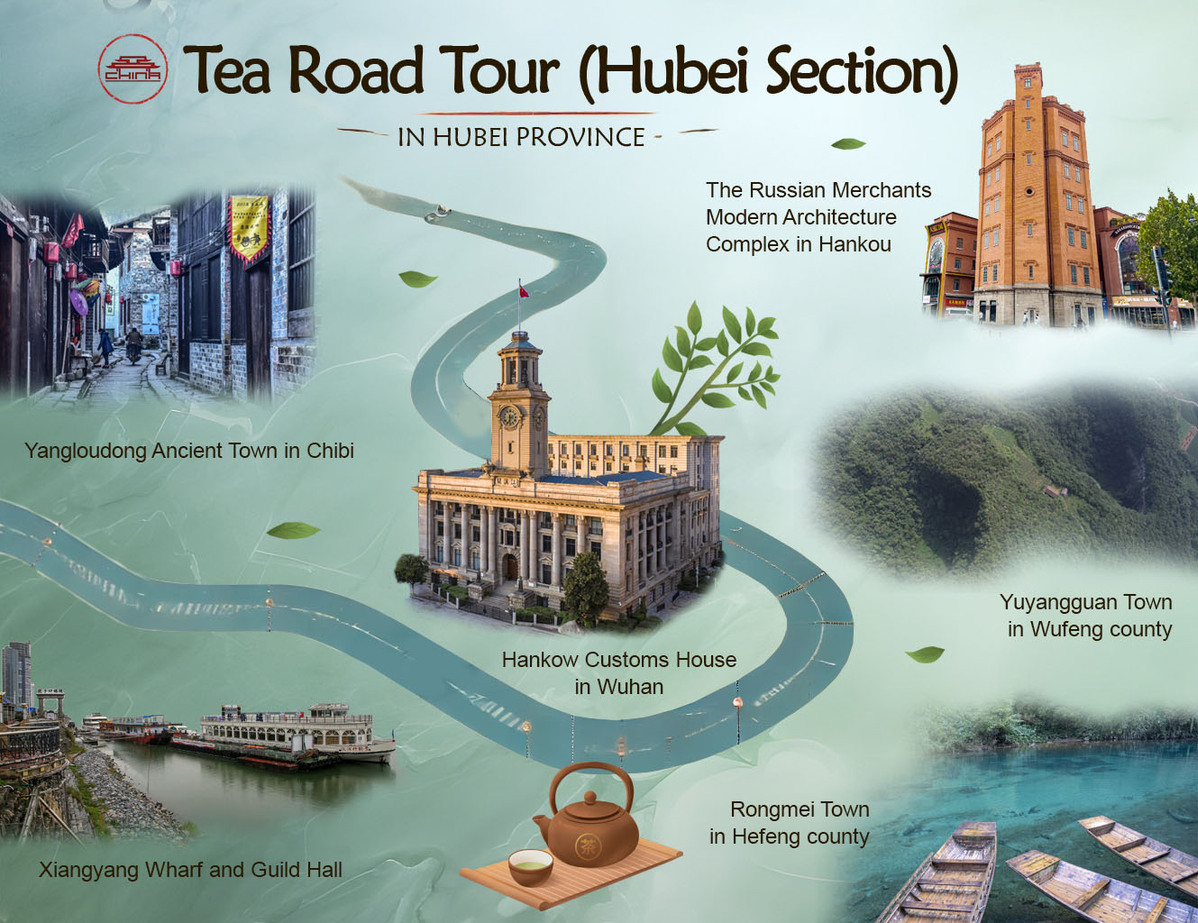
The "Tea Road Tour (Hubei Section)" passes through major cities that include Xianning, Enshi, Wuhan, Yichang and Xiangyang. Attractions along the route include:
The Russian Merchants Modern Architecture Complex in Hankou
Hankow Customs House in Wuhan
Xiangyang Wharf and Guild Hall
Yangloudong Ancient Town in Chibi
Yuyangguan Town in Wufeng county, and Rongmei Town in Hefeng county
( Source: chinaservicesinfo.com)
Source: en.hubei.gov.cn
















 京公网安备11010802044359
Contact Us:86-10-58882453 86-10-58882413