
Exhibition at Suzhou Museum shares stories of China-foreign craftsmanship exchanges
Apr 13, 2026
Suzhou 2026.04.13 - 2026.05.10At the ongoing ancient lacquerware exhibition at the Suzhou Museum, Jiangsu province, one particular piece commands attention: executed in black lacquer and richly ornamented with carved lacquer motifs and mother-of-pearl inlay, the incense stand is supported on four gently outward-curving legs.
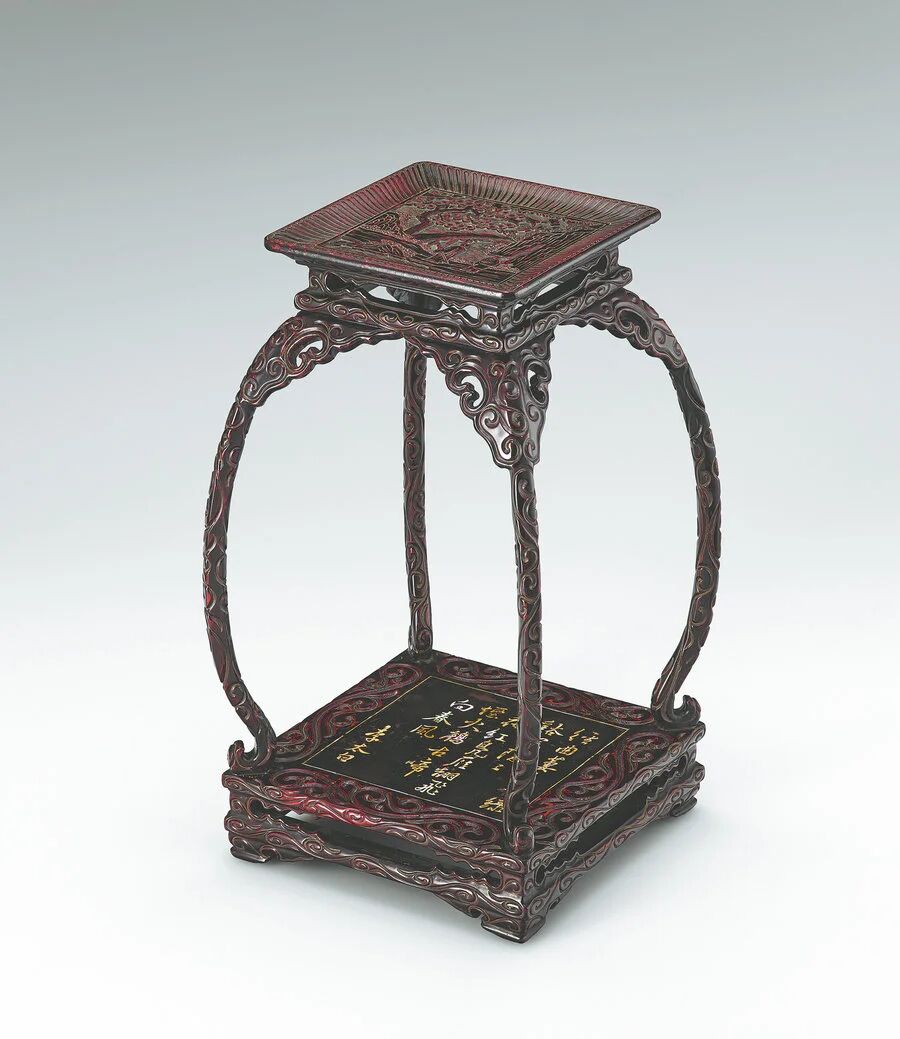
A lacquer incense stand made in Japan between the 18th and 19th centuries. [Photo provided to China Daily]
At the center of its base, Village Dwelling, a poem attributed to Li Bai (701-762), one of the most worshiped poets of ancient China, is rendered in shimmering mother-of-pearl. Above, the tabletop is carved with a pictorial scene that echoes the poem's imagery, both likely derived from the illustrations and verse in the Tangshi Huapu (Illustrated Anthology of Tang Poetry), first printed in China during the Ming Dynasty (1368-1644).
"The piece speaks as much to its patron's devotion to Chinese poetry — above all to Li Bai — as to the refinement of the lacquer craftsmanship of Japan, where it was made during the Edo period (17th-19th centuries)," says Xi Zhe, the exhibition's curator.
"Somewhat amusing, if not ironic, is that the patron, who likely worked from a copy of the book transmitted to Japan, would have had no idea that its compiler had made a significant error in attributing the poem to Li Bai, which we have identified in light of what is known about the transmission of his poetry across the centuries," Xi continues. "However, this does nothing to diminish the value of the piece as a testament to Japan's historical enthusiasm for Chinese literature and lacquerware.
"Li Bai lived during the Tang Dynasty (618-907). And for those who might question the extent of Tang's influence on its neighbor, the exhibition presents a telling example: a red lacquer tray accompanied by a paper document identifying it, in Xi's words, as an "authenticated Tang treasure".
"The appraisal was conducted in Japan on an object believed to have been transmitted from China, presumably by individuals with the requisite expertise," Xi notes. "Such a designation would have conferred considerable value upon the piece.
"According to Xi, lacquer techniques were first introduced to Japan from China within the first few centuries AD, and were more fully absorbed and developed during the Asuka and Nara periods (6th–8th centuries), a span that broadly corresponds to the Tang Dynasty.
In this, they bear witness to a long continuum of cultural and artistic exchanges across East Asia, one that also encompassed the transmission of Buddhism and the practices of tea preparation and consumption, closely intertwined with the rise of Chan Buddhism in China and its subsequent development in Japan, where it came to be known as Zen.
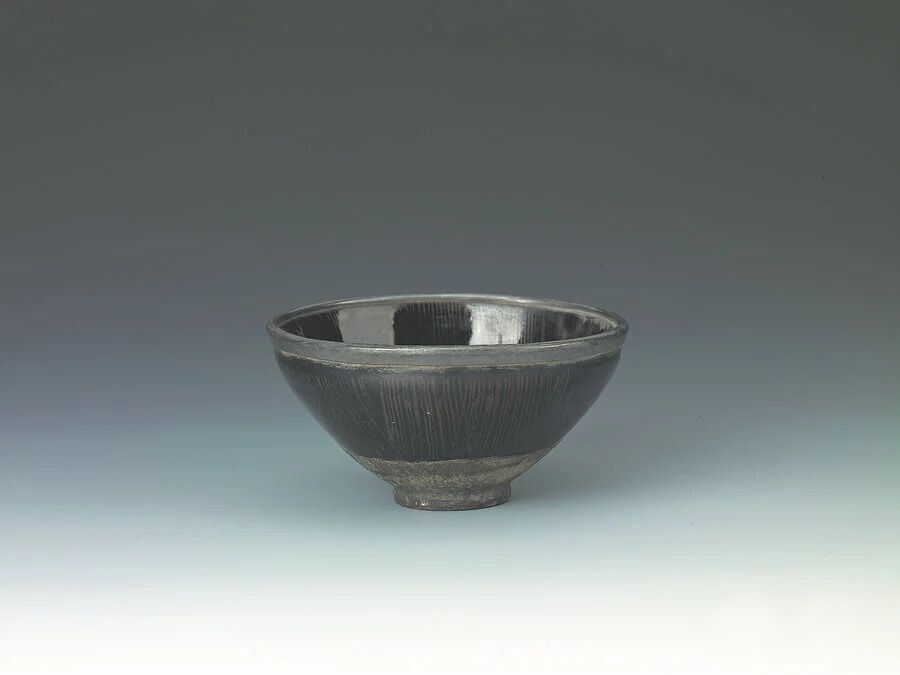
A black lacquer tea bowl, its interior subtly decorated with hair-thin, intermittently shimmering gold lines to evoke the famed "hare's-fur" porcelain. [Photo provided to China Daily]
On display at the exhibition is a black lacquer tea bowl, its interior and outer wall subtly decorated with hair-thin, intermittently shimmering golden lines. These evoke the famed "hare's-fur" porcelain tea bowls of the Song Dynasty (960-1279), in which iron-rich glazes fired at high temperatures produced fine, streak-like markings resembling the soft strands of a hare's fur.
According to Clarissa von Spee, curator of the 2023 exhibition China's Southern Paradise: Treasures From the Lower Yangzi (Yangtze) Delta, held at the Cleveland Museum of Art in the United States, during China's Tang and Song dynasties, novice monks from Japan and the Korean Peninsula came to the region where, taught in monasteries by Buddhist masters, they received an education that was not only religious, but also literary, aesthetic and philosophical.
A minimalist aesthetic, coupled with a cultivated regard for antiquity, found ready resonance in Japan.
However, with lacquer art, Japanese artisans didn't simply preserve what they learned; they transformed it, technically and aesthetically, most notably through maki-e, in which gold or silver powder is delicately sprinkled onto wet lacquer and sealed through successive layers. The result is decorative brilliance and a surface where light is carefully modulated and controlled.
Also added is a marked preference for mother-of-pearl inlay, whose shifting iridescence offers a counterpoint to the steady glow of metal, a practice facilitated by the country's ready access to marine resources.
With its emphasis on precision and restraint, the latter achieved through a measured use of pictorial emptiness in the depiction of nature and the seasons, the technique reached a highly refined, codified form during the Edo period. In this phase, its influence extended not only to Europe but also, in a reversal of earlier transmissions, back to China during the Qing Dynasty (1644-1911).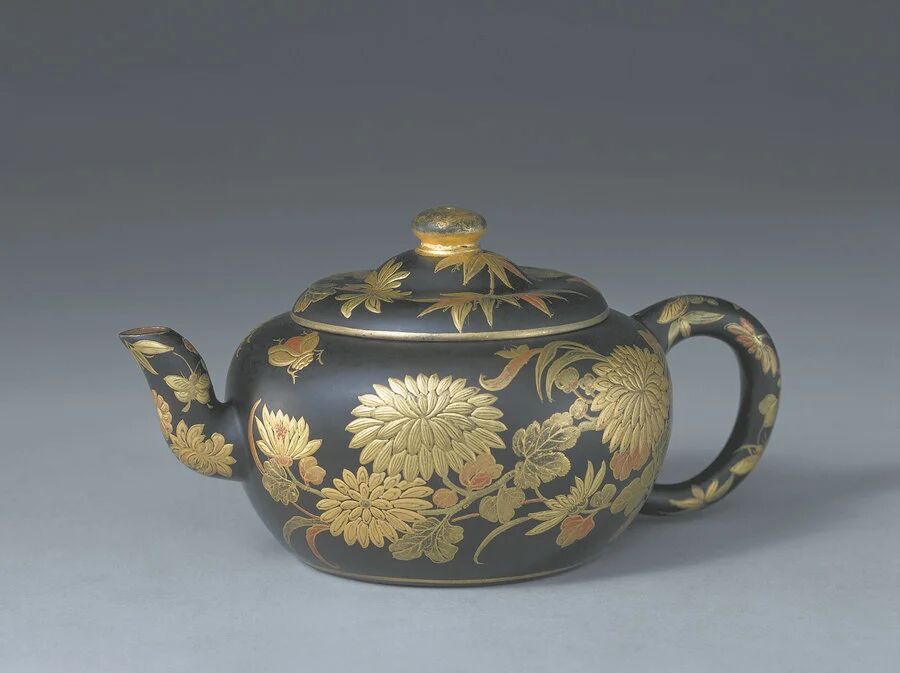
A handled teapot with floral motifs, produced by imperial workshops during the Qing Dynasty (1644-1911). [Photo provided to China Daily]
The ongoing exhibition includes several works that attest to this two-way exchange. Among them, a lacquer fan, a rectangular box with a parcel-wrapping motif, and a handled teapot with floral decoration — the latter two from the Qing imperial collection. In these pieces, gold set against black, whether a delicate sprinkling or in painted petals, speaks to the adoption of Japanese lacquer artistry by Chinese practitioners.
Meanwhile, by the 18th century, Chinese lacquerware already played a significant role in shaping the European taste for Chinoiserie — a style that draws on imagined or adapted elements of Chinese art, reinterpreted through a Western lens — its distinctive visual language finding expression across a range of media, from furniture to interior decoration. In this context, lacquerware also formed part of the imperial gifts presented by the Qianlong emperor to the Macartney Embassy of 1793, a British diplomatic mission sent to the Qing court in hopes of expanding trade between the two countries.
Yet the embassy did not achieve its immediate aims. The Qing court, confident in the sufficiency of its system, saw little need to accommodate such demands, while British interests lay less in objects of refinement than in the expansion of trade on terms favorable to their own commercial ambitions, which would, in time, be pursued through invasion.
The Qing court's loss in the Opium Wars led to the signing of unequal treaties and the opening of ports. Set against this broader trajectory, the lacquerware once presented as diplomatic gifts appears in a more complex light: not only as an expression of aesthetic accomplishment, but as a quiet prelude to a changing world in which the balance of power had decisively shifted, redefining the terms of cross-cultural encounters."In lacquerware, utility and beauty are never apart: it holds, it adorns, it endures. It is a bearer of daily use and of histories long past," Xi says.
Trilogy in LacquerThe Art of Chinese Lacquerware from the Song to Qing Dynasties
Time: Till May 10
Venue: Suzhou Museum West苏州博物馆西馆
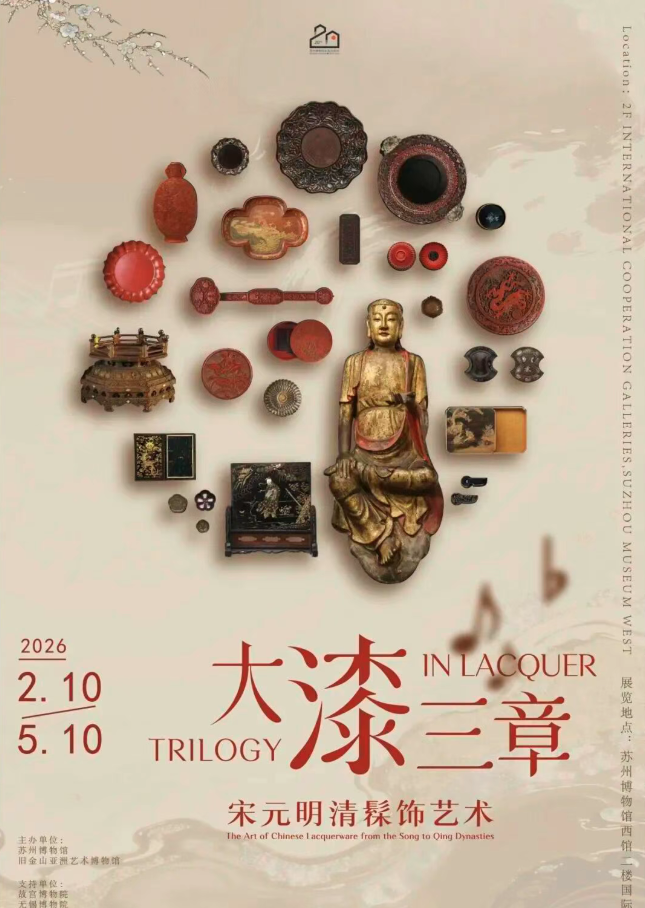
As Suzhou Museum's first exhibition on lacquerware, the exhibition is based on lacquer pieces from the collection of the Asian Art Museum of San Francisco and artifacts from eight museums across China, featuring 175 pieces/sets of exquisite objects, including Song- and Yuan-Dynasty lacquerware and Ming- and Qing-Dynasty imperial court lacquer pieces.
Source: China Daily









 京公网安备11010802044359
Contact Us:86-10-58882453 86-10-58882413