
In the golden autumn season, the 250,000 mu (approximately 16,667 hectares) of pear orchards in Zhao County, Shijiazhuang, are heavy with fruit. On September 4, our reporter visited the ancient pear orchard in Nanzhuang Village, Fanzhuang Town. Among the gnarled and vigorous branches of centuries-old pear trees hung plump, golden snow pears, their weight bending the boughs—everywhere radiated the atmosphere of a bountiful harvest.
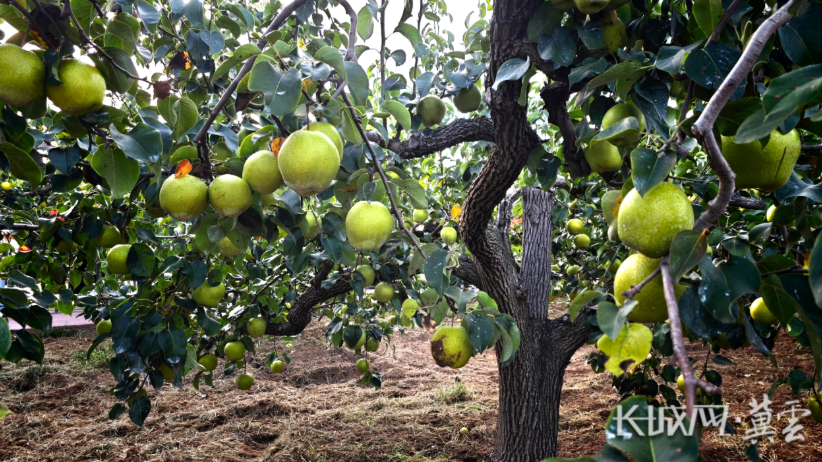
The ancient pear orchard in Nanzhuang, Zhao County, Shijiazhuang. (Photo by Zhu Haoming)
Zhao County, Shijiazhuang, lies in the south‑central part of the North China Plain, enjoying abundant sunshine and fertile soil. With a pear‑growing history of over 2,000 years, it is known as the “Hometown of Chinese Snow Pears” and a “National Key County for Quality Pear Production.” The ancient orchard in Nanzhuang is situated on the south side of Huixin Road, west of Nanzhuang Village. It contains over 3,000 ancient pear trees in a contiguous area, among which 15 are more than 500 years old and the oldest is 800 years old—making it one of the largest ancient pear tree communities in Zhao County.
“These old trees are treasures passed down from our ancestors. Though aged, they produce pears with fine texture, abundant juice, and outstanding quality,” said pear farmer Master Li, who was picking fruit in the grove. He added that for a long time, the county’s pears were all brought to market in the autumn, and the ancient orchard faced two major challenges: on one hand, the old trees are precious agricultural heritage and cannot be over‑commercialized; on the other hand, relying solely on fresh fruit sales left the industry vulnerable to market fluctuations, with significant losses from secondary‑grade fruit.
To break through these development bottlenecks, Zhao County has in recent years leveraged its local resource advantages, deeply exploring the integration of agriculture, culture, and tourism. Scenic walking trails and viewing platforms have been built within the orchard, allowing visitors to experience picking, touch the ancient trees, and immerse themselves in the millennia‑old pear‑farming culture. The combination of sightseeing, fresh‑fruit picking, and agricultural study tours has turned the ancient pear resources into tourist traffic, driving surrounding villagers to develop farm‑style dining and local product sales—letting the locals benefit from tourism.
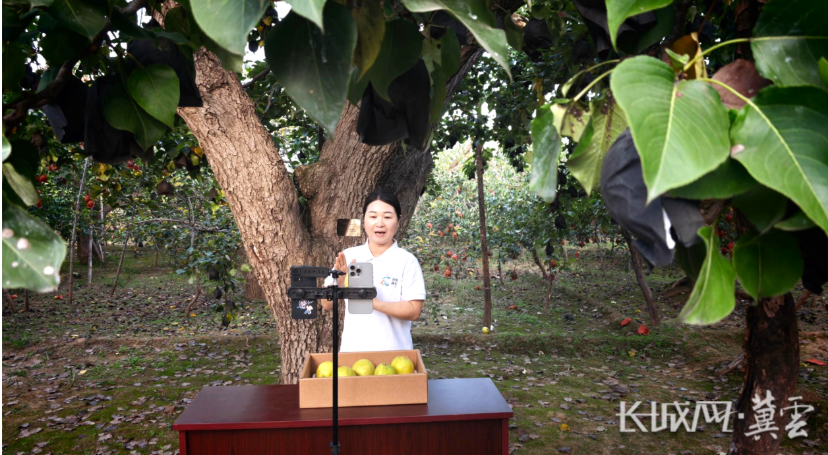
A pear farmer livestreaming in the orchard. (Photo by Zhu Haoming)
In addition, Zhao County has vigorously promoted the development of deep‑processing industries for pears, relying on its unique ancient tree resources. Some of the fruit is supplied to processing enterprises to make traditional pear paste, dried pear slices, snow pear tea, baked pears, canned pears, and other products. This achieves full‑utilization of the ancient pear fruit and broadens income channels for farmers.
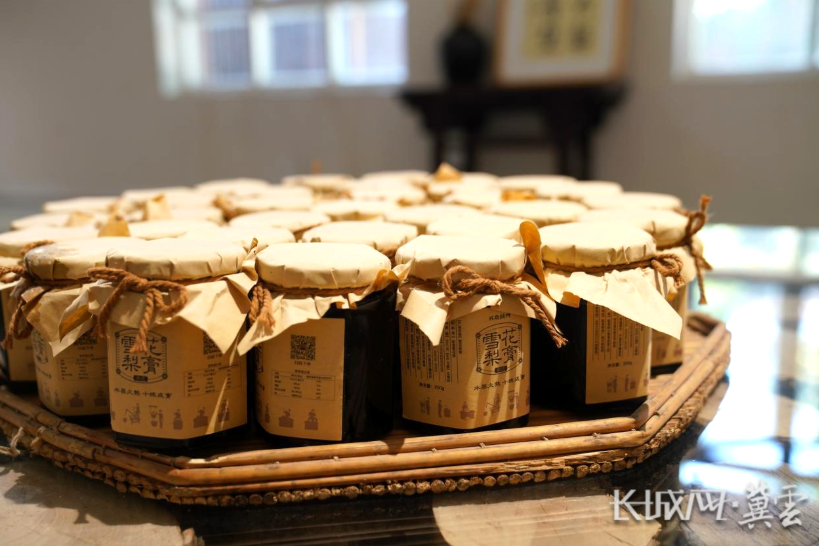
Pear paste produced at the “Meet Zhaozhou” Common Prosperity Workshop. (Photo by Zhu Haoming)
Walking into the “Meet Zhaozhou” Common Prosperity Workshop in Dashiqiao Village, Zhaozhou Town, one finds dozens of copper pots steaming with fragrant pear aroma. Located just next to the Zhaozhou Bridge scenic area, the workshop operates under a “village collective + enterprise + cooperative” model. The formerly idle old school buildings have been revitalised, with old classrooms converted into pear‑paste boiling workshops, intangible‑cultural‑heritage experience zones, and pear‑culture exhibition halls.
“We adhere to the traditional eight‑art ancient method of making Zhaozhou snow pear paste. Every step—from washing and crushing the snow pears, to steaming, grinding, filtering, and slow‑simmering to concentrate the paste—is strictly controlled,” said Liu Chang, the principal of the “Only Zhaozhou” Snow Pear Paste Scenario Workshop in Zhao County. All the snow pears used by the workshop come from local orchards in Zhao County. Villagers from nearby areas can also find employment close to home, working on tasks such as packaging pear paste, applying labels, and packing shipments, which enables left‑behind rural labourers to earn income without leaving their villages.
Furthermore, to expand into the young consumer market, the workshop has innovatively launched pear‑infused coffee, combining the unique sweetness of traditional pear paste with the richness of coffee—a blend that has won favour with many consumers.

AI‑powered unmanned coffee machine. (Photo by Zhu Haoming)
“Now, to reach an even wider young consumer market, the pear‑paste coffee has taken on a new form. We are in the process of deploying 100 AI‑powered unmanned coffee machines, which will be placed in universities and hospitals in surrounding areas. I hope that through these machines and new products, we can promote our offerings to the national market and let Zhao County’s snow pears go even further,” Liu Chang said.
From orchard branches to processed transformations, a single snow pear gives rise to a diverse range of product forms. Deep processing is not simply about turning pears into paste or canned fruit—it represents an upgrade in industrial thinking. Next, Zhao County will further advance the “Zhaozhou Snow Pear” brand revitalisation project, deepen innovation in the pear industry, and broaden development paths, so that this thousand‑year‑old Zhaozhou pear can gain new vitality.
Source:www.hebei.gov.cn
















 京公网安备11010802044359
Contact Us:86-10-58882453 86-10-58882413