
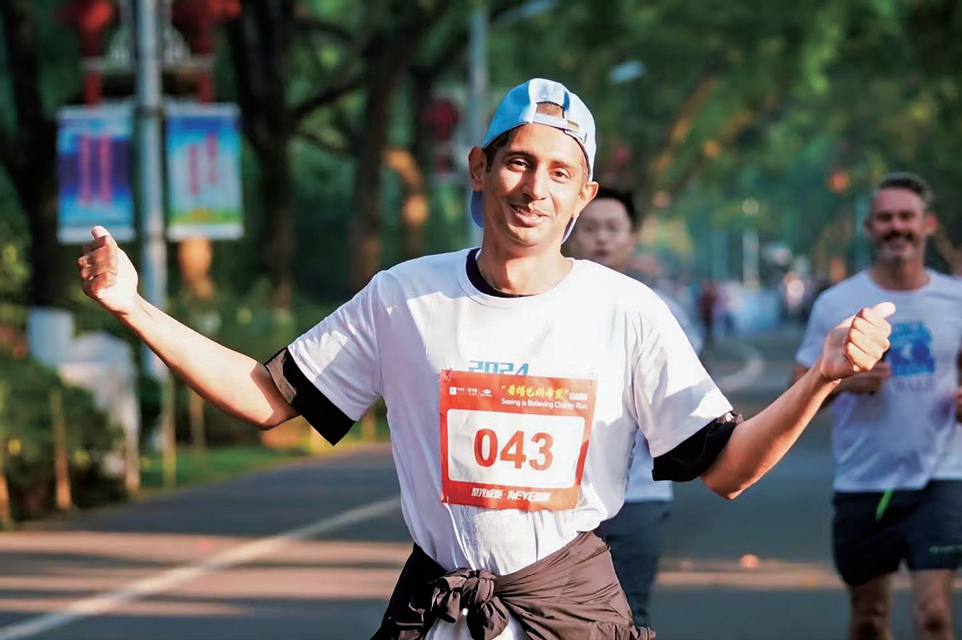
In 2008, I landed in Changsha with a suitcase and a handful of Chinese phrases. Seventeen years later, I leave my home here each morning with a stethoscope, a research agenda, and a family. My Chinese name is 可汗阿德,and this is the story of how a city’s speed and warmth turned my ambition into a life.
My Journey in Medicine: From Student to Bridge-Builder
My path wound through the halls of Hunan University of Chinese Medicine to the laboratories of Central South University, where I earned my Master’s and PhD in Ophthalmology. Today, at Aier Eye Hospital Group, I serve as an Assistant to the Dean and a postdoctoral researcher, working to bridge clinical practice, scientific inquiry, and institutional development.
I’ve learned that medicine transcends science; it is about people, systems, and trust. A patient’s anxiety dissolves with respect, a family exhales when they understand their care, and a young doctor blooms with support. These moments form the universal language of healthcare. This is the ethos I have absorbed in Changsha, a place where global standards meet profound human connection.
Witnessing a City’s Metamorphosis
When I first arrived, Changsha hummed with a raw, ambitious energy. What I’ve witnessed since is a metamorphosis deeper than skyscrapers and subways; it’s etched into the city’s social fabric and professional soul.
Changsha’s ascent has been relentless yet deliberate. It has cultivated a fertile ecosystem for growth, especially in long-term fields like healthcare and research. For an international professional, this is vital. A city becomes a true home when it allows you to sink roots through efficient processes, supportive services, and genuine openness.
I've felt this progress in tangible ways: seamless connectivity, vibrant academic networks, and clear pathways for global collaboration. The city now possesses a global confidence, yet it holds fast to its local soul. This rare balance is what anchors those of us who choose to build our futures here.
The Deeper Business of Healing
True "business opportunity" here is broader than profit. Changsha is building an ecosystem where good ideas become reality, fueled by talent, momentum, and mature platforms for cooperation.
This is critical in healthcare, which requires stable institutions, clear vision, and a culture of execution. Changsha's strengths—its academia, growing medical industry, and expanding openness—create a unique space for international professionals to contribute meaningfully. It's a place where global knowledge is not just imported, but adapted, improved, and made locally relevant. That cycle saves and improves lives.
In my role, I often stand at a crossroads: translating clinical needs into operations, turning research into practical tools, and bridging cultures to build trust. This work matters because borders should confine neither healing nor innovation.
The Personal Foundations: Kindness and Family
My perspective was forever shaped during my Master's studies. Overwhelmed by work, I pushed myself to the point of collapse. My supervisor, Professor Lin Ding, responded not with criticism, but with profound humanity. He prioritized my health, mandating rest and checking on me daily. He taught me that the core of any great institution is respect for the individual—a lesson I carry into hospital leadership every day.
Beyond career, people stay for the life they build. China's greatest gift to me is my family—my wife and our daughter. Becoming a "Changsha son-in-law" is a daily reality of belonging. I remember the patient guidance of my Chinese family as they helped me navigate complex residency formalities, their quiet support transforming a process into an act of welcome. That is the kindness that turns a foreign land into a true home.
One evening, I was visiting my wife's family, and I tried to be "polite in a foreign way." I kept saying, "It's okay, it's okay," refusing help, refusing more food, and refusing attention. I thought I was showing respect by not taking up space. But in Changsha, refusal can sound like distance. My mother-in-law paused, looked at me for a second, and quietly asked my wife, "他在这里觉得不自在吗?"("Is he uncomfortable here?")

That question hit me hard, not because anyone was angry, but because it revealed the cultural gap so clearly. In my own culture, independence is considered considerate. In their home, being cared for is part of being family.
So the next time she offered me food, I didn't do the automatic foreign "no, thank you." I nodded and said a simple "好"("OK"). And when she poured tea, I stood up to receive it with both hands. The room felt instantly warmer, as if a door had opened. Later that night, my father-in-law patted my shoulder and said something like, "That's right. Don't be a guest." I didn't need perfect Chinese to understand what he meant. That moment taught me something I still carry: in Changsha, love often speaks through small insistences, another bowl, another cup, another "come sit closer."
There's a market near where I live that I used to treat like a simple place to buy vegetables. But over time, it became something else: a place that quietly "raised" me into local life. The first few times I went, I was just the foreign face people stared at, smiled at, and spoke to too fast for me to keep up with. I would point, pay, and leave quickly, feeling like I was borrowing someone else's world.
Then one morning, an older vendor noticed me struggling to choose ingredients for a home meal. She watched my clumsy pronunciation, then said, almost like a teacher, "No, not that one, this one." She handed me better greens, then added an extra handful without charging me. When I tried to refuse, she waved her hand as if I were being ridiculous. "你是女婿嘛,"("You're a son-in-law!") she joked.
From that day on, the market changed. People began recognizing me. Someone would call out, "Today you cooking spicy or not?" Another vendor would remind me to bring a bag when it might rain. It sounds small, but it was emotional for me: I wasn't just shopping anymore. I was being noticed, and in Changsha, being noticed is often the first step to belonging. I realized that this city's warmth doesn't always come from big speeches. Sometimes it comes from a stranger giving you the "right" vegetables and treating you like you already have a place here.
An Evening by the Xiang River: Where I Knew I Belonged
One memory, soft as the river mist, captures why my heart is here. During the Dragon Boat Festival, my family took an evening stroll at Juzizhou.
The riverside was a tapestry of communal peace. Children darted like fireflies, while the murmur of elders blended with the city's distant hum. Across the water, the skyline's lights danced on the current.
At a small booth, volunteers were making zongzi. An auntie, her hands moving with a lifetime's muscle memory, saw my daughter watching. With a smile of pure neighborly welcome, she waved us over and gently guided my daughter's small hands, teaching her to fold the leaves and tie the string.
My daughter's first zongzi was lopsided, a delightful mess. When she held it up, the volunteers applauded—not for perfection, but for participation and belonging. A stranger then gave her a fragrant sachet for "safety and good luck," which she clutched like treasure.
Walking hand-in-hand with my family along the ancient river, a truth crystallized with serene clarity: Changsha was no longer just where I studied. It had become the soil for my daughter's memories, the harbor of my wife's contentment, a place where a stranger's kindness felt like family. In that moment, I was filled with a profound, settled joy—the quiet kind that whispers rather than shouts, and lingers for a lifetime.

One night, after a long day, I was heading home when a sudden rainstorm arrived, one of those storms that feels like the sky has opened. My umbrella flipped inside out, my shoes got soaked, and I stood under a shop awning, feeling frustrated and completely out of rhythm with the city.
A delivery rider pulled up nearby and also took shelter. Without a big conversation, he pointed at my broken umbrella, laughed, and then very naturally shifted his scooter slightly to make more space for me under the cover. A few seconds later, a woman from inside the shop came out with a handful of tissues and silently offered them to me: no dramatic kindness, no performance, just calm, practical care. The rain kept falling, and for a moment I felt something unexpected: relief, and a kind of quiet emotion I didn't know how to explain.
When the rain eased, the rider gestured toward the road and said a simple phrase: "走咯." (Let's go.) That tiny sentence, so ordinary, felt like encouragement. I walked home with wet sleeves and a lighter heart. That night reminded me: Changsha moves fast, yes, but it also has a way of carrying people forward, especially when you're tired and far from your original home.
Changsha's growth is not just in its speed, but in its depth—its ability to support a meaningful life and long-term contribution. It gave me more than a career; it gave me a home, a family, and a purpose: to be a bridge, through medicine and understanding, in the city that embraced me as its own.
Source: International Talent Magazine









 京公网安备11010802044359
Contact Us:86-10-58882453 86-10-58882413