
Falling in love with Guangzhou's greenery and warmth, a Greek student has developed a special bond with China through the Guangzhou Award.
Apr 08, 2026
GuangzhouSince its establishment, the Guangzhou Award has been dedicated to identifying and promoting outstanding practices in urban innovation worldwide. In recent years, the Award has also explored more diverse ways to support winning cities beyond recognition.
In 2024, the Guangzhou Award Secretary partnered with Guangzhou University to launch an international scholarship program for awarded and shortlisted cities. Jointly implemented by the Secretary and the University’s School of Education, the program supports participants in coming to Guangzhou for study and exchange.
At the 6th Guangzhou Award, the project “Cultural H.ID.RA.N.T.” from Halandri, Greece, was selected as a winning initiative and received a scholarship placement. Dimitrios Prokos Juan is one of its beneficiaries. As a student from an awarded city, he came to Guangzhou University to study Chinese. After completing one semester, he chose to continue his studies. During his time on campus, he has performed well academically and developed a deeper understanding of China’s urban development and social culture.
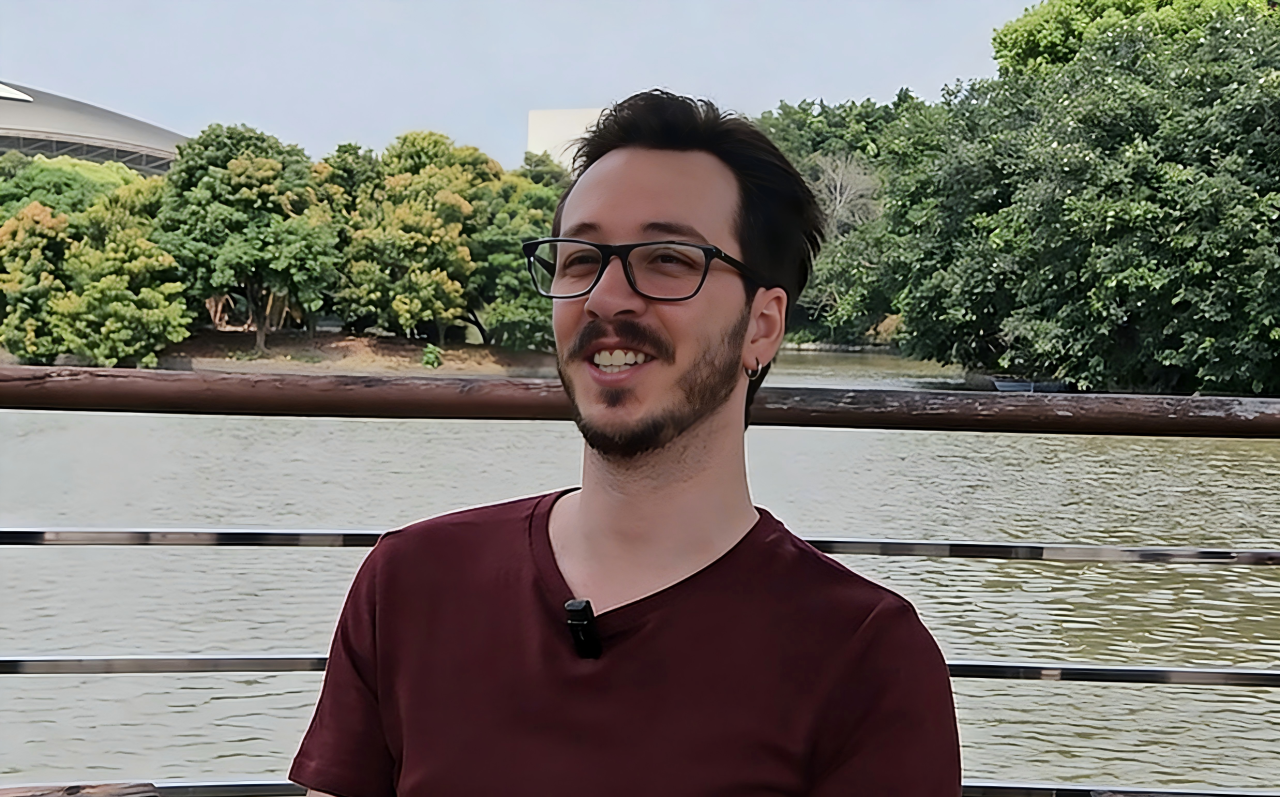
希腊哈兰德里留学生Dimitrios Prokos Juan
Recently, the Guangzhou Award Secretary interviewed Dimitrios. He shared that this experience has not only broadened his academic and professional horizons, but also reshaped his understanding of China and urban development—ultimately bringing him a sense of “peace of mind.”
Q. Could you briefly introduce yourself and what brought you to China and Guangzhou University?
My name is Dimitrios Prokos Juan. I come from Halandri, in the northern part of Athens, Greece. I am half Spanish, which has made me interested in different countries and cultures since I was young.
Halandri is an ancient area with a history of about 2,500 years. It used to be an important residential area in ancient times. Even today, there are ancient aqueducts and temples, and the land is very fertile. Growing up in such an environment made me appreciate cultural and historical diversity even more.
Because of this curiosity about different cultures, I have always wanted to see “the other side of the world.” Although I have traveled to many European countries, no one in my family had ever been to China. That made it feel both unfamiliar and especially attractive to me.
I was particularly curious about the people here and the ideas and lifestyles that are very different from the so-called “Western mentality.” It was this difference that made me decide to come to China and eventually choose Guangzhou University.
Q. How did you learn about the Guangzhou Award Scholarship?
I first learned about it through my city. Our municipality had an innovation project that won the Guangzhou Award. At that time, I didn't know much about the Award itself, but I knew it involved an ancient aqueduct. It left a strong impression on me.
Later, I applied for a master's program in Europe but was not accepted. Two days later, I saw a post about this scholarship on my municipality's Facebook and other social media. I thought, “Why not give it a try?” So I submitted my application.
Q. What were your first impressions of China?
To be honest, I didn't know much about China before coming here. Many of my impressions came from Western narratives, which are quite outdated. I think many people still imagine China as it was 20, 30, or even 40 years ago.Some friends had been to China and told me it was very developed, but I found it hard to believe at the time.
Q. How has your overall experience at Guangzhou University been?
Overall, it has been very good. I consider myself lucky—I've had excellent teachers from middle school to university and now in my master's studies. But even so, I would say that Teacher Tang is one of the best teachers I've ever had. She is very perceptive, often understanding what I want to ask before I even say it. She is also very patient and understanding of the challenges we face with the language.
Beyond the classroom, I really like the campus atmosphere. People are very friendly, and there is greenery everywhere. I almost can't get enough of it—I step outside and immediately want to walk in a park or what feels like a forest. It makes me really enjoy spending time on campus.
If I had to highlight one thing, it would be the level of education here, which I truly admire. This experience is very valuable to me, and I hope there will be more opportunities like this in my home country in the future.
Q. What has your life experience in Guangzhou been like? Any memorable impressions?
The most striking impression is the “greenery.” It's incredible—wherever I go, there are parks, sometimes very large ones, full of trees.
I've been to many European cities, and I can say that Guangzhou is one of the greenest cities I've ever seen. This was quite unexpected, because before coming, many people have stereotypes about China, but the reality is completely different.
I've also been to Liwan Lake Park—it's very beautiful, with lakes and small islands, and I really like the area around the Moon Bridge. Another thing that impressed me is seeing people dancing and singing outdoors. This is very different from Greece, where people tend to sit in cafés or restaurants for hours rather than engage in outdoor activities like this.
People here are also very friendly. I'm often invited to take photos with others—I probably already have hundreds of photos with different people on my phone (laughs).
Q. Why did you decide to continue for another semester?
At first, I only planned to stay for one semester. My idea was to “come and see first, then decide.” But gradually, I began to feel that maybe I could continue studying, or even look for opportunities to develop my career here in the future.
During my time in China, I had the opportunity to visit many different cities, such as Beijing, Harbin, Xi’an, Chengdu, Zhangjiajie, and Nanjing. After traveling to these places, I truly realized how vast China is and how diverse its cities are. This made me start to reconsider whether I might want to stay here longer.
Another reason is that I believe learning Chinese will be very helpful for my future career. It is not just a language, but also a different way of thinking and a cultural background—and learning it in a real language environment makes it even more effective. Since I had already started, I wanted to continue studying in China and explore more possibilities, such as opportunities in the environmental field. Compared to my home country, opportunities in this field are relatively limited.
When I learned that my second semester tuition would be waived, I was very happy. It was an important support for me financially and also a key factor in my decision to stay.
Q. What has been your biggest takeaway from this experience?
Since I study geology and environmental sciences, I find China's development approach very impressive. It is a highly industrialized country, yet it also places great importance on green development.
For example, the emphasis on protecting and opening up rivers. In Europe, this has only become a focus in recent decades, but here I can clearly feel that this awareness is already integrated into cities and daily life.
This has led to an important shift in my thinking—I now believe more strongly that humans should coexist with nature rather than dominate it. This is one of my biggest takeaways.
Q. In one sentence, how would you describe your experience in Guangzhou?
Guangzhou has brought me peace of mind. Here, I'm no longer driven by anxiety. Instead, I can slow down, think about the future, and truly feel relaxed and safe.
Q. How do you understand the significance of the Guangzhou Award?
For me personally, it changed my life by giving me the opportunity to come to China.
For my city, it supported an important project—the reuse of the aqueduct—allowing water resources that were previously wasted to be used again. This is especially important for Greece, which is facing water-related challenges.
More importantly, I think a global award like the Guangzhou Award is very meaningful. We are living in a time full of challenges, and the international environment is complex. In such a context, it is important for people from different countries and cultures to come together, exchange ideas, and find better solutions from different perspectives.
In a way, when you look at the world from an airplane, you don't see borders. We are all part of the same world. We need to think together about how to make this planet better and improve people's lives. I believe this is the greatest value of such awards.
Q. What would you say to future applicants?
Just do it. Don't close any doors or limit yourself. Try to open as many possibilities as you can and seize opportunities.
For me, this was not just a study experience, but a chance to step completely out of my previous life path. Especially for people from Europe or “Western” backgrounds, the culture and ways of thinking here can be very different—but it is exactly this difference that helps you see the world in a new way.
I believe people shouldn't confine themselves to familiar environments. You need to go out, see, and experience. Coming to a country that is completely different from what you know can be a transformative experience—one that may change your life in ways you cannot imagine.
Source:广州外事港澳









 京公网安备11010802044359
Contact Us:86-10-58882453 86-10-58882413