
Accelerating the Commercialization of Scientific and Technological Advances: Zhangjiakou Leverages the Xiong’an Future City Scenarios Hub Platform
Apr 09, 2026
Hebei ZhangjiakouHebei Daily Client News (Reporter Guo Xiaotong) – The first batch of demand lists for the third Xiong’an Future City Scenarios Hub was recently unveiled, featuring 112 selected scenarios from Zhangjiakou. “We have also built a reserve pipeline of over 300 additional scenarios. Zhangjiakou’s scenario development is increasingly gaining scale and momentum,” said Dong Feng, Party Secretary of the Zhangjiakou Municipal Bureau of Science and Technology. He noted that in recent years, the city has proactively contributed to the development of the Xiong’an New Area by actively engaging with the Scenarios Hub, expediting the commercial application of scientific breakthroughs, and driving industrial innovation.
“During his inspection of Xiong’an New Area, the General Secretary emphasized that reform and innovation must be the engine, urging a deep integration of sci-tech and industrial innovation to cultivate new quality productive forces in light of local conditions. This is not just a directive for Xiong’an; it is our guiding principle for development,” Dong Feng stated. Zhangjiakou will fully utilize the Xiong’an Future City Scenarios Hub to attract more high-caliber technological outcomes from Beijing and Tianjin for local implementation, continuously boosting innovation capacity, nurturing innovation entities, refining the innovation ecosystem, pooling essential resources, optimizing the environment for innovation, and accelerating high-quality growth.
Since last year, Zhangjiakou has positioned application scenarios as a vital link between technology and industry, and between R&D and the marketplace. It has established an Application Scenario Service Center to foster the convergence of sci-tech innovation and industrial development. The city has created “two databases and one list”—an advanced technology achievements database, an application scenario database, and a list of scenario construction needs and challenges—to proactively identify, design, and open up new scenarios.
This year, with a focus on innovation within its pillar industries and county-level specialty clusters, Zhangjiakou will treat the Xiong’an Future City Scenarios Hub as a key catalyst for the application of research outcomes, technological upgrading, and rapid industrial expansion, aiming to build a framework driven by demand, powered by technology, and integrated through collaboration.
Capitalizing on its strengths in new energy, big data, and high-end equipment manufacturing, Zhangjiakou will coordinate the development of a series of comprehensive scenarios. These include nine strategic scenarios each exceeding 100 million yuan in investment, 36 transformation-oriented scenarios each in the tens of millions, 48 product and technical upgrade scenarios each in the millions, and over 100 specialized scenarios with investments below one million yuan.
Through coordinated policy and platform support, the city aims to accelerate the rollout of these application scenarios. Efforts will be made to fully mobilize businesses in shaping these scenarios and to strengthen policy backing. Measures have been introduced to bolster new quality productive forces via sci-tech innovation, offering targeted support to high-tech enterprises from the Scenarios Hub that settle in Zhangjiakou, as well as to jointly established innovation platforms with participating entities.
The city also encourages its counties and districts to roll out supportive policies for scenario innovation that are tailored to local conditions, amplifying the combined impact of these policies to expedite the transfer of advanced technologies emerging from the Hub. Additionally, construction of the 500-square-meter Zhangjiakou Exhibition Hall for the Scenarios Hub is being accelerated. The hall will serve as a dynamic showcase for competition outcomes and function as an integrated platform for exhibition, matchmaking, and technology transfer.
Buoyed by innovation resources from Beijing and Tianjin, the region’s industrial vitality is on a steady rise. During the 14th Five-Year Plan period, the total value of technology contracts Zhangjiakou absorbed from Beijing and Tianjin reached 18.54 billion yuan. Several major commercialization projects have been executed, including the “Transformation and Industrialization of Major Scientific and Technological Achievements in Onshore High-Power Lightweight Wind Turbine Blades,” which have significantly enhanced collaborative innovation capabilities.
This year, Zhangjiakou will continue fostering scientific and technological partnerships between local enterprises, universities, and research institutes and their counterparts in Beijing and Tianjin. The goal is to bring in high-quality projects and breakthroughs, ensuring that technological “seeds of innovation” planted by Beijing and Tianjin blossom into tangible “fruits of development” in Zhangjiakou.
Heeding the General Secretary’s call, the city will accelerate the coordinated deployment of innovation chains. It will focus on areas such as the full hydrogen energy industrial chain, the automotive sector, and the low-altitude economy, consistently engaging with Beijing and Tianjin’s sci-tech resources. Initiatives will include co-developing industrial innovation platforms, launching pilot low-altitude logistics routes, and jointly building R&D bases to foster high-end, clustered industrial growth. Furthermore, Zhangjiakou will promote the co-development and sharing of R&D facilities such as the Hebei Hybrid Millet Technology Innovation Center and the Hebei Powertrain Industrial Technology Research Institute to enhance its capacity to absorb and apply research from the Beijing-Tianjin region.
Dong Feng explained that the city will actively guide local businesses to collaborate with enterprises, universities, and research institutes from Beijing on planning and deploying major application scenarios. These efforts will focus on extending industrial chains and enhancing complementary coordination. Key demonstration projects will be expedited, including an application scenario for the production validation of high-end green automotive steel using hydrogen metallurgy and an intelligent agricultural condition monitoring and service platform. Ongoing Beijing-Zhangjiakou scenario supply-demand matchmaking events will continue, along with co-hosted innovation contests and technology roadshows to attract new scenario-based innovations. Using the Hebei Zhangjiakou National Agricultural Science and Technology Park as a hub, the city will partner with universities and institutes from Beijing and Tianjin on critical research in areas like grape cultivation and wine processing. The aim is to drive the application of scientific achievements, create a range of modern agricultural innovation scenarios, strengthen specialized industrial clusters, and establish a model for green, low-carbon development.
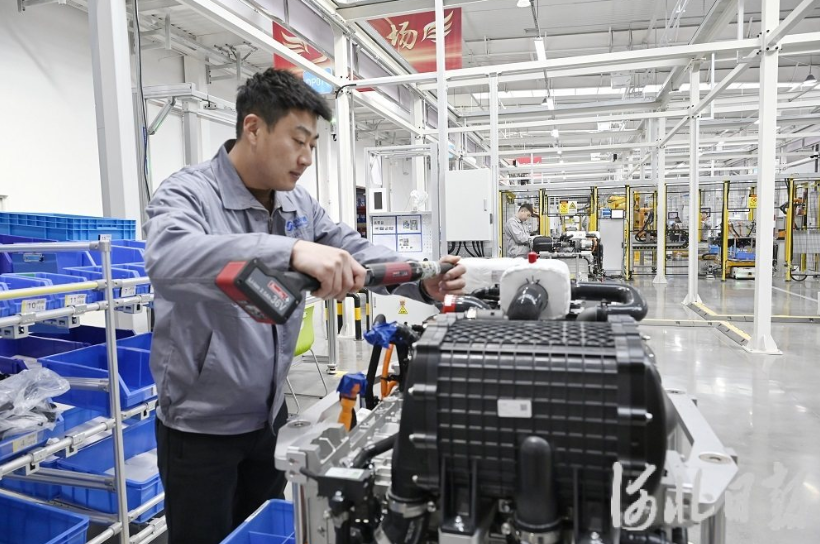
Image Caption:March 25 – Workers assemble a hydrogen fuel cell engine at Yihuatong Power Technology Co., Ltd., located within the Zhangjiakou Airport Economic and Technological Development Zone. Photo by Hebei Daily reporter Guo Xiaotong.
Source: Hebei Daily Client News










 京公网安备11010802044359
Contact Us:86-10-58882453 86-10-58882413