


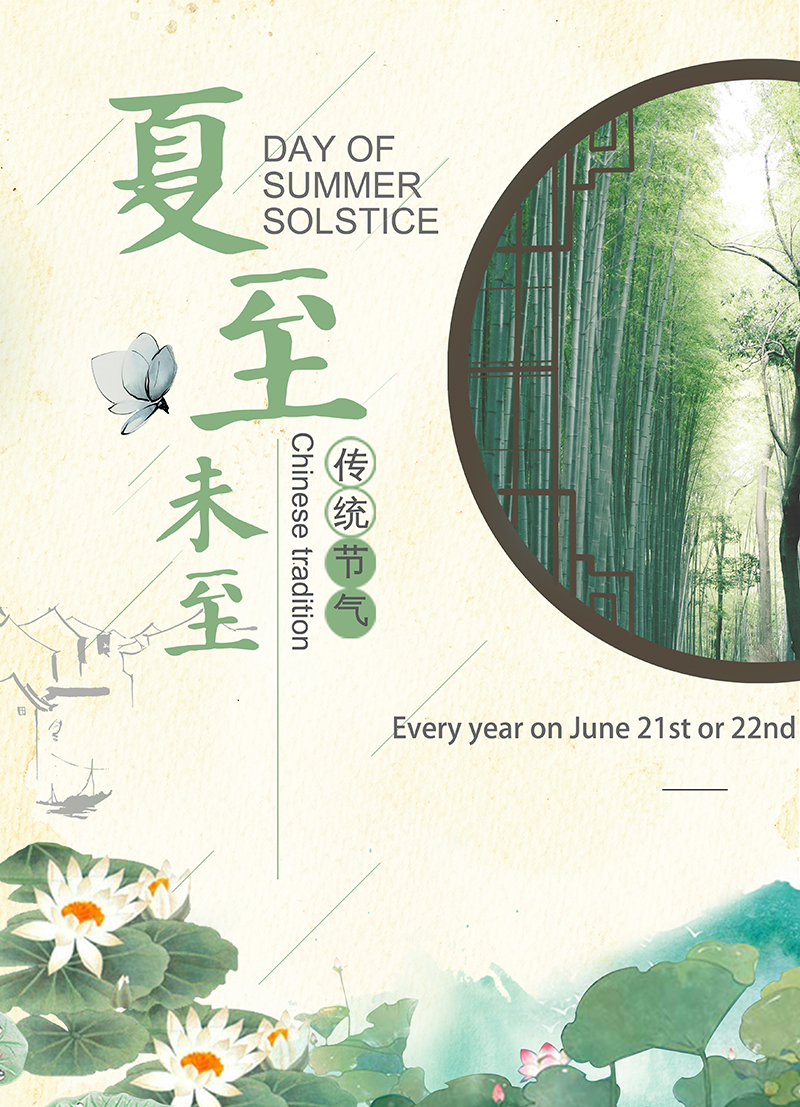
What is Summer Solstice?
Summer Solstice, or "Xiazhi" in Chinese, is the tenth solar term of the traditional Chinese lunar calendar. It marks the arrival of midsummer. This is the Northern Hemisphere's longest day and shortest night of the year.
The Summer Solstice occurs when one of Earth's poles has its maximum tilt toward the Sun. After the solstice, the subsolar point begins its migration south, and daytime gradually shrinks.
One of the Earliest Solar Terms
Xiazhi is one of the earliest solar terms established by ancient people.
According to Lyu Hongjun, a scholar of the Twenty-Four Solar Terms, the system developed over a long period. In the Western Zhou Dynasty (c.11th century-771 BC), the two solstices and equinoxes appeared. During the Warring States Period (475-221 BC), the rudiment of the Twenty-Four Solar Terms was basically established, and their names were decided across the Qin (221-206 BC) and Han (206 BC-AD 220) dynasties.
Climate: Not the Hottest Time
Despite what many might think — with it being at the height of summer — Xiazhi is not the hottest time of year. A Chinese folk saying goes: "The summer is not hot enough until Summer Solstice."
At this time, much of the northern hemisphere receives the most hours of daylight, but it does not bring the hottest temperatures, which will come only 20 to 30 days later.
The arrival of Xiazhi brings high temperature and high humidity, with thundershowers occurring from time to time.
The Turning Point of Yin and Yang
Ancient Chinese believe the Summer Solstice is the time when yang energy is at its most potent, and gets weaker as the days progress, giving way to yin energy, which increases in strength. That is to say, Summer Solstice is the turning point between yin and yang.
The Three Pentads (San Hou)
The Summer Solstice period is divided into three pentads:
First pentad: Deer shed their antlers. Deer prefer Yang Qi (positive life energy); their antlers begin to fall when they are affected by Yin Qi (negative life energy).
Second pentad: Cicadas begin to chirp. Cicadas sing when they feel Yin Qi.
Third pentad: Banxia (Pinellia ternata, a Chinese medicinal herb) thrives.
A Major Festival in Ancient Times
While in modern China, Summer Solstice is simply known as one of the solar terms, in ancient times it was a major festival. In the Song Dynasty (960-1279), the festival offered officials a holiday of three days. A grand sacrificial ceremony, led by the incumbent emperor, was also held on the Summer Solstice during the Ming (1368-1644) and Qing dynasties.
Before the Qing Dynasty (1644-1911), people even enjoyed a one-day holiday on Summer Solstice. According to records from the Song Dynasty (960-1279), officials could have three days off during the Summer Solstice.
Customs: Eating Noodles and Worshipping the Earth
It has long been a custom to hold sacrificial ceremonies during the Summer Solstice. People have offered sacrifices to gods on this day, hoping that they will eliminate famine, pestilence and death.
There is a saying in Shandong province: "Eat dumplings on the Winter Solstice and eat noodles on Summer Solstice." People in different areas of Shandong province enjoy chilled noodles on this day. Additionally, people in Beijing and other regions across China also have a tradition of eating noodles.
Xiazhi is also an important folk festival in China. Folks developed customs like eating cold noodles and worshiping the earth, praying for protection from the summer heat and hoping for a good autumn harvest.
Women's Customs: Fans and Sachets
On the Summer Solstice, women gave each other colored fans and powder pouches, using these small useful gifts to strengthen their friendships.
Source:Chinajob


 京公网安备11010802044359