

I. Basic Facts
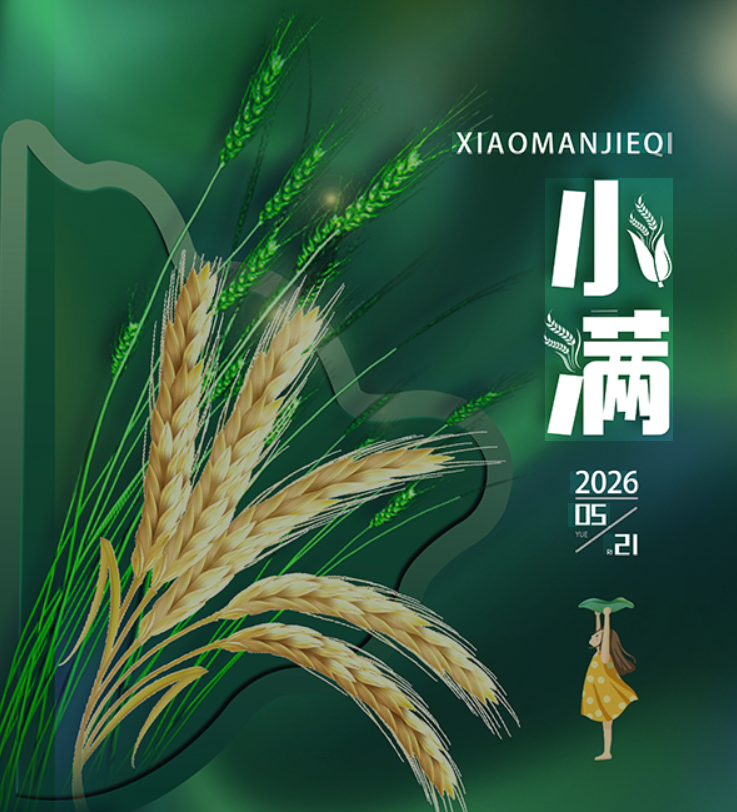
Grain Buds is the eighth of the 24 traditional Chinese solar terms and the second solar term of summer. It typically begins around May 21 and ends around June 5.
The name "Xiaoman" carries different meanings in northern and southern China. In the south, it refers to the increase in rainfall — as a folk saying goes, "A heavy rainfall makes the river full." In the north, it means that the seeds of winter wheat are becoming full but are not yet ripe.
During the Grain Buds period, summer falls throughout the whole country. The temperature difference between northern and southern areas narrows further, while precipitation increases. Overall, the climate is hot, humid and rainy.
II. Customs and Traditions
1. Worshipping the Waterwheel God
This is an old custom in some rural areas. According to legend, the Waterwheel God is a white dragon. During the Grain Buds season, people place offerings such as fish and incense on the waterwheel. There will be a cup of water in all sacrifices, which is poured into the field, wishing for plenty of irrigation water.
2. Celebrating the Silkworm Deity's Birthday
Silkworm rearing is a traditional byproduct for people in regions south of the Yangtze River. During the Grain Buds season, silkworms have cocooned. People in Jiangsu and Zhejiang provinces regard this season as the birthday of the silkworm deity. Those who engage in the silk industry thank the deity by offering sacrifices and staging performances, praying for a boom season for the silk business.
In ancient times, people believed that the silkworm deity could protect against diseases and disasters affecting silkworms. Celebrating the silkworm deity is one of the most important folk activities in southern China during Grain Buds.
3. Eating Bitter Herbs
Grain Buds is a season for eating the herb of the common sow thistle, which is one of the earliest edible potherbs in China. As written in the Book of Zhou more than 1,000 years ago: the day of Grain Buds is the day of the common sow thistle.
It tastes a little bitter and tart, but also sweet. According to traditional Chinese medicine, it has the function of cooling the blood and detoxifying the body. People in Ningxia Hui Autonomous Region like to eat it blended with salt, vinegar, peppers or garlic. Some people boil the herb with water and then squeeze out the juice, which can be used to make soup.
III. Seasonal Foods
1. Eating Fish and Shrimp
During the Grain Buds period, because of the great increase in rainfall, rivers are full of water, which makes fish and shrimp big and fat. This is a good time to eat fish and shrimp. It is also harvest season for fishermen.
2. Eating Mulberries
A Chinese farmer proverb says, "Mulberries become black during the Grain Buds period." Thus it is a good season to eat mulberries.
3. Eating Sponge Gourd
During the Grain Buds season, sponge gourds have absorbed enough rainwater and are full of juice, so it is the best time for them to be eaten. When frying it together with green soybean, the dish will be bright green in color, while clear and crisp in flavor.
4. Three Delicacies
An old saying has it that there are "three delicacies seen in Grain Buds." The three fresh delicacies are cucumber, garlic shoots and cherries. The temperature will rise after Grain Buds, and juicy cucumbers can help relieve heat and quench thirst.
IV. Health and Wellness Tips
High temperatures and humidity are common during the Grain Buds period. The increase in temperature over this season may also give rise to nettle rash, rheumatism, sweat spots, eczema and other skin diseases.
It is important to exercise to keep healthy during the hot summer days. Walking, jogging and practicing tai chi are popular. During the Grain Buds period, the summer heat can leave people feeling a little grumpy. To lift their spirits, many turn to these popular summer exercises.
V. Flower Management
This time is a good period for the quick growth of flowers. It is also a season when plant diseases and pests are at an all-time high. Flower trimming and clipping is important. A systematic fertilized water system should be carried out. Weeding should be done as they grow quickly and have to be extirpated in order to keep the soil loose and from competing with the flowers for nutrients.
VI. Philosophical Connotations
Xiaoman is not only closely related to agricultural production but also rich in connotations drawn from Chinese philosophy. In Chinese, "Xiao" means little, and "Man" means full. Thus, the combination of these two characters indicates things are not full to their extreme. Chinese philosophy cherishes the virtue of moderation, while Chinese paintings emphasize the significance of empty spaces. In the eyes of common people, finding contentment is synonymous with happiness.
Among the 24 solar terms, there are Minor Heat and Major Heat, Minor Snow and Major Snow, but only Minor Fullness (Xiaoman) — there is no "Major Fullness". This reflects the Chinese philosophy of life: "The modest receive benefit, while the conceited reap failure." The best state in life lies in finding contentment with little, just like a flower not in full bloom, and a moon not fully round.
Xiaoman represents the traditional Chinese value of modesty and humility. Unlike other solar terms that have "Major" counterparts, Xiaoman stands alone. This unique naming conveys the wisdom of balance — "full, yet not overflowing."
VII. Poetry
Northern Song Dynasty (960-1127) poet Ouyang Xiu wrote in his poem Grain Buds:
Most dear the ridge-side wheat in view;
In wind they smile at rosy dew.
VIII. UNESCO Recognition
The 24 solar terms were inscribed on the UNESCO Representative List of the Intangible Cultural Heritage of Humanity in November 2016. The system of 24 solar terms remains a significant guide for Chinese farmers in their agricultural work. It represents a knowledge system developed through observations of the sun's annual motion and associated agricultural, cultural, and social practices in China.
Source: Chinajob


 京公网安备11010802044359