
Definition and Timing
The Zhongyuan Festival, also known as the Ghost Festival or Hungry Ghost Festival, falls on the 15th day of the seventh lunar month. In the Chinese lunar calendar, the seventh month is called the Ghost Month, when the Gates of Hell are believed to be thrown open to release hungry ghosts to wander the earth in search of food and take revenge upon those who wronged them in life. The festival is the climax of Ghost Month, and in some regions, such as Guangdong and Guangxi, celebrations begin as early as the 14th day of the month.
Religious Origins
The festival has dual origins in both Taoism and Buddhism. In Taoism, it is called the Zhongyuan Festival, believed to be the day when the Earth Official pardons sins. In Buddhism, it is known as the Ullambana Festival, which is derived from the story of Mulian Rescuing His Mother. The Ullambana Festival has two meanings: one is to persuade people to provide for Buddhist monks; the other is to convince people to do more charitable deeds to release departed souls from sin and advocate family devotion.
The Legend of Mulian Rescuing His Mother
According to the Ullambana Sutra, Mulian, a disciple of the Buddha, traveled to the underworld and saw his mother suffering for her sins in life. He begged the Buddha for a way to save her. The Buddha told him to prepare a feast of hundreds of flavors on the 15th day of the seventh month and offer it to ten thousand monks, which would free his mother from her suffering.
Ancestor Worship
Since ancient times, people have used the festival to honor departed spirits of ancestors, offering newly harvested rice and other produce to report the year's harvest. Unlike Qingming Festival and Chung Yeung Festival, where descendants pay homage to ancestors, the Zhongyuan Festival is distinct in that the deceased are believed to visit the living. "The Zhongyuan Festival is not strictly religious. We are not worshipping gods but the spirits of our ancestors," said Hsieh Yuan-chang, a 70-year-old artisan from Taiwan, whose family has practiced the rituals for 18 generations since migrating from Fujian.
Floating River Lanterns
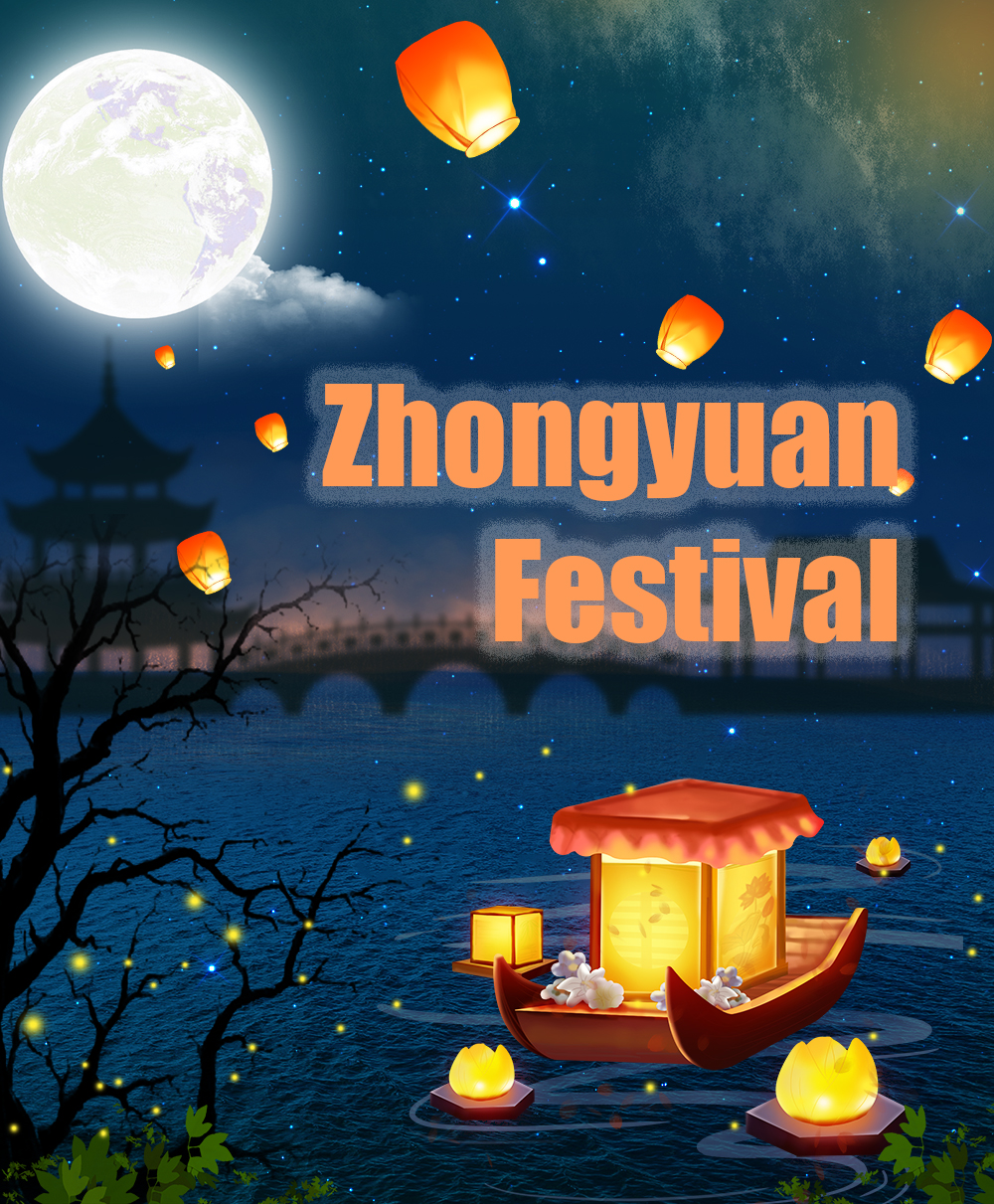
People release river lights as an important activity during this time, as it is said that river lights can comfort and warm the homeless ghosts. These lanterns, mostly in the shape of lotus flowers, are placed on rivers, lakes or seas to drift freely, symbolizing lighting the way for the deceased ancestors. In Keelung, Taiwan, the peak of the parade is reached at 11 p.m. when lit paper lanterns of various shapes are pushed into the sea, carrying people's best regards to the other world.
Pudu Ritual (Salvation Ritual)
Every household places sacrificial offerings on an altar in front of their door and hangs paper lanterns under the eaves to comfort wandering ghosts and pray for peace and smoothness throughout the year. For more grand ceremonies, monks or Taoist priests are invited to recite scriptures and perform rituals to deliver the souls of the deceased. In Keelung, a four-floor-high altar is erected in the city's downtown area, with long tables set up and meat dishes, vegetables, fruits and other offerings served. All 15 prominent families of Keelung set up display boards introducing their hometowns on the mainland and recalling how they migrated to Taiwan.
Cultural Significance and Heritage
The Zhongyuan Festival is not only a commemoration of the deceased, but also a respect for life and a cherishing of family. Together with the Lunar New Year's Eve, Qingming Festival and Double Ninth Festival, it is known as one of China's four major traditional ancestor-worship festivals. In 2011, the Yu Lan Festival of the Hong Kong Chiu Chow community was inscribed onto the third national list of Intangible Cultural Heritage.
Source:Chinajob


 京公网安备11010802044359